
Official statement
Other statements from this video 12 ▾
- □ Faut-il se fier à PageSpeed Insights ou à la Search Console pour mesurer la vitesse de son site ?
- □ Pourquoi Googlebot ignore-t-il vos liens JavaScript si vous n'utilisez pas de balises <a> ?
- □ Google a-t-il vraiment abandonné l'idée d'un score SEO global ?
- □ Peut-on créer des liens vers des sites HTTP sans risque SEO ?
- □ Faut-il vraiment écrire « naturellement » pour ranker sur Google ?
- □ Faut-il vraiment supprimer son fichier de désaveu de liens ?
- □ Faut-il vraiment éviter d'implémenter le Schema markup via Google Tag Manager ?
- □ Robots.txt vs meta robots : pourquoi bloquer le crawl peut-il nuire à la désindexation ?
- □ Peut-on dupliquer la même URL dans plusieurs fichiers sitemap sans risque SEO ?
- □ Comment indexer le contenu d'une iframe sans indexer la page source ?
- □ HSTS et preload list : une fausse piste pour le référencement ?
- □ Pourquoi un nom de domaine descriptif ne garantit-il pas votre classement sur sa requête ?
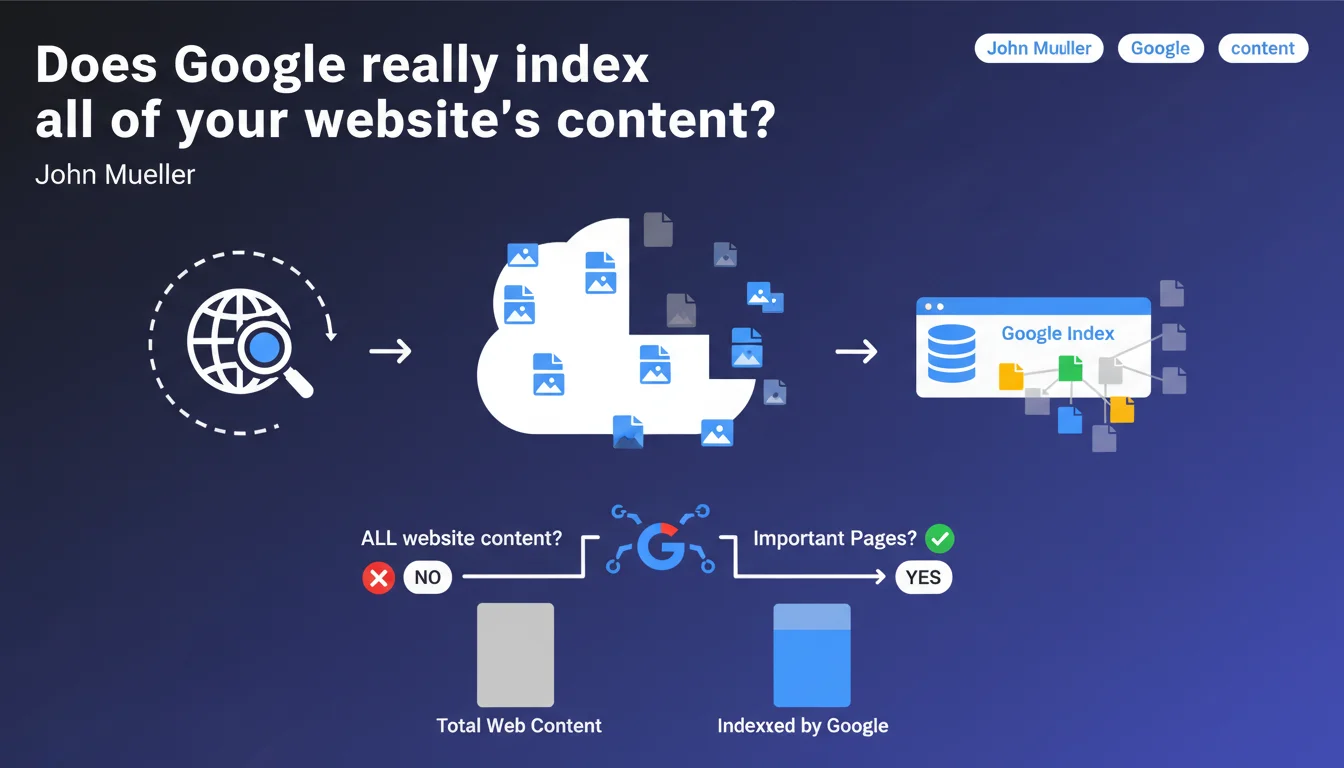
Google will never be able to index the entirety of a non-trivial website. The goal isn't to get everything indexed, but rather to concentrate crawl resources on strategically important pages. This reality requires strict content hierarchy and proactive crawl budget management.
What you need to understand
Why can't Google index everything?
John Mueller's statement rests on a technical reality: the web is too vast to be completely mapped. Even for a single website, indexing every URL represents a resource cost that Google cannot assume uniformly across all sites.
Googlebot allocates a crawl budget to each domain based on criteria like authority, content freshness, and the quality of already-indexed pages. If a site massively generates low-value URLs — filters, pagination, duplicates — the bot risks wasting time on secondary content.
What counts as a "non-trivial" website according to Google?
A non-trivial website goes far beyond a simple showcase of a few pages. We're talking about e-commerce catalogs with thousands of products, media outlets publishing hundreds of articles per month, or UGC platforms where users continuously create content.
These sites present structural complexity: multiple filtering facets, mobile/desktop versions, language variants. Googlebot cannot physically handle everything, and this is precisely where SEO strategy must intervene.
What does it mean to "focus on important pages"?
The phrase "important pages" doesn't just refer to those currently generating traffic. It means pages with strategic potential: main categories, flagship product pages, pillar content, conversion pages.
Google expects the site to make its job easier by clearly signaling this hierarchy — through internal linking, segmented XML sitemaps, and elimination of crawlable noise.
- Selective indexation: Google never aims for completeness, even for authoritative sites
- Limited crawl budget: Each site receives a resource allocation proportional to its authority and freshness
- Mandatory hierarchy: SEO must guide Googlebot toward high-value pages
- Quality signal: A site generating too many low-quality URLs penalizes its own crawl
SEO Expert opinion
Is this statement consistent with real-world observations?
Absolutely. Crawl audits consistently reveal that Google ignores entire sections of some websites — even those with solid authority. Server logs show that Googlebot intentionally skips sections deemed non-priority.
A classic example: an e-commerce site with 50,000 products sometimes sees 30% of its catalog never crawled, simply because these pages are buried 6-7 clicks from the homepage, or because they present near-duplicate content with other product pages.
What nuances should we add to this statement?
Mueller's phrasing can be misleading. Just because Google can choose not to index everything doesn't mean you should resign yourself to partial coverage. A well-optimized site can achieve indexation rates of 80-90% for its strategic pages.
The trap is confusing "complete indexation" with "relevant indexation." A site generating 100,000 URLs through automated filtering has no interest in these variations being indexed — quite the opposite, it dilutes quality signals. [To verify]: Google publishes no precise crawl budget thresholds by site type, making optimization largely empirical.
In what cases doesn't this rule apply?
For small sites — say fewer than 500 pages — complete indexation remains a realistic goal. If Google refuses to index certain pages on a site this size, it's usually a quality alert signal: duplicate content, thin content, misconfigured robots.txt directives.
Practical impact and recommendations
What concrete steps should you take to maximize indexation of strategic pages?
First step: identify priority pages. Analyze your revenue-generating pages, pillar content, main categories. Ensure they're crawlable within 3 clicks from the homepage.
Next, segment your XML sitemaps by priority level. A "premium" sitemap for your 500 essential pages, another for secondary content. Googlebot understands this hierarchy better than a monolithic 50,000-URL XML file.
Internal linking must reinforce this signal. Strategic pages should receive more internal links than secondary pages. A flagship product deserves 50 links from other site pages, while a marginal product page can make do with 5.
What mistakes must you absolutely avoid?
Don't let facets and filters generate infinite URLs. Use canonicals to merge variations, or block crawling outright via robots.txt if these pages have no SEO value.
Avoid diluting crawl with poorly managed pagination pages. If you have 200 results pages for a category, use rel="next"/"prev" or an infinite-scroll system with server-side rendering.
Don't rely on Google's auto-detection to find your important pages. Be proactive: manually submit via Search Console critical URLs that are slow to be indexed.
How can you verify your site is optimized for this reality?
- Analyze server logs to identify which sections Googlebot systematically ignores
- Compare the number of URLs submitted in your XML sitemaps versus the number actually indexed in Search Console
- Verify that your strategic pages are crawled at least once per week
- Eliminate zombie URLs (crawled but never indexed) to free up crawl budget
- Test crawl depth: no strategic page should be more than 3 clicks from the homepage
- Audit robots.txt directives and noindex tags to avoid accidentally blocking important pages
❓ Frequently Asked Questions
Combien de pages Google peut-il indexer sur un gros site e-commerce ?
Comment savoir si Google ignore certaines de mes pages importantes ?
Faut-il bloquer les pages de faible valeur pour économiser le budget de crawl ?
Un site de 10 000 pages peut-il être intégralement indexé ?
Est-ce grave si Google n'indexe pas tout mon contenu ?
🎥 From the same video 12
Other SEO insights extracted from this same Google Search Central video · published on 04/07/2022
🎥 Watch the full video on YouTube →
💬 Comments (0)
Be the first to comment.