
Official statement
Other statements from this video 10 ▾
- □ Why is Google discontinuing 7 structured data types, and what should you do about it now?
- □ Should you keep maintaining structured data if Google stops displaying certain types?
- 4:56 Why is Google refusing to commit to a clear future roadmap for AI Overviews?
- 6:24 Why doesn't Google index all your pages and how can you prepare for it?
- 8:48 Can you really stop Google from ranking your site for specific keywords?
- 9:56 Is page quality alone enough to guarantee indexing by Google?
- 9:56 How long does Google really take to recognize your SEO changes?
- 12:00 How does Google actually discover all the URLs on your website?
- 12:00 Does counting the exact number of URLs on your site really matter for SEO?
- 15:15 Do you really need to submit your sitemap every single day?
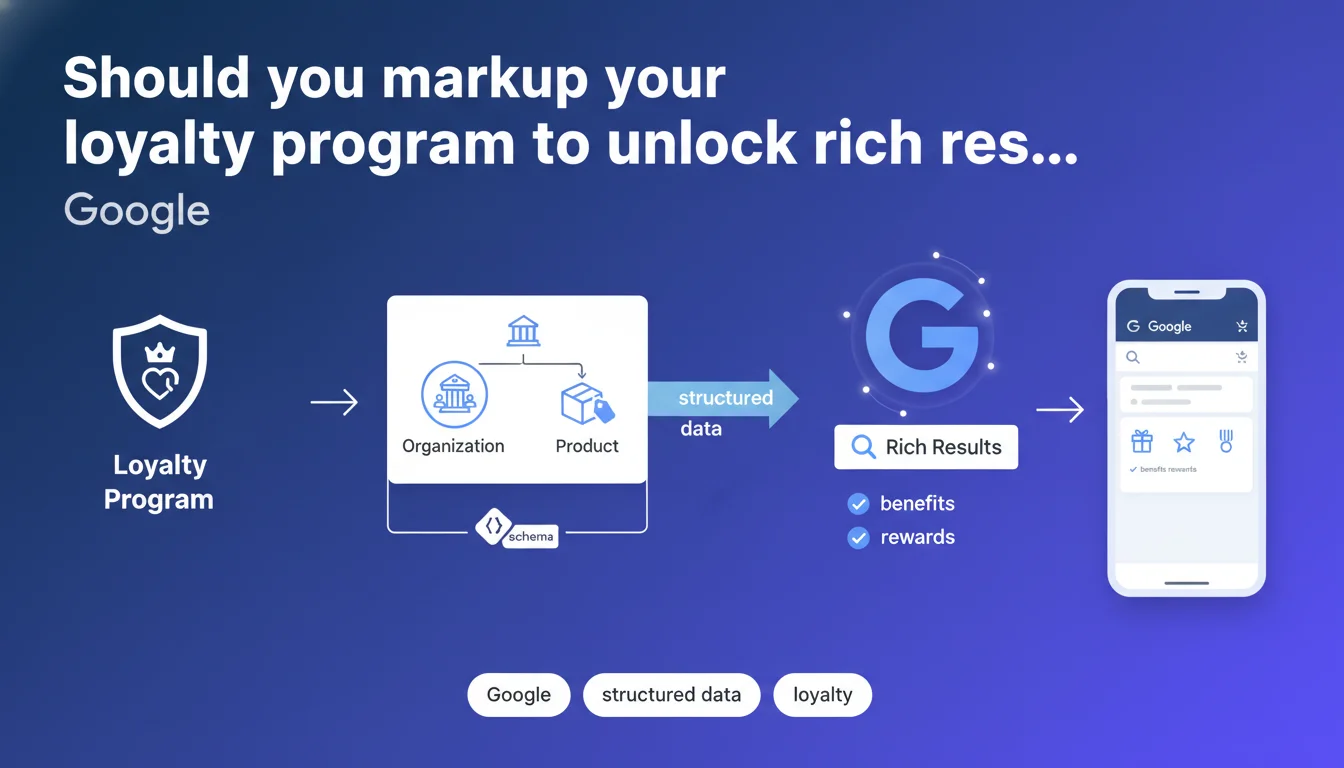
Google now officially supports loyalty program markup in structured data. By adding the Loyalty Program schema to Organization and Product entities, search results can display program benefits and rewards — an underexploited SERP enrichment opportunity that deserves your attention.
What you need to understand
What exactly does this new markup allow you to do?
The Loyalty Program markup lets you signal to Google that a product or organization offers a loyalty program with specific benefits. The information can include the program name, points earned, applicable discounts, or access conditions.
This structured data complements existing Organization and Product schemas. The goal: enrich search results by displaying loyalty program benefits directly in the SERP, without requiring users to click through to your site.
Why is Google rolling out this support now?
Customer retention is a major business lever, and Google is constantly adding more contextual information to its SERPs. By structuring this data, the search engine can compare offers from multiple merchants and provide unified display.
For e-commerce sites and brands with reward programs, this is a differentiation opportunity directly in organic results. The remaining question: how many queries will actually trigger these rich snippets in practice?
What are the essential technical points to keep in mind?
- The markup applies to Organization and Product schema types
- Properties include program name, points, discounts, and eligibility conditions
- Rich snippet display is not guaranteed — Google decides whether to activate it based on query relevance
- Markup must accurately reflect visible page content (standard anti-spam rule)
- Google has not disclosed any data on actual activation rates for this rich snippet
SEO Expert opinion
Is this announcement consistent with real-world observations?
Google has been expanding structured data types for years, but not all of them deliver the same ROI in terms of visibility. Some markups remain invisible in SERPs for months or even years, despite proper implementation.
Official support doesn't guarantee rich result display. Many sites already implement dozens of schemas without observing meaningful changes in results. [To verify]: to what extent will this markup actually be activated on competitive commercial queries?
What risks should you anticipate with this markup?
The main danger is over-marking hoping for immediate visibility that may never materialize. Adding schema markup requires development time — you need to weigh this implementation against other, more directly measurable optimizations.
Another consideration: if your loyalty program changes frequently (conditions, points, thresholds), maintaining this markup becomes an operational burden. Outdated markup can trigger manual action for spam if Google detects a flagrant inconsistency between content and structured data.
In what cases does this markup make sense?
If your e-commerce site has a structured, visible, and attractive loyalty program, implementation is justified. This is particularly relevant for retailers with millions of monthly visitors and a track record of active rich snippets on other schemas.
Conversely, for a smaller site with a marginal or undifferentiated program, the markup effort risks being disproportionate to gains. Better to prioritize optimizations with proven impact: Core Web Vitals performance, internal linking, enriched product content.
Practical impact and recommendations
What should you do concretely to implement this markup?
First step: identify eligible pages. Markup applies to product pages (Product schema) and organization presentation pages (Organization schema). Verify that your loyalty program is clearly described on these pages — visible content must match your structured data.
Next, add the LoyaltyProgram type properties to your existing JSON-LD. Fields include: program name, points awarded, access conditions, and potentially a link to program terms. Test your markup using Google's structured data validation tool.
What errors should you avoid during implementation?
- Don't markup a non-existent or outdated program — Google penalizes misleading data
- Avoid duplicating information across all pages indiscriminately (spam risk)
- Don't expect immediate rich result display — Google may take weeks to activate the rich snippet, or may never activate it
- Don't neglect maintenance: a program that evolves requires markup updates
- Don't forget to monitor rich snippet appearance (or lack thereof) in Search Console
How can you measure the real impact of this markup?
Track the appearance of new rich result types in Google Search Console. If the markup is activated, you should see increased impressions with enriched display. Compare the CTR of marked-up URLs before and after implementation.
Caution: the impact may be zero for a long time. If no changes are observable after 3 months, ongoing maintenance may not be justified. Prioritize other levers with more tangible ROI instead.
❓ Frequently Asked Questions
Le markup Loyalty Program garantit-il un affichage enrichi dans les résultats de recherche ?
Quels types de pages peuvent utiliser ce schema markup ?
Combien de temps faut-il pour voir un impact dans les SERP ?
Ce balisage peut-il déclencher une pénalité si le programme change souvent ?
Faut-il baliser tous les produits ou seulement certains ?
🎥 From the same video 10
Other SEO insights extracted from this same Google Search Central video · published on 26/06/2025
🎥 Watch the full video on YouTube →
💬 Comments (0)
Be the first to comment.