
Official statement
Other statements from this video 10 ▾
- □ Should you markup your loyalty program to unlock rich results in Google Search?
- □ Why is Google discontinuing 7 structured data types, and what should you do about it now?
- □ Should you keep maintaining structured data if Google stops displaying certain types?
- 4:56 Why is Google refusing to commit to a clear future roadmap for AI Overviews?
- 6:24 Why doesn't Google index all your pages and how can you prepare for it?
- 9:56 Is page quality alone enough to guarantee indexing by Google?
- 9:56 How long does Google really take to recognize your SEO changes?
- 12:00 How does Google actually discover all the URLs on your website?
- 12:00 Does counting the exact number of URLs on your site really matter for SEO?
- 15:15 Do you really need to submit your sitemap every single day?
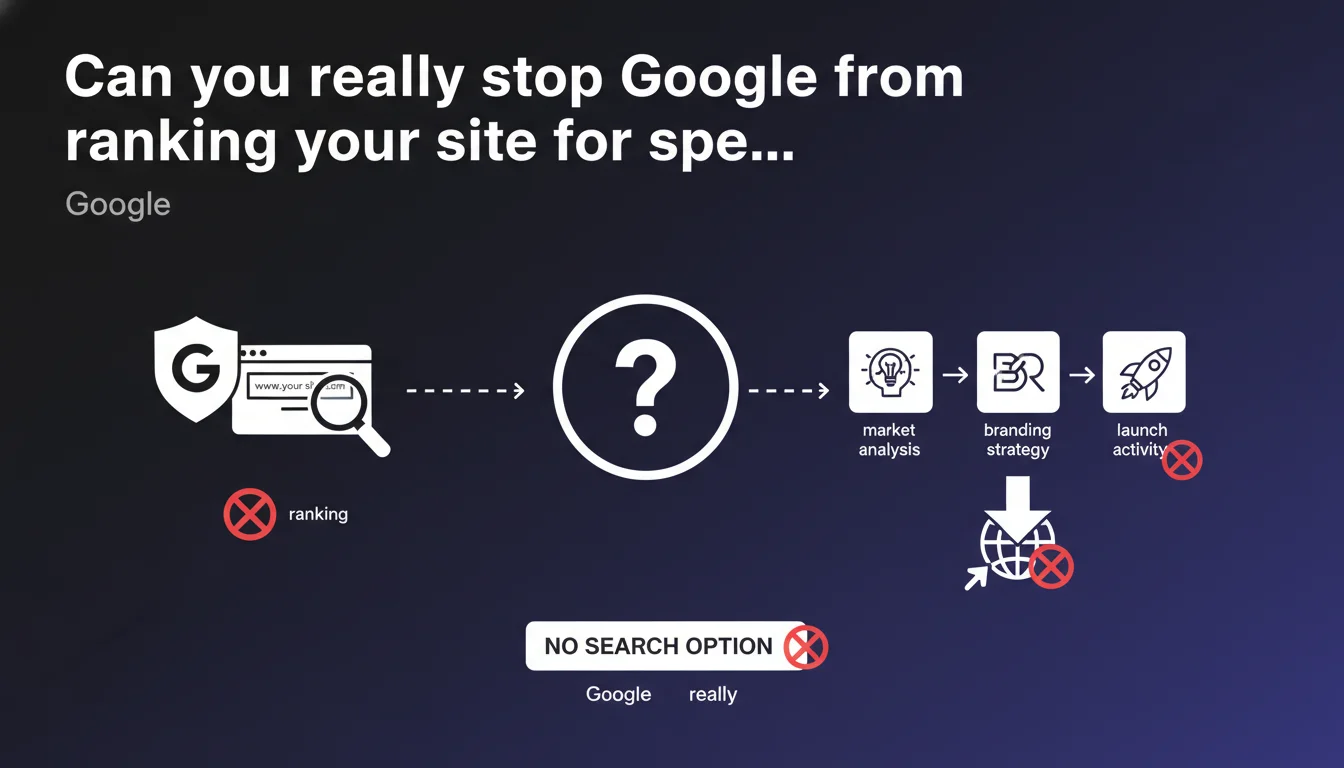
Google confirms that no technical option exists to prevent a site from appearing for specific search queries. The only solution: anticipate branding and perception issues upstream, before launch. Once semantic associations are established in the index, there is no lever to block them.
What you need to understand
Why do some sites want to block certain keywords?
The problem comes up regularly: a brand finds itself ranked for terms that damage its image. A commercial law firm appearing for "cheap lawyer", a luxury brand ranked for "sale" or "discount", a training organization associated with "fake degree".
These associations can result from external link anchors, poorly controlled UGC content, or simply how Google interprets the semantic context of a site. The natural instinct? Look for an option to block these specific queries.
What is Google's official position?
The statement is unequivocal: no technical option exists to prevent appearing for targeted keywords. No meta tag, no configuration file, no Search Console parameter.
Google shifts responsibility upstream — to the moment of strategic thinking about branding and positioning. In other words: it's your brand problem, not a technical problem to solve on the search engine side.
What are the concrete implications for an SEO professional?
This limitation means you can only act in indirect and imperfect ways. Modify content to reduce semantic salience of certain terms, disavow toxic backlinks with problematic anchors, rewrite title/meta tags.
But none of this guarantees disappearance for unwanted queries. Google interprets the overall context — and if the association exists in its semantic graph, it persists.
- No technical option allows you to block specific keywords
- Prevention must happen before launch, at the branding stage
- Classic SEO levers (content, anchors, disavow) have indirect and uncertain effects
- Google considers this problem as part of marketing strategy, not technique
SEO Expert opinion
Is Google's position actually tenable in practice?
Let's be honest: the advice "think better about your branding" often arrives too late. Companies pivot, brands evolve, contexts change. A domain name can become problematic years after launch.
And then there are all the cases where the problem comes from outside — wild backlinks, third-party content you have no control over, evolution of language and usage. Saying "it's your fault, you should have planned ahead" doesn't help anyone.
Are there workarounds to limit the damage?
In practice, several approaches deliver partial results — but none are guaranteed. Massively rewrite content to eradicate a lexical field, aggressively disavow toxic anchors, use strategic deindexing of entire pages that carry problematic associations.
Some SEOs try to "drown out" bad associations by reinforcing other semantic signals. This can work on long-tail terms, rarely on core terms. [To verify]: the real effectiveness of these approaches has never been validated by large-scale studies.
When does this rule cause the most problems?
The most difficult cases involve double-meaning terms or brands that share a common name. A restaurant "The Good Buy" will never prevent Google from mixing it with the classifieds platform.
Another critical situation: sites that historically practiced certain strategies (aggressive promos, overoptimized anchors) and want to move upmarket today. SEO history becomes a millstone — and Google provides no "reset button".
Practical impact and recommendations
What to do if your site ranks for unwanted queries?
First step: audit the origin of problematic associations. Analyze your backlinks (anchors, context of linking pages), your content (lexical fields, co-occurrences), your title/meta tags. Identify dominant signals.
Then act by priority. If the problem comes mainly from external anchors, disavow — but expect a long process. If it's your content, massively rewrite the pages involved. In some extreme cases, deindexing entire pages can be considered.
How do you prevent these issues upstream?
Before any brand launch or positioning overhaul, conduct a complete semantic analysis. Check what terms are already associated with your chosen brand name, scrutinize existing SERPs, identify collision risks.
Build your initial content with clear and coherent semantic intent. Avoid ambiguous lexical fields, control your first link anchors, actively manage your linking strategy from the start. Better to be directive at the beginning than corrective afterward.
What mistakes must you absolutely avoid?
Don't waste time looking for a magic technical solution — it doesn't exist. Google has explicitly confirmed this. Focus on indirect levers that have real impact.
Also avoid mass disavowing without fine analysis. Some SEOs panic and disavow everything containing a problematic word — risking loss of useful link power. Disavow must be surgical, not with a hatchet.
- Audit backlinks, content and tags to identify the origin of unwanted associations
- Disavow toxic anchors in a targeted and documented way
- Rewrite problematic content by eliminating the relevant lexical fields
- Consider deindexing entire pages in extreme cases
- Before any launch, validate branding with a thorough semantic analysis
- Build initial content with clear and controlled semantic intent
- Regularly monitor new associations via Search Console and SERPs
❓ Frequently Asked Questions
Peut-on utiliser le fichier robots.txt pour bloquer certains mots-clés ?
Le désaveu de liens peut-il éliminer complètement un positionnement indésirable ?
Supprimer toutes les occurrences d'un terme de mon site garantit-il sa disparition des SERPs ?
Existe-t-il une différence entre bloquer l'indexation d'une page et bloquer son apparition pour certains mots ?
Google prévoit-il d'ajouter cette fonctionnalité à l'avenir ?
🎥 From the same video 10
Other SEO insights extracted from this same Google Search Central video · published on 26/06/2025
🎥 Watch the full video on YouTube →
💬 Comments (0)
Be the first to comment.