
Official statement
Other statements from this video 10 ▾
- □ Should you markup your loyalty program to unlock rich results in Google Search?
- □ Why is Google discontinuing 7 structured data types, and what should you do about it now?
- 4:56 Why is Google refusing to commit to a clear future roadmap for AI Overviews?
- 6:24 Why doesn't Google index all your pages and how can you prepare for it?
- 8:48 Can you really stop Google from ranking your site for specific keywords?
- 9:56 Is page quality alone enough to guarantee indexing by Google?
- 9:56 How long does Google really take to recognize your SEO changes?
- 12:00 How does Google actually discover all the URLs on your website?
- 12:00 Does counting the exact number of URLs on your site really matter for SEO?
- 15:15 Do you really need to submit your sitemap every single day?
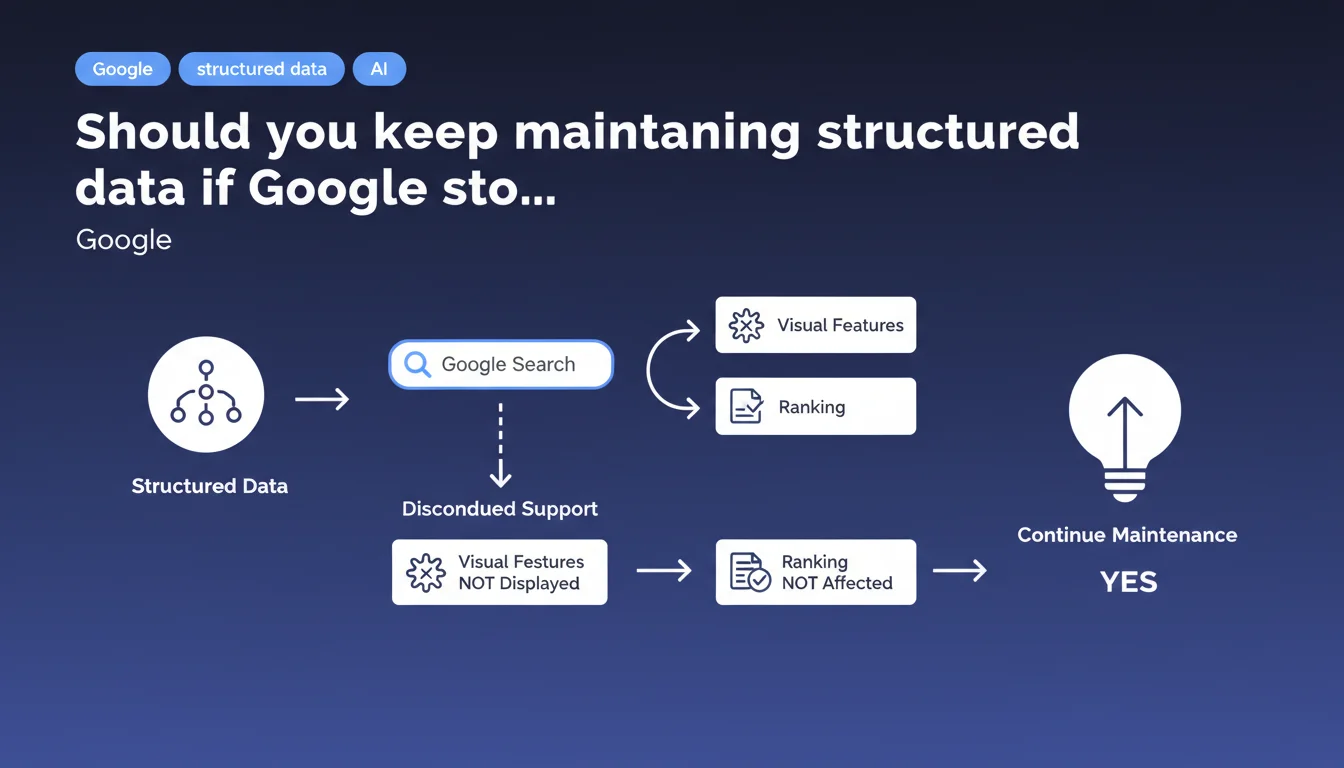
Google confirms that abandoning support for certain types of structured data does not impact organic search rankings. Only the visual features associated with them (rich snippets, carousels, etc.) disappear. This statement clearly separates enriched display from ranking, but remains vague on indirect effects.
What you need to understand
What does "abandoning certain types of structured data" really mean?
Google regularly removes support for certain Schema.org markup formats — sometimes because they're obsolete, sometimes because they never achieved expected adoption. In concrete terms, this means the search engine stops interpreting these tags to generate rich snippets or specific SERP features.
Example: if the "Event" markup were to lose support, it would no longer trigger the display of an enriched event block in search results. The content remains indexed, but without special processing.
Why does Google insist there's no impact on rankings?
Because many practitioners have long believed — and some still do — that structured data serves as a direct ranking signal. Google wants to cut through this idea: markup is not a ranking factor, it only serves to enrich the display.
This position is consistent with what John Mueller has been repeating for years. But it masks a reality: a rich snippet that disappears can cause organic CTR to plummet, which indirectly affects traffic and potentially user behavior.
Which types of structured data are affected?
Google doesn't provide an exhaustive list in this statement — that's typical of their communication style. We know that certain markups like SpeakableSpecification or certain subtypes of Product have already been removed or deprecated.
The only certainty: when a type is abandoned, Google announces it via Search Console or official documentation. You need to monitor warning messages in GSC.
- Abandoning a markup does not directly affect organic rankings
- Associated visual features (rich snippets, carousels) disappear
- Content remains indexed normally, but without display enrichment
- Google rarely communicates in advance about withdrawals; monitoring Search Console is essential
- Loss of a rich snippet can affect CTR and thus organic traffic
SEO Expert opinion
Is this statement consistent with real-world observations?
Yes and no. Fundamentally, it's true: no large-scale test has ever proven that adding or removing Schema markup directly changes algorithmic ranking. Structured data is not a relevance signal in the strict sense.
But — and this is where Google deliberately remains vague — a site that loses its product stars or enriched FAQs often sees its CTR collapse. Fewer clicks means fewer sessions, potentially less engagement, and on competitive queries, it can end up weighing on performance. [To verify]: Google denies any connection between CTR and ranking, but correlations do exist.
What nuances should be applied to this claim?
Google talks about "ranking," not "visibility" or "traffic." This is a crucial distinction many people miss. Your positioning stays the same, but your click-through rate can plummet if your competitor keeps a rich snippet and you don't.
Another point: the statement says nothing about markups that remain supported. If you maintain clean JSON-LD on active types (Article, Product, LocalBusiness), you maximize your chances of enriched display — which remains a huge competitive advantage, even without ranking effects.
In what cases might this rule not apply?
If a markup becomes mandatory to appear in a specific SERP vertical (Google Shopping, Google Jobs, etc.), then its absence disqualifies you outright. You no longer rank in that channel — which factually amounts to an impact on visibility.
Another scenario: E-A-T markups like Author or Organization. Google claims they don't serve ranking, but we know they help with entity disambiguation. Less clarity about the author or publisher can affect algorithmic trust, especially in YMYL. [To verify] — no official confirmation, but tests show correlations.
Practical impact and recommendations
What should you do concretely if a markup is abandoned?
First, don't panic: your positioning won't collapse overnight. Content remains indexed, relevance signals remain active. But you need to act on two fronts.
First reflex: check Search Console to see if Google flags errors or warnings on the markup in question. If yes, decide whether to remove it (to clean up your code) or leave it in place (it doesn't hurt, just has no effect anymore).
Second action: compensate for the loss of enriched display through other channels. Optimize your meta descriptions to be clickable, target featured snippets with well-structured lists or tables, improve your title tags to maximize organic CTR. The goal: limit impact on traffic.
What mistakes should you avoid in this situation?
Classic mistake: removing all markups at once as a precaution. That's counterproductive. Types still supported (Product, Article, BreadcrumbList, LocalBusiness) continue to work and deliver value. Don't throw out the baby with the bathwater.
Another trap: thinking that since "it doesn't affect ranking," you can ignore the problem. A competitor who keeps an active rich snippet will steal clicks from you, even at the same position. SEO isn't just about ranking — CTR is a critical KPI.
How do you verify your site remains optimized after a markup withdrawal?
Use Google's Rich Results Test to test your pages one by one. Verify that markups still supported are properly validated and error-free. Also monitor impressions and CTR in GSC on affected pages: a sharp drop post-withdrawal signals an indirect impact.
Finally, compare your SERP with that of your competitors. If they keep enrichments and you don't, you're losing a visual advantage — and that translates to traffic.
- Consult Search Console to identify deprecated or erroneous markups
- Decide case by case: remove the obsolete markup or leave it with no effect
- Compensate for lost enriched display by optimizing meta descriptions and title tags
- Target featured snippets with structured content (lists, tables, concise paragraphs)
- Test pages with the Rich Results Test to validate remaining markups
- Monitor impressions and CTR in GSC to detect any indirect impact
- Visually compare your SERPs with those of competitors to assess display differential
❓ Frequently Asked Questions
Si Google retire un type de données structurées, dois-je le supprimer de mon code ?
Les données structurées influencent-elles indirectement le classement via le CTR ?
Quels types de données structurées sont les plus stables à long terme ?
Comment savoir si un markup va être abandonné avant que Google ne l'annonce ?
Faut-il continuer à implémenter de nouveaux markups si leur effet est uniquement visuel ?
🎥 From the same video 10
Other SEO insights extracted from this same Google Search Central video · published on 26/06/2025
🎥 Watch the full video on YouTube →
💬 Comments (0)
Be the first to comment.