
Official statement
Other statements from this video 9 ▾
- □ Pourquoi l'API Search Console révèle 50 fois plus de données que l'interface standard ?
- □ L'API Search Analytics peut-elle remplacer l'interface Search Console pour piloter votre SEO ?
- □ L'API URL Inspection peut-elle vraiment remplacer les tests manuels d'indexation ?
- □ Comment exploiter l'API URL Inspection pour détecter les écarts entre canonical déclaré et canonical Google ?
- □ Peut-on vraiment déboguer les données structurées à grande échelle avec l'API URL Inspection ?
- □ L'API URL Inspection dévoile-t-elle enfin le vrai statut d'indexation de vos pages ?
- □ Faut-il surveiller vos sitemaps via l'API dédiée de Google ?
- □ Pourquoi combiner l'API Search Console avec d'autres sources de données SEO ?
- □ L'API Sites de Search Console peut-elle vraiment simplifier la gestion de vos propriétés ?
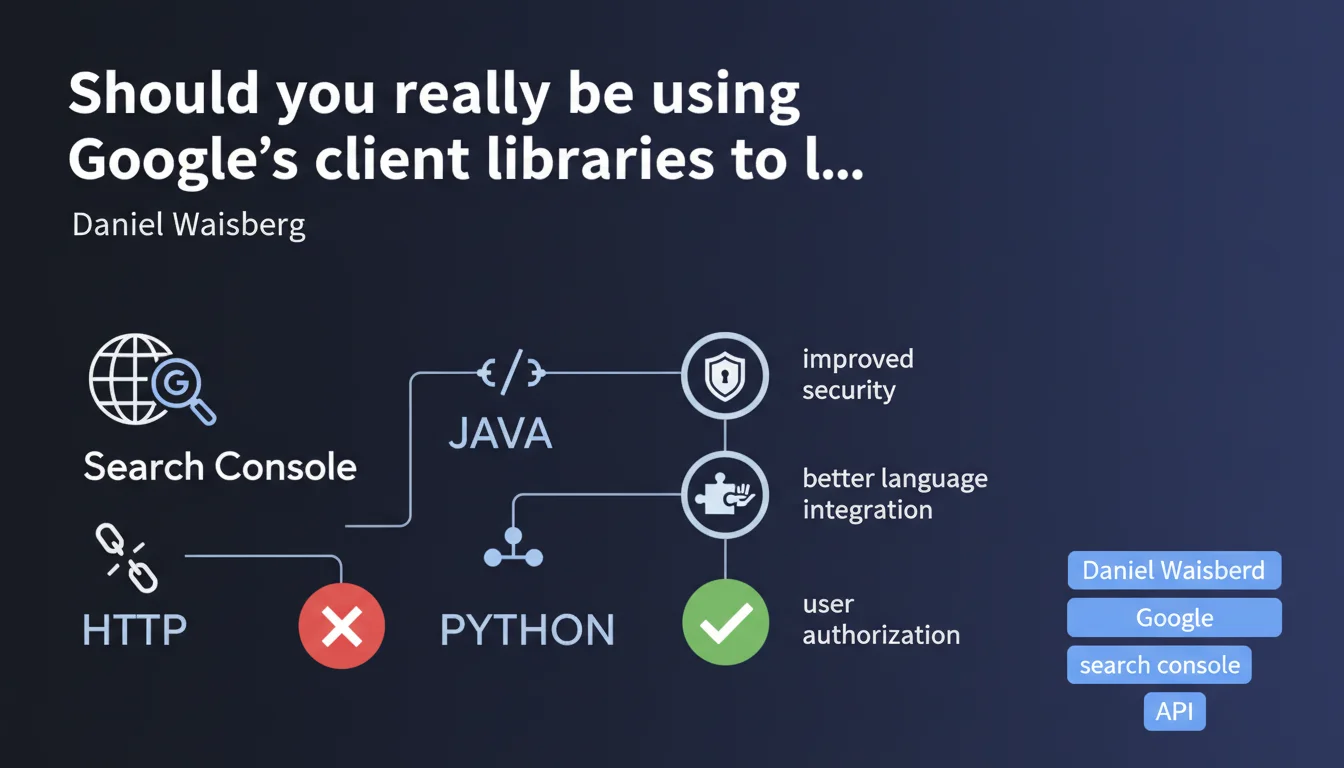
Google recommends using official client libraries (Java, Python, etc.) rather than directly calling the Search Console API's REST HTTP service. The argument: better language integration, enhanced security, and simplified permission management. A position that clearly steers you toward Google's ecosystem rather than native REST solutions.
What you need to understand
What exactly are these client libraries?
Google's client libraries are official SDKs that encapsulate calls to the Search Console API. Available in multiple languages (Java, Python, PHP, .NET, JavaScript), they automatically handle OAuth 2.0 authentication, pagination, automatic retries, and data serialization.
Instead of manually building HTTP requests with the correct headers, tokens, and parameters, these libraries provide pre-structured methods. You call a function, it returns a typed object — that's it.
Why is Google pushing this approach now?
Three official arguments: better language integration (type safety, IDE autocompletion), enhanced security (token management, forced HTTPS), and native support for user authorization. In short, Google wants to simplify API adoption while maintaining control over the abstraction layer.
The subtext? Less chance you'll do something questionable with your OAuth tokens, fewer support tickets about poorly handled 401 HTTP errors. And incidentally, a more homogeneous ecosystem that makes updates easier on Google's side.
- Technical abstraction: less boilerplate code to manage authentication
- Reduced maintenance: API updates are reflected in the libraries without breaking your code
- Error handling: automatic retries, integrated exponential backoff
- Strong typing: especially useful in Java, Python with type hints
Does that mean the REST API is becoming obsolete?
No. Google isn't saying that direct REST approach is discouraged or deprecated — simply that the libraries are recommended. Important nuance.
If you already have a system consuming the API via native HTTP calls (curl, requests, fetch), you're not forced to migrate. But for any new project, Google is clearly steering you toward official SDKs.
SEO Expert opinion
Is this recommendation consistent with real-world practices?
Yes and no. In large organizations or SEO agencies, client libraries are already widely adopted — mainly for time savings and stability. Nobody wants to debug a refresh token OAuth failure at 3 AM.
On the other hand, for one-off scripts or small projects, pulling in a full library might feel like overkill. A simple REST call with requests in Python works just fine — and it's more transparent. The choice really depends on context.
What are the blind spots in this statement?
Google talks about enhanced security, but doesn't explain why a properly configured REST call would be less secure. [Worth verifying] — if you handle secrets correctly, use HTTPS, and store your tokens safely, the concrete difference remains unclear.
Another point: "better language integration" depends entirely on your tech stack. If you're in a modern Node.js environment with TypeScript, autocompletion works quite well even with typed REST calls. The argument matters most for Java or C# where strong typing is king.
When is the REST approach still preferable?
When you need full control over requests: precise logging, custom timeout handling, integration with an existing queue system. Libraries abstract a lot — sometimes too much.
Also for constrained environments where adding heavy dependencies isn't desirable (serverless with critical cold start times, edge computing). A simple fetch() might be more suitable than importing an entire SDK.
Practical impact and recommendations
What should you do if you're already using the REST API directly?
Nothing urgent. Google isn't deprecating REST access, so no immediate corrective action is required. Your code continues to work normally.
However, if you're planning to evolve your stack or add new Search Console features, now's the time to evaluate a gradual migration to client libraries — especially if you're experiencing recurring authentication or error management issues.
How do you migrate to a client library without breaking everything?
Start by isolating a non-critical endpoint: retrieving top-performing URLs, for example. Migrate just that part with the official library, test in parallel with your old REST implementation.
Once you've validated stability and performance, expand gradually. Don't change everything at once — that's the best way to end up with production bugs you can't debug.
- Verify your language has an officially maintained client library
- Test performance comparisons (latency, response time) between direct REST and SDK
- Document the added dependencies and their impact on your build environment
- Plan a fallback to REST if the library causes issues (graceful degradation)
- Train your technical team on using the chosen SDK
What mistakes should you avoid when adopting client libraries?
Don't fail to version your dependencies correctly. Google SDKs evolve, and a minor update can introduce breaking changes if you haven't pinned a specific version in your dependency files (requirements.txt, package.json, pom.xml).
Another classic pitfall: assuming the library handles all edge cases. It simplifies usage, but doesn't replace solid error handling on the application side — exceeded quotas, network timeouts, empty responses still need manual handling.
❓ Frequently Asked Questions
Les bibliothèques clientes Google sont-elles gratuites ?
Puis-je continuer à utiliser des appels REST HTTP directs ?
Quels langages de programmation sont supportés par les bibliothèques clientes ?
Les bibliothèques clientes améliorent-elles vraiment la sécurité ?
Y a-t-il des inconvénients à utiliser les bibliothèques clientes ?
🎥 From the same video 9
Other SEO insights extracted from this same Google Search Central video · published on 26/04/2023
🎥 Watch the full video on YouTube →
💬 Comments (0)
Be the first to comment.