
Official statement
Other statements from this video 8 ▾
- □ La latence tue-t-elle vraiment vos conversions et votre SEO ?
- □ La performance mobile est-elle vraiment un facteur de classement déterminant ?
- □ Faut-il vraiment lancer Lighthouse en boucle pour diagnostiquer la performance de ses pages ?
- □ Les GIF animés plombent-ils vraiment votre SEO et vos Core Web Vitals ?
- □ Le lazy loading d'images est-il vraiment indispensable pour votre SEO ?
- □ Vos bundles JavaScript plombent-ils vraiment vos Core Web Vitals ?
- □ Faut-il vraiment analyser ses bundles JavaScript avec webpack pour performer en SEO ?
- □ 15% de vitesse mobile en plus = combien d'utilisateurs gardés sur vos pages produits ?
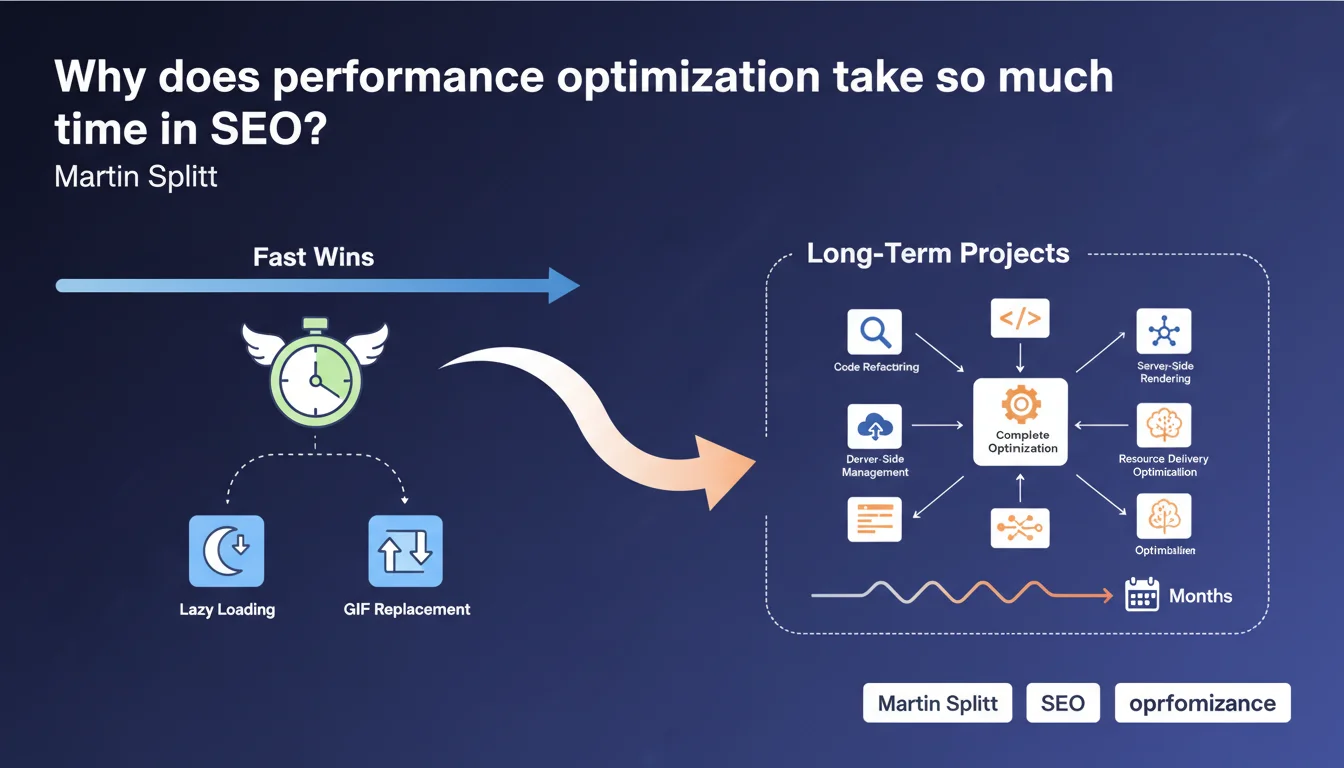
Google acknowledges that comprehensive web performance optimization is not a quick fix. Some corrections are immediate (lazy loading, GIF replacement), but JavaScript bundle optimization can take several months. A reality check that forces teams to rethink timelines and client expectations.
What you need to understand
What does Google mean by "complete optimization"?
Martin Splitt distinguishes between two levels of intervention. On one hand, quick wins — lazy loading, image compression, replacing GIFs with modern formats. These adjustments are implemented within hours or days.
On the other hand, JavaScript bundle optimization, which requires a thorough audit of front-end architecture. You need to identify unnecessary dependencies, refactor code, implement code splitting, test impacts across the entire site. This work touches the core of the application.
Why do several months become necessary?
Because we're not talking about a simple configuration change. Bundle optimization often involves restructuring technical architecture — breaking down monolithic modules, reviewing imports, negotiating with dev teams on priorities.
Testing phases cannot be compressed. Each modification can break a critical function, impact conversion rate, generate bugs invisible in development but glaringly obvious in production. Iterations accumulate.
How does this impact SEO?
Web performance is a ranking factor since Core Web Vitals were integrated into the algorithm. A slow site loses visibility, organic traffic, conversions. But this statement enforces a long-term vision: results won't be visible before several crawl cycles.
- Surface optimizations (images, lazy loading) provide immediate but limited gains
- Structural optimizations (JS bundles) take months but deliver lasting gains
- You must plan these projects in advance, not reactively after traffic drops
- Client expectations must be recalibrated: performance optimization is not a sprint
SEO Expert opinion
Is this timeline realistic in the field?
Yes, and sometimes even optimistic. On complex applications with years of technical debt, bundle optimization can take more than six months. The bottlenecks aren't always technical — they're organizational.
Dev teams have their own roadmaps, sprints are already packed, performance isn't always prioritized against new features. SEO must negotiate for every percentage point gained on LCP. And when the site relies on a poorly optimized framework or dozens of unmanaged third-party scripts, the project becomes massive.
What nuances should be added?
Google doesn't specify which performance level justifies several months of work. A site at 8 seconds LCP? A site already at 3 seconds aiming for 2.5? [To verify] — this distinction changes everything in terms of priority and investment.
Another missing point: the differentiated impact across sectors. An e-commerce site can see its conversion rate skyrocket after optimization. An informational blog will see more modest effects. ROI varies enormously, but Google provides no figures, no concrete benchmarks.
In what cases can you move faster?
If the site uses a static site generator (Next.js, Gatsby, Astro), bundle optimization is often quicker. The architecture is designed for performance from the start, analysis tools are built-in.
On a WordPress with 40 plugins, half of which inject unoptimized JavaScript? Good luck. The problem is no longer technical, it's structural. Sometimes the only viable solution is a complete redesign with a modern stack — which delays things further.
Practical impact and recommendations
What should you do concretely?
Start with a detailed performance audit to identify quick wins and heavy projects. Use Lighthouse, WebPageTest, Chrome DevTools to map bottlenecks. Prioritize actions by impact and implementation cost.
Address simple optimizations immediately: image compression, modern formats (WebP, AVIF), lazy loading, caching. These adjustments deliver measurable gains within days and improve user experience immediately.
For heavy optimizations (JS bundles, refactoring), plan a roadmap over 3-6 months. Break the project into sprints with quantified objectives. Measure impact at each iteration to adjust priorities. Involve dev teams from the start — without their buy-in, nothing will move.
What mistakes should you absolutely avoid?
Don't promise immediate results on structural optimizations. Clients often expect metrics to skyrocket after two weeks of work. Recalibrate expectations from the start: explain the difference between quick wins and deep optimizations.
Don't optimize blindly. Some "best practices" can break critical features — lazy loading misconfigured on above-the-fold elements, code splitting that delays main content display. Test each modification under real conditions before deployment.
Avoid underestimating organizational complexity. Bottlenecks are rarely purely technical. If the project requires convincing three departments, changing the deployment process, training teams, a three-month plan becomes six.
How do you measure and validate progress?
- Set up continuous monitoring of Core Web Vitals (Search Console, RUM, Lighthouse CI)
- Define precise KPIs before starting: LCP target, FID, CLS
- Measure business impact: bounce rate, conversions, revenue per session
- Audit JS bundles with webpack-bundle-analyzer or source-map-explorer
- Test on real devices, not just in lab (field results often differ)
- Document each optimization and its measured gain to justify investment
❓ Frequently Asked Questions
Combien de temps faut-il pour optimiser les bundles JavaScript d'un site e-commerce complexe ?
Les quick wins suffisent-ils à améliorer les Core Web Vitals ?
Faut-il attendre la fin de l'optimisation complète avant de voir un impact SEO ?
Comment convaincre les équipes dev de prioriser l'optimisation de performance ?
Peut-on accélérer le processus avec des outils automatisés ?
🎥 From the same video 8
Other SEO insights extracted from this same Google Search Central video · published on 29/12/2022
🎥 Watch the full video on YouTube →
💬 Comments (0)
Be the first to comment.