
Official statement
Other statements from this video 8 ▾
- □ La latence tue-t-elle vraiment vos conversions et votre SEO ?
- □ Faut-il vraiment lancer Lighthouse en boucle pour diagnostiquer la performance de ses pages ?
- □ Les GIF animés plombent-ils vraiment votre SEO et vos Core Web Vitals ?
- □ Le lazy loading d'images est-il vraiment indispensable pour votre SEO ?
- □ Vos bundles JavaScript plombent-ils vraiment vos Core Web Vitals ?
- □ Faut-il vraiment analyser ses bundles JavaScript avec webpack pour performer en SEO ?
- □ 15% de vitesse mobile en plus = combien d'utilisateurs gardés sur vos pages produits ?
- □ Pourquoi l'optimisation de performance prend-elle autant de temps en SEO ?
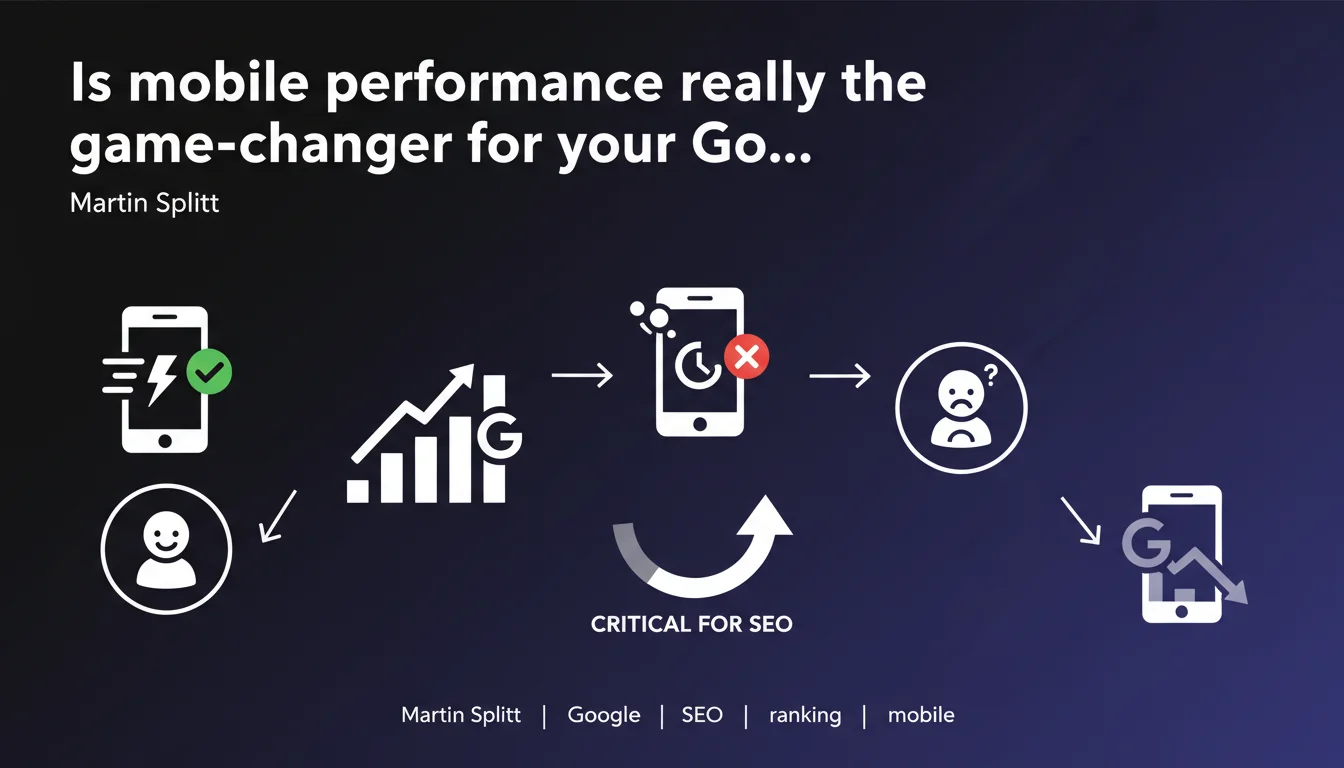
Google affirms that slow mobile pages cause user abandonment and harm search rankings. Martin Splitt emphasizes the "critical" nature of mobile performance for SEO. In practice, a slow mobile site risks losing both traffic and positions in the SERPs.
What you need to understand
Why does Google put such emphasis on mobile performance?
Since the shift to mobile-first indexing, Google prioritizes indexing and evaluating the mobile version of websites. If this version is slow, the entire site's rankings suffer.
User experience on mobile now determines organic visibility. High loading time generates pogo-sticking — the user immediately returns to search results — a negative signal that Google detects and interprets.
What exactly do we mean by "critical mobile performance"?
Splitt's phrasing remains vague. We're probably talking about Core Web Vitals — LCP, FID, CLS — but also ancillary metrics like TTFB or Speed Index.
The word "critical" suggests a direct impact on ranking, not just a "nice-to-have". Yet Google has never precisely quantified the weight of these signals in its algorithm.
What's the connection between user abandonment and SEO?
Rapid abandonment degrades behavioral signals: high bounce rate, low time on site, lack of engagement. Google officially denies using these metrics as direct ranking factors, but it observes them via Chrome and Android.
Result: even if the signal isn't explicit, a site that drives away mobile users mechanically loses visibility. The correlation is there, even if causality remains debated.
- Mobile-first indexing makes the mobile version the reference for rankings
- Core Web Vitals are official indicators of mobile performance
- User abandonment indirectly impacts SEO through behavioral signals
- Google captures this data via Chrome, Android, and Search Console
- A slow mobile site loses both direct traffic and organic positions
SEO Expert opinion
Does this statement really reflect on-the-ground observations?
Yes, partly. Slow mobile sites definitely lose traffic — that's indisputable. But the direct impact on ranking is more nuanced than announced.
We've seen sites with catastrophic Core Web Vitals maintain top 3 positions for months. Conversely, ultra-fast sites struggle to gain traction if content or backlinks don't measure up. Mobile performance is a factor, but far from the only one — or even the primary one in many competitive sectors.
What nuances should be added to this official narrative?
Google uses the term "critical" to push sites to improve, but the real weight of the signal varies by query. On highly competitive commercial searches, mobile speed matters little against domain authority and semantic relevance.
However, on low-engagement informational queries, a slow site is indeed overtaken by faster competitors. Context determines impact. [To verify]: Google has never published specific data on the relative weight of Core Web Vitals in the overall algorithm.
In what cases doesn't this rule apply fully?
If your site has overwhelming authority — premium backlinks, solid history, recognized E-E-A-T — you can afford middling mobile performance without losing everything. Users will wait a bit longer if the content is unique.
Another exception: technical niches where desktop audience remains dominant. Sure, Google indexes mobile-first, but if 80% of your visitors come from computers, the practical impact of weak mobile performance is diluted.
Practical impact and recommendations
What should you do concretely to improve mobile performance?
Start by measuring: PageSpeed Insights, Lighthouse, and especially real data in Search Console (Core Web Vitals report). Lab metrics provide a baseline, but actual user data is what counts.
Then tackle the biggest levers: image compression (WebP), lazy loading, removal of render-blocking scripts, aggressive caching. Unoptimized JavaScript is often the main culprit — a WordPress site with 15 plugins can easily double its mobile loading time.
What mistakes must you absolutely avoid?
Don't test only on premium mobile devices. An iPhone 15 Pro on fiber WiFi doesn't represent your audience. The average user browses on a mid-range Android device on unstable 4G.
Another classic trap: optimizing only the homepage. Google indexes and evaluates your entire site. If your category or product pages are slow, you still lose positions on those segments.
How do you verify your site meets Google's standards?
Use real user data from Search Console, not just lab tests. If 60% of your actual URLs are rated "Poor" in the Core Web Vitals report, you have a serious problem.
Also monitor mobile bounce rate in Google Analytics (or GA4). A significant gap between desktop and mobile (e.g. 40% vs 65%) signals degraded mobile experience — even if technical metrics seem fine.
- Measure real Core Web Vitals through Search Console (real user data > lab)
- Compress and convert images to WebP or AVIF
- Enable native lazy loading on images and iframes
- Minimize and defer non-critical JavaScript
- Implement efficient browser and server-side caching
- Test on real mid-range Android devices under actual 4G conditions
- Verify all pages — not just the homepage — are optimized
- Monitor monthly metric evolution in Search Console
❓ Frequently Asked Questions
Les Core Web Vitals sont-ils le seul critère de performance mobile à surveiller ?
Un site rapide en desktop mais lent en mobile peut-il bien ranker ?
Faut-il privilégier un site mobile dédié (m.example.com) ou un responsive ?
Quel est le délai pour voir un impact SEO après optimisation mobile ?
Un CDN suffit-il à résoudre tous les problèmes de performance mobile ?
🎥 From the same video 8
Other SEO insights extracted from this same Google Search Central video · published on 29/12/2022
🎥 Watch the full video on YouTube →
💬 Comments (0)
Be the first to comment.