
Official statement
Other statements from this video 8 ▾
- □ La performance mobile est-elle vraiment un facteur de classement déterminant ?
- □ Faut-il vraiment lancer Lighthouse en boucle pour diagnostiquer la performance de ses pages ?
- □ Les GIF animés plombent-ils vraiment votre SEO et vos Core Web Vitals ?
- □ Le lazy loading d'images est-il vraiment indispensable pour votre SEO ?
- □ Vos bundles JavaScript plombent-ils vraiment vos Core Web Vitals ?
- □ Faut-il vraiment analyser ses bundles JavaScript avec webpack pour performer en SEO ?
- □ 15% de vitesse mobile en plus = combien d'utilisateurs gardés sur vos pages produits ?
- □ Pourquoi l'optimisation de performance prend-elle autant de temps en SEO ?
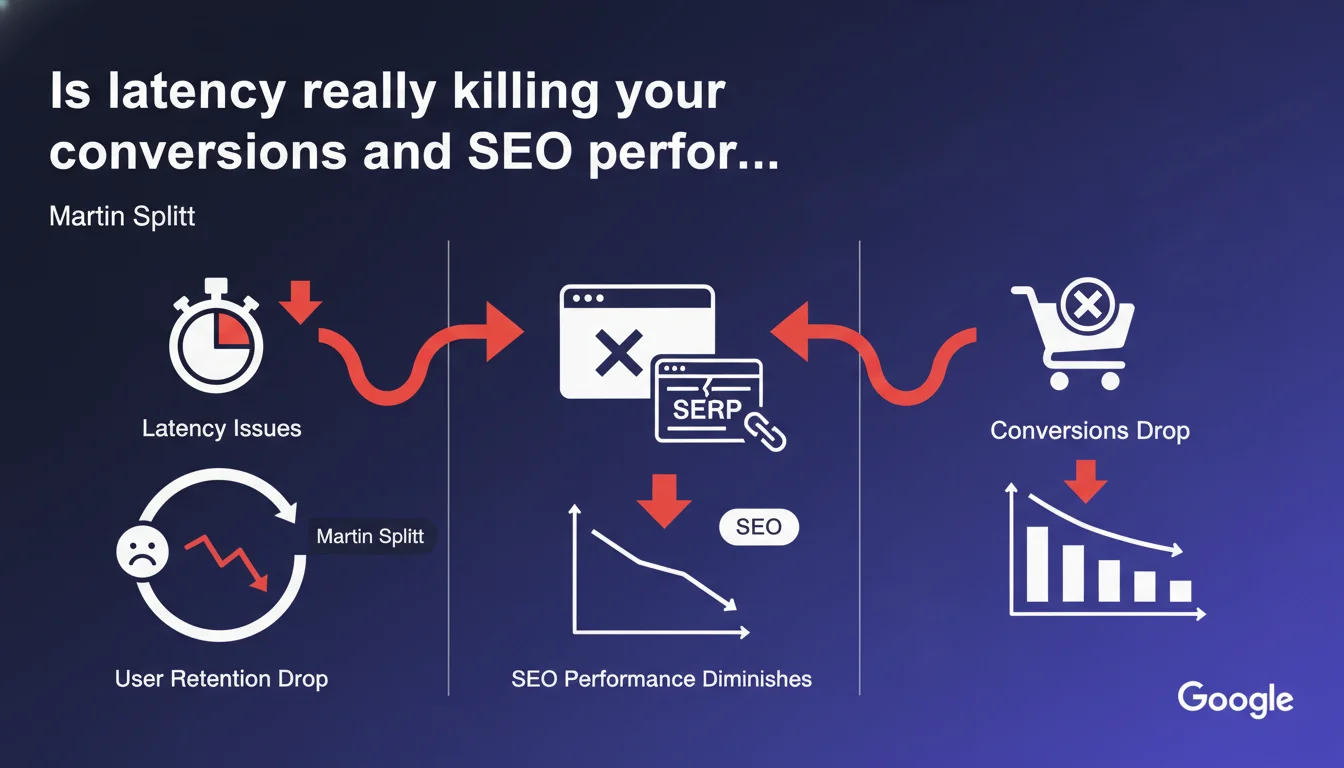
Google confirms that latency on product pages simultaneously degrades user retention and SEO performance. Users quickly abandon slow pages, which directly impacts the behavior observed by the algorithm. Load time isn't just a Core Web Vitals factor — it's a conversion and visibility lever.
What you need to understand
Does Google explicitly link latency and SEO?
Yes, and it matters. Martin Splitt establishes a direct connection between product page load speed and organic performance. This isn't just about user experience — it's a signal that Google integrates into its evaluation.
The mechanics work on two levels: on one hand, users abandon slow pages, generating negative behavioral signals (bounce rate, time spent). On the other hand, Google observes these behaviors and adjusts rankings accordingly. Latency becomes a two-tier problem: UX and algorithm.
What exactly do we mean by "latency" here?
Martin Splitt doesn't specify whether he's talking about TTFB, LCP, or pure network latency. It's vague — and this is a recurring issue in Google's communications. We assume he's targeting the entire loading journey, from the initial request to the display of main content.
In practice, this likely covers Core Web Vitals (LCP, FID, CLS), but also less visible metrics like Time to Interactive or First Contentful Paint. Product pages, with their heavy images and third-party scripts, are particularly vulnerable.
Why specifically target product pages?
Product pages are critical conversion points — and Google knows it. High latency on these pages not only causes traffic loss but also leads to conversion drops, impacting revenue.
Google has every incentive to favor sites that convert well, as this validates the relevance of its results. If your product pages are slow, users bounce, search elsewhere, and Google registers that your site doesn't satisfy search intent. Result: ranking degradation.
- Latency simultaneously impacts UX and SEO — they're two sides of the same coin.
- Behavioral signals (bounce, time spent) play a role in quality evaluation.
- Product pages are priority targets because they concentrate commercial intent.
- Google observes navigation patterns to adjust rankings based on user satisfaction.
- Core Web Vitals remain a partial proxy — other latency metrics matter too.
SEO Expert opinion
Is this statement consistent with real-world observations?
Yes, but with important nuances. We do observe that sites with slow product pages lose positions — but the correlation isn't always as clear-cut as Google suggests. Some slow sites continue ranking well if their authority and content compensate.
The real problem is that Google provides no concrete thresholds. At what latency does the penalty kick in? 3 seconds? 5 seconds? We don't know. [To verify]: Google speaks of "taking too long to load," but this formulation remains vague and non-actionable.
Do behavioral signals really weigh in the algorithm?
Google officially denies using bounce rate as a direct ranking factor — but nobody really believes that. User behaviors (clicks, SERP returns, time spent) are necessarily integrated in some way, even if Google calls them something else.
What's certain is that if your product pages are slow and users flee, Google will test other results to see if they perform better. If they do, you lose positions. Call it "user satisfaction," "dwell time," or "engagement" — the outcome is the same.
Should you prioritize latency over other SEO optimizations?
It depends. If your product pages are already well-optimized for content, internal linking, and backlinks, then yes, latency becomes the bottleneck. But if you have structural issues (duplicate content, indexation, architecture), speed won't save you.
Let's be honest: an ultra-fast site with mediocre content won't beat a slower competitor who's better optimized. Latency is a multiplier factor — it amplifies existing strengths and weaknesses. Don't treat it as a magic solution.
Practical impact and recommendations
How do you identify latency issues on product pages?
Start with Google Search Console: Core Web Vitals section, "Page Experience" report. Identify red or orange URLs, with a particular focus on product pages. Cross-reference with traffic data to prioritize high-volume pages.
Then use PageSpeed Insights or Lighthouse to analyze each page. Look at LCP (Largest Contentful Paint) — it's often the most problematic on product pages with heavy images. An LCP above 2.5 seconds is a warning sign.
Finally, test in real conditions with WebPageTest (3G connection, mobile profile). Google tools measure in the lab — real-world testing often reveals much worse latencies, especially on mobile.
What are the most common causes of latency on product pages?
Unoptimized images: this is the number one cause. Heavy formats (JPEG instead of WebP), oversized dimensions, missing lazy loading. A single 2 MB image can tank your LCP.
Third-party scripts: tracking, chatbots, customer reviews, ads. Each external script adds network requests and slows rendering. Some scripts actually block loading — identify them and defer them.
Server response time (TTFB): if your hosting is undersized or poorly configured, even a lightweight page will be slow. A TTFB above 600 ms is problematic. Also check database queries — product pages often make dozens of unoptimized queries.
What concrete steps can you take to reduce latency?
- Optimize images: switch to WebP or AVIF formats, compression, native lazy loading (loading="lazy").
- Defer third-party scripts: asynchronous loading or after the onload event. Eliminate unnecessary scripts.
- Enable a CDN: reduce network latency by serving assets from geographically close servers to the user.
- Optimize TTFB: server-side caching (Varnish, Redis), Gzip/Brotli compression, optimized database queries.
- Implement preconnect for critical third-party resources (fonts, APIs).
- Test after each change: latency can vary depending on context (mobile, 3G, geolocation).
- Monitor continuously: regressions often happen after updates or adding new features.
Latency on product pages is a double poison: it drives users away and degrades rankings. Google doesn't provide precise thresholds, but observations show that an LCP above 2.5 seconds and a TTFB above 600 ms are problematic.
Prioritize image optimization, cleaning up third-party scripts, and implementing a CDN. These technical projects can seem complex to orchestrate alone, especially with large product catalogs. If your team lacks resources or technical expertise, considering support from an SEO agency specializing in this area can accelerate results and prevent costly mistakes.
❓ Frequently Asked Questions
La latence est-elle un facteur de ranking direct ?
À partir de quel seuil la latence devient-elle pénalisante ?
Faut-il prioriser la latence sur mobile ou desktop ?
Les scripts tiers (tracking, chatbot) peuvent-ils vraiment plomber le SEO ?
Un CDN suffit-il à résoudre les problèmes de latence ?
🎥 From the same video 8
Other SEO insights extracted from this same Google Search Central video · published on 29/12/2022
🎥 Watch the full video on YouTube →
💬 Comments (0)
Be the first to comment.