
Official statement
What you need to understand
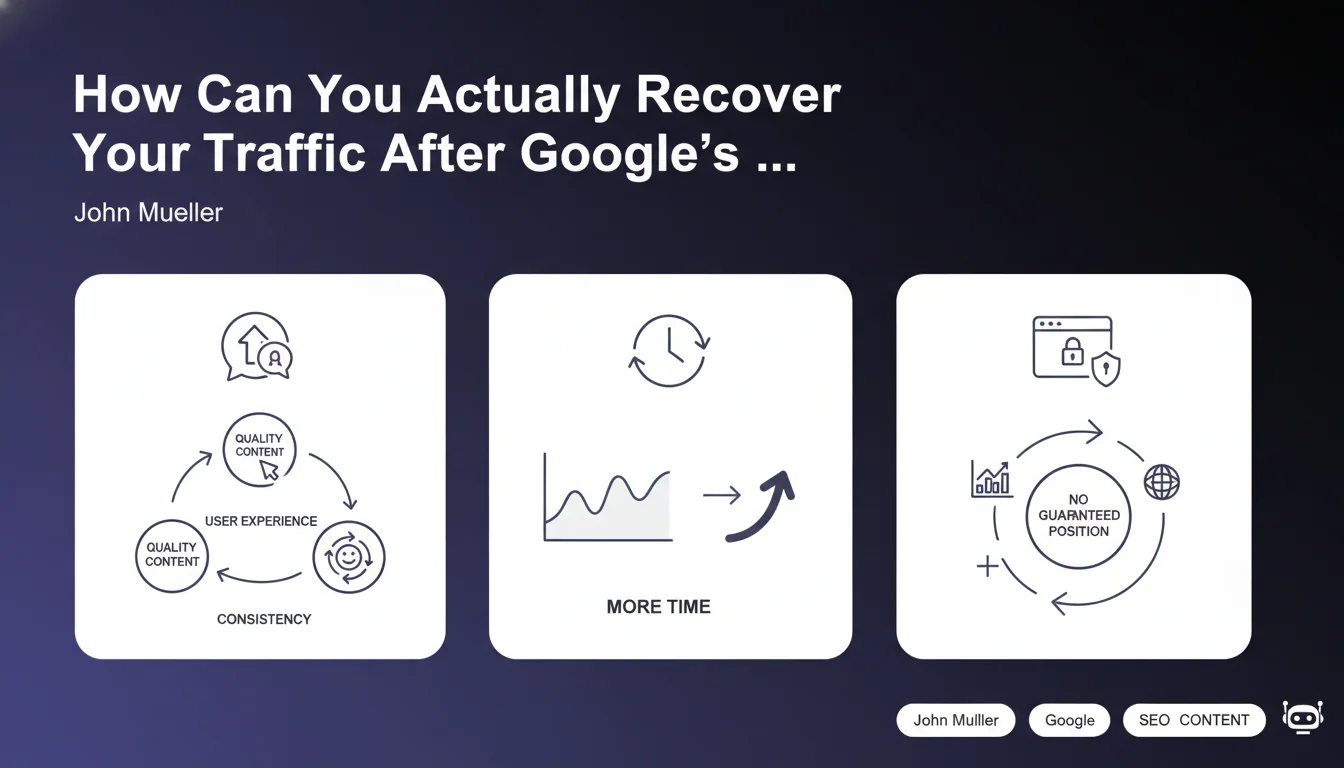
Google officially acknowledges that certain algorithmic updates, particularly the Helpful Content Update (HCU), have deep and lasting impacts on site rankings. Unlike typical fluctuations, these updates require more time to recover from and guarantee no return to the previous situation.
The official message emphasizes a fundamental point: no page has a guaranteed or static position in search results or in Google Discover. This statement underscores the dynamic and competitive nature of the SEO ecosystem, where ranking depends on numerous constantly evolving factors.
When facing an algorithmic penalty, Google recommends an approach centered on quality and patience rather than on isolated technical optimizations. Site owners must accept uncertainty and focus on substantial improvements.
- HCU recoveries take more time than for other algorithmic updates
- No guarantee of recovering lost rankings or visibility, even after improvements
- Positions in SERPs are dynamic and never permanently secured
- The recommended approach prioritizes content quality and user experience over the long term
- Patience and consistency of efforts are essential, without obsessing over daily fluctuations
SEO Expert opinion
This statement reflects a reality we've observed since 2022: the Helpful Content Update marked a paradigm shift in Google's algorithmic approach. Unlike the Panda or Penguin adjustments of the past where targeted corrective actions enabled rapid recoveries, the HCU evaluates a site's overall legitimacy in a more holistic manner.
The lack of recovery guarantee is frustrating but consistent with our field observations. We see that some sites that have made major improvements (removal of thin content, complete editorial overhaul) wait 6 to 12 months before seeing tangible results. Others never fully recover. This situation suggests that Google evaluates trust over the long term, not just the site's current state.
An important nuance concerns diversification: if Google guarantees nothing, your digital strategy shouldn't rely solely on organic SEO. Single-channel sites (100% SEO) are most vulnerable to these updates without recourse.
Practical impact and recommendations
- Conduct an in-depth audit of your content quality: identify and delete or radically improve low-value pages, mass-generated content, or superficial articles
- Assess the perceived expertise and legitimacy of your site: strengthen authority signals (detailed author pages, references, cited sources, editorial credibility)
- Optimize user experience substantially: loading times, intuitive navigation, clear layout, reduction of intrusive elements (excessive pop-ups, aggressive advertising)
- Adopt a long-term vision: plan your improvements over 6 to 12 months minimum and measure progress on quarterly periods, not weekly
- Diversify your traffic sources: develop newsletter, social media, partnerships, to reduce dependence on organic SEO
- Document your actions: keep a log of modifications made with precise dates to correlate with future traffic changes
- Avoid superficial optimizations: simply adding more words or rephrasing without improving substance won't suffice against the HCU
- Remain consistent in your efforts: don't give up after 2-3 months without results, post-HCU recovery requires patience and perseverance
- Monitor Core Web Vitals and technical metrics: even though content is priority, technical aspects remain fundamental prerequisites
💬 Comments (0)
Be the first to comment.