
Official statement
What you need to understand
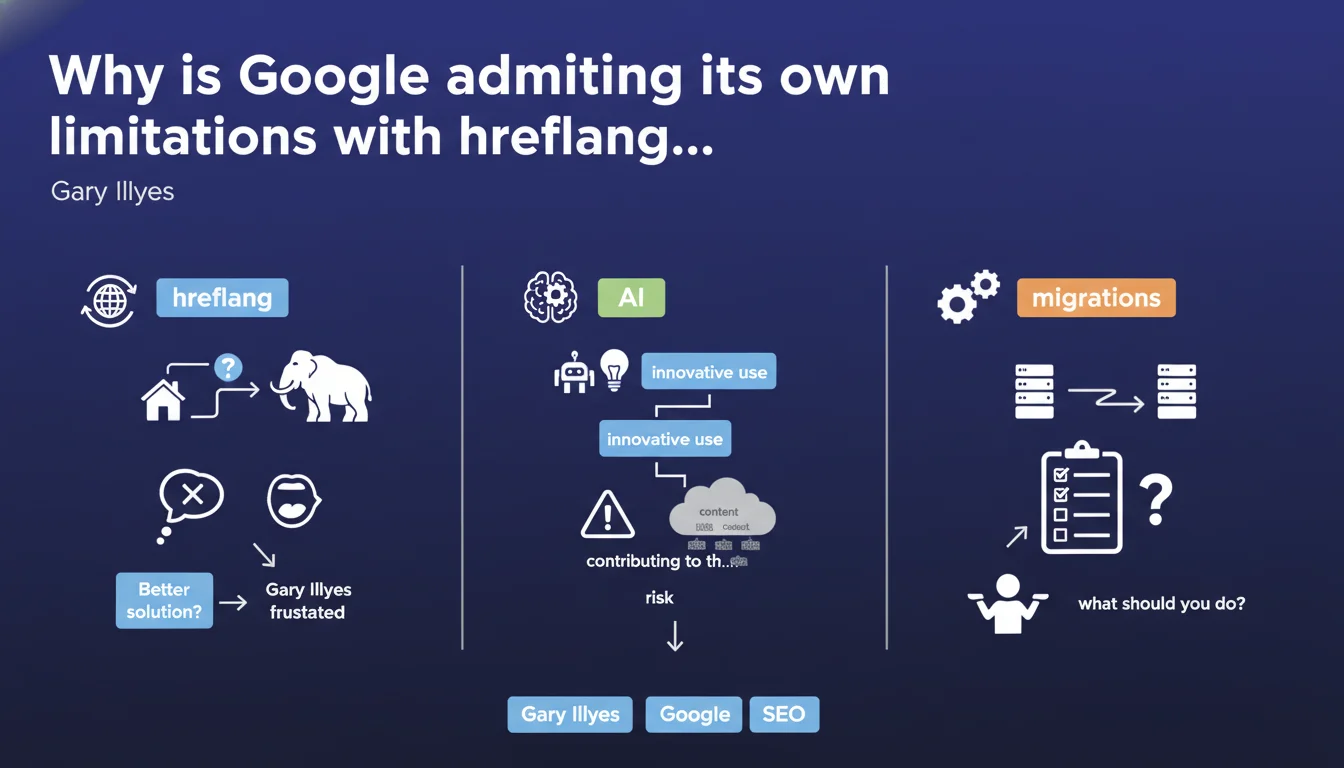
Google openly acknowledges certain weaknesses in its technical ecosystem through Gary Illyes' statements. The hreflang tag, supposed to properly manage multilingual and multi-regional aspects, is described as frustrating by one of the search engine's main representatives.
This admission is revealing: even Google is looking for a better solution to manage site internationalization. The current system works but remains complex to implement correctly, generating confusion and errors among webmasters.
Regarding generative AI, the message is twofold. Google encourages innovation and the use of AI tools for SEO, but firmly warns against the massive production of mediocre content. The nuance is important: it's not AI that's problematic, but its use to industrialize content without added value.
- Hreflang remains problematic even in Google's eyes, which is actively seeking alternatives
- AI is accepted as an SEO work tool, provided quality is maintained
- Complex migrations can justify direct contact with Google if they stagnate
- SEO is not dead despite AI - this discourse has returned cyclically since 2003
- Google acknowledges its fallibility and invites dialogue on persistent technical problems
SEO Expert opinion
This statement is remarkably honest and consistent with what we observe in the field. The complexity of hreflang is a problem that has been documented for years: syntax errors, broken redirect chains, incompatibility with certain CMS. That Google officially admits it validates the difficulties that practitioners face daily.
On AI, the position is pragmatic and realistic. Google cannot prohibit the use of tools that have become ubiquitous. The real red line remains quality: well-supervised, enriched, and verified AI content generally passes without problem, while content generated en masse without human intervention will be detected and penalized.
The point about migrations is particularly interesting. Admitting that there are blocking cases where contacting Google directly can help is a form of recognition that their automatic systems are not infallible. It's rare to see this transparency.
Practical impact and recommendations
- Continue using hreflang despite its complexity - no alternative currently exists, but document your implementations to facilitate a future migration if Google proposes a new system
- Systematically validate your hreflang tags with tools like Search Console and third-party validators - errors are frequent and directly impact geographic targeting
- Use AI as an assistant, not as an autonomous writer - human supervision, factual enrichment, and verification remain essential to maintain quality
- Audit your existing AI content: add unique value, updated data, real expertise to differentiate them from ambient noise
- Document your migrations precisely: dates, redirects, URL changes, traffic evolution - this data will be crucial if you need to contact Google
- Don't panic about post-AI fluctuations - SEO has been adapting to technological changes for 20 years, focus on fundamentals: relevance, quality, user experience
- Test and measure rather than blindly following statements - even Google admits its fallibility, your field data remains your best guide
- Maintain active monitoring on hreflang alternatives that Google might propose - being an early adopter of a simplified system could offer a competitive advantage
Implementation: These technical optimizations, particularly on multilingual and complex migrations, require sharp expertise and rigorous monitoring. The stakes of hreflang configuration or large-scale AI content management can quickly become time-consuming and technical. For sites with high international stakes or in transformation phase, support from a specialized SEO agency helps secure these critical implementations and avoid costly visibility errors.
💬 Comments (0)
Be the first to comment.