
Official statement
Other statements from this video 5 ▾
- □ Is Google finally offering the advanced SEO training that practitioners have been demanding?
- □ Should you trust local SEO experts over Google's official statements?
- □ Is Google really serious about hands-on learning with its new Deep Dive workshops?
- □ Is Google really using your feedback to shape its SEO events—or just making you think it does?
- □ Is Search Central Live finally coming to Africa—and what does this mean for local SEO professionals worldwide?
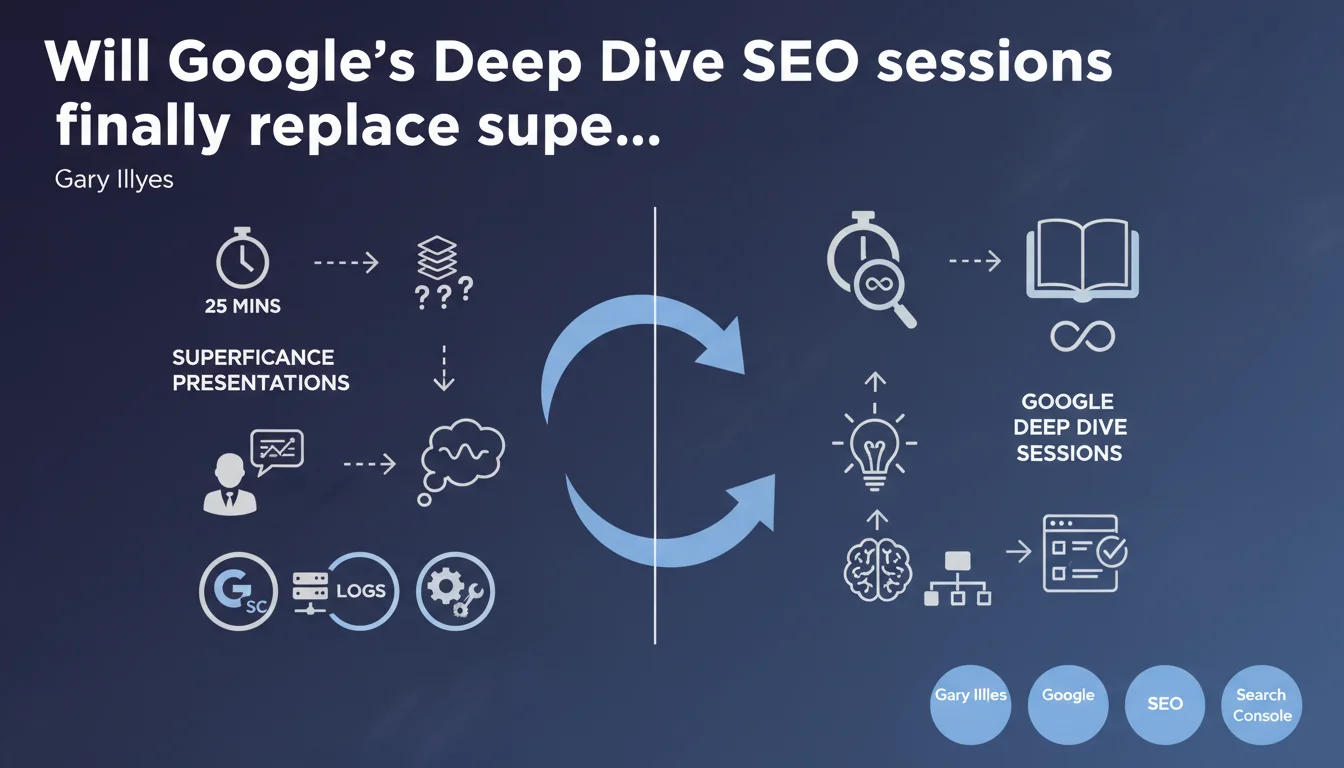
Google is launching a new "Deep Dive" format to provide in-depth contextualization of SEO topics, with concrete demonstrations via Search Console and server logs. Gone are the days of 25-minute sessions that skim over concepts — the goal is to show how to actually apply recommendations in the field.
What you need to understand
Why is Google changing its format for SEO communications?
Traditional 25-minute conferences impose a pace that prevents any serious contextualization. Result: vague statements, unanswered questions, and growing frustration among SEO practitioners.
The "Deep Dive" format aims to fix this problem by providing the necessary time to break down a topic in detail, with real examples and tools manipulated live. The idea is to move from "what" to "how" — concretely.
What types of topics will be covered in these Deep Dives?
Google hasn't yet specified the exact list, but the logic of the format suggests complex topics that would benefit from an in-depth approach: advanced Search Console interpretation, server log analysis to diagnose crawl issues, or fine technical optimization.
The emphasis will be on practical demonstration rather than theory — showing how to use data to make informed SEO decisions.
How does this differ from existing Google resources?
Google's official documentation often remains generic, even evasive on implementation details. Short sessions make this problem worse by forcing extreme simplification.
The Deep Dives promise to bridge this gap by providing space for nuance, edge cases, and direct interactions with engineers. It's potentially a step forward — if execution follows through.
- Long format enabling in-depth contextualization of SEO topics
- Concrete demonstrations via Search Console and server logs
- Focus on practical application rather than theory
- Response to the limitations of short 25-minute formats
SEO Expert opinion
Is this initiative truly new or just rebranding?
Google has already tried longer formats in the past — webinars, extended YouTube sessions — without it becoming systematic. The question is whether Deep Dives will become regular practice or remain anecdotal.
The announcement itself lacks details on planned frequency, priority topics, or actual depth level. [To verify] — let's wait for the first events to judge the substance.
Will Google really share exploitable insights?
Let's be honest: Google has always oscillated between selective transparency and strategic opacity. Deep Dives could offer more technical details, but it's unlikely to touch on sensitive algorithm mechanisms.
What's realistic: concrete use cases on Search Console, interpretations of log patterns, and best practices for solving common problems. What won't be: revelations about internal ranking mechanics.
Will server logs finally be treated seriously?
Log analysis remains a blind spot for many SEOs — not from lack of interest, but because educational resources are lacking. If Google devotes time to demonstrating how to cross-reference logs and Search Console, that's tangible progress.
That said, watch out for over-simplification. Server logs reveal complex Googlebot behaviors — reducing that to a few slides risks missing the essentials.
Practical impact and recommendations
What can you do to leverage these Deep Dives right now?
First step: master the tools Google will likely cover. If you don't know how to correctly interpret Search Console reports or analyze your server logs, bridging this gap becomes a priority.
Next, prepare your specific questions. Longer formats typically offer more space for Q&A — might as well take advantage to ask the real technical questions you've been carrying around for months.
What mistakes should you avoid while waiting for these events?
Don't fall into the waiting trap. Deep Dives won't replace a solid SEO strategy — they'll complement your approach, not define it.
Also avoid over-interpreting the first sessions. Google is testing this format, which means that quality will likely vary before stabilizing.
How can you verify that your site will benefit from these insights?
Make sure you have clean access to your server logs and that Search Console is properly configured. Without reliable data, even the best Google advice will remain theoretical.
Document your current technical issues: inefficient crawl, partial indexing, unexplained traffic drops. Deep Dives could provide leads to unlock these situations.
- Master the interpretation of Search Console and performance reports
- Implement server log analysis if not already in place
- Prepare a list of precise technical questions for Q&A sessions
- Document persistent SEO problems on your site
- Don't suspend your optimizations while waiting for these events
- Cross-reference Google insights with your own field observations
❓ Frequently Asked Questions
Les Deep Dive seront-ils accessibles gratuitement ?
Quelle est la fréquence prévue pour ces événements ?
Les Deep Dive remplaceront-ils les conférences courtes actuelles ?
Peut-on soumettre des sujets à traiter en Deep Dive ?
Les Deep Dive seront-ils disponibles en replay ?
🎥 From the same video 5
Other SEO insights extracted from this same Google Search Central video · published on 01/05/2025
🎥 Watch the full video on YouTube →
💬 Comments (0)
Be the first to comment.