
Official statement
Other statements from this video 5 ▾
- □ Is Google finally offering the advanced SEO training that practitioners have been demanding?
- □ Will Google's Deep Dive SEO sessions finally replace superficial conference presentations?
- □ Should you trust local SEO experts over Google's official statements?
- □ Is Google really serious about hands-on learning with its new Deep Dive workshops?
- □ Is Search Central Live finally coming to Africa—and what does this mean for local SEO professionals worldwide?
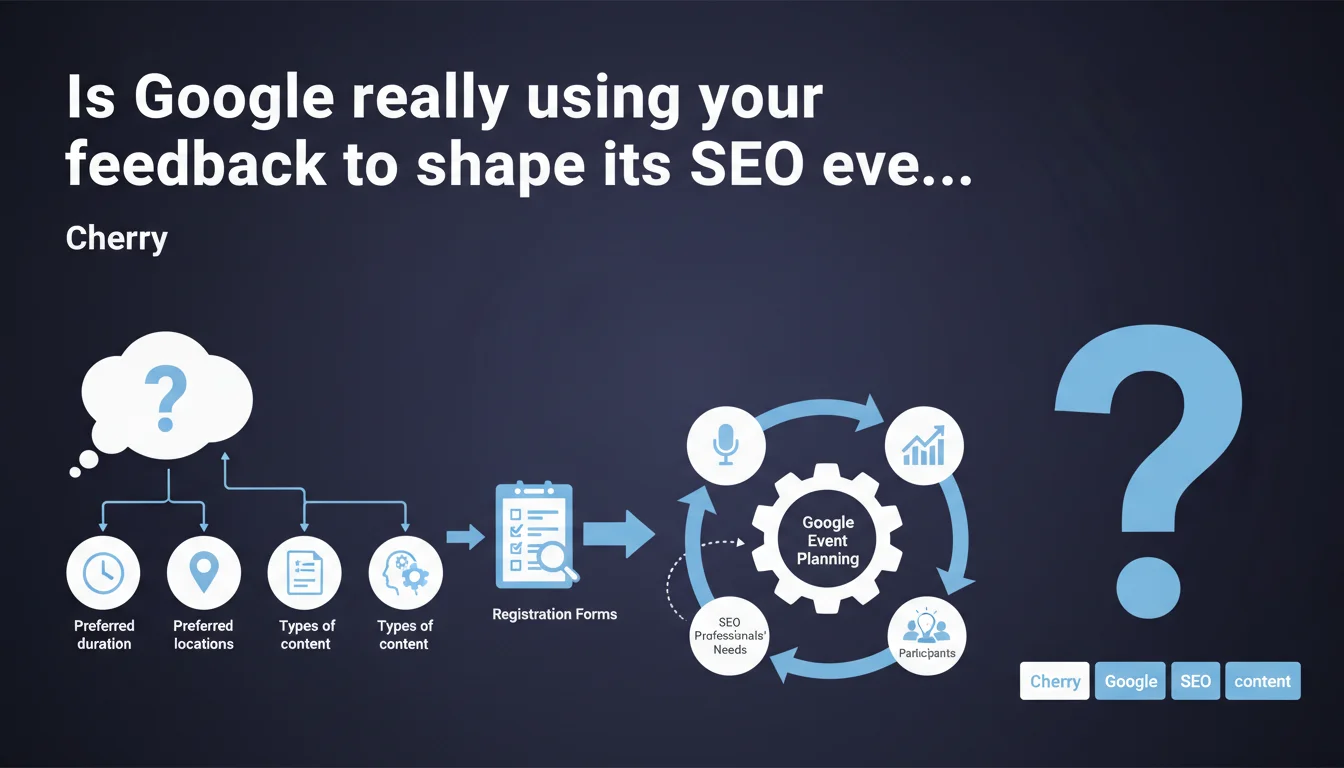
Google claims to base event planning (duration, locations, content, participants) on feedback collected through registration forms from the SEO community. The stated objective: tailor programs to real professional needs. An approach that raises questions about how seriously this feedback is actually considered and what concrete impact it truly has.
What you need to understand
Why is Google communicating about this participatory approach?
Google regularly organizes events dedicated to search professionals — Search Central Live, Google Search Office Hours, industry-specific conferences. The company now claims to systematically integrate community feedback into the design of these events.
This communication aims to demonstrate that Mountain View listens to on-the-ground needs: optimal session duration, geographic location, content formats (practical workshops, theoretical presentations, Q&A), desired speaker profiles. Registration forms thus become tools for collecting strategic data to adjust the offering.
Which elements are actually influenced by this feedback?
According to the statement, several key parameters would be influenced by community input:
- Event duration: half-day sessions, full-day sessions, or multi-day formats
- Geographic location: choice of cities and regions to maximize accessibility
- Content types: balance between theory, practical case studies, technical demonstrations
- Participant profiles: adapting technical level based on audience (beginners, experienced practitioners, developers)
- Format of presentations: keynote lectures, interactive workshops, question-and-answer sessions
Is this approach part of a broader strategy?
This participatory approach reflects a shift in Google's stance toward the SEO community. After years of top-down and sometimes opaque communication, the company appears to want to demonstrate active listening.
Registration forms thus become a bidirectional channel: not only does Google qualify its audience, but it also collects behavioral data on the real market expectations. A way to optimize the ROI of these events while improving their perceived relevance.
SEO Expert opinion
Is this statement consistent with what we observe in practice?
Let's be honest: the claim that Google systematically adapts its events to community feedback remains objectively difficult to verify. SEO professionals who regularly participate in these events report mixed experiences.
Some events do seem adjusted — shorter formats, in-depth technical sessions when demand is strong. But others remain in a standardized framework, with generic content that doesn't address specific expressed expectations. [To be verified]: what proportion of suggestions actually results in program modifications?
What limitations should you keep in mind?
Registration forms do collect data. But between collection and actual implementation, there's a gap this statement doesn't bridge.
First point: Google's logistical and budgetary constraints necessarily limit its capacity to adapt. Organizing an event in a specific city because 30% of respondents request it requires a critical mass of potential participants — which isn't always the case.
Second point: feedback can be contradictory. If half the audience wants advanced technical content and the other half wants accessible basics, how does Google decide? The statement remains silent on these trade-offs.
In what cases might this approach disappoint?
If you expect Google to radically modify its event format based on a few isolated comments, you risk disappointment. The major strategic directions (which topics to cover, what message to convey) remain decided internally, independently of feedback.
Moreover, Google events also serve corporate communication objectives: highlighting certain features, steering practices in a given direction. Community feedback can refine the form, but rarely the substance of the message Google wants to deliver.
Practical impact and recommendations
What should you do concretely if you participate in these events?
Systematically complete feedback forms with precise, well-reasoned comments. Avoid generalities like "more technical content" — specify which technical aspects interest you (JavaScript SEO, crawl management on large sites, Core Web Vitals optimization for e-commerce, etc.).
Be realistic about expectations. Relevant feedback has a better chance of being considered if it's shared by a significant portion of the audience and remains within Google's logistical and strategic possibilities.
What mistakes should you avoid in your approach to these events?
- Don't treat these events as the only reliable source of SEO information — diversify your research channels
- Avoid taking every statement at face value without critical distance
- Don't overlook networking: informal exchanges with other practitioners often yield as much as official sessions
- Don't expect a single piece of feedback to change the program — think collectively and repeat your suggestions across multiple events
How can you maximize the return on investment of your participation?
Prepare your questions in advance: identify technical or strategic points you want to clarify. Take advantage of Q&A sessions to ask specific, well-documented questions that force Google representatives to move beyond standard answers.
After the event, cross-reference the information you received with your on-the-ground observations. If a Google recommendation contradicts what you're seeing in your data, dig deeper — you might be onto an actionable insight.
❓ Frequently Asked Questions
Les feedbacks influencent-ils vraiment le contenu des interventions Google ?
Dois-je participer à tous les événements Google pour que mon feedback compte ?
Comment savoir si mon retour a été pris en compte ?
Les événements Google sont-ils la meilleure source d'information SEO ?
Peut-on influencer la localisation géographique des prochains événements ?
🎥 From the same video 5
Other SEO insights extracted from this same Google Search Central video · published on 01/05/2025
🎥 Watch the full video on YouTube →
💬 Comments (0)
Be the first to comment.