
Official statement
Other statements from this video 8 ▾
- □ Local domains, subdomains, or subdirectories: which structure should you choose for an international website?
- □ Can poorly formatted hreflang codes really damage your international indexation?
- □ Does Google really require all your hreflang versions to link to each other bidirectionally?
- □ Should you really include a self-referential hreflang link on every page?
- □ Should you really create visible links between language versions for SEO?
- □ Should you block automatic language-based redirects on your multilingual website?
- □ Does limiting the number of language versions on your website really help you rank better?
- □ Should you really create different content for each local market or is translation enough?
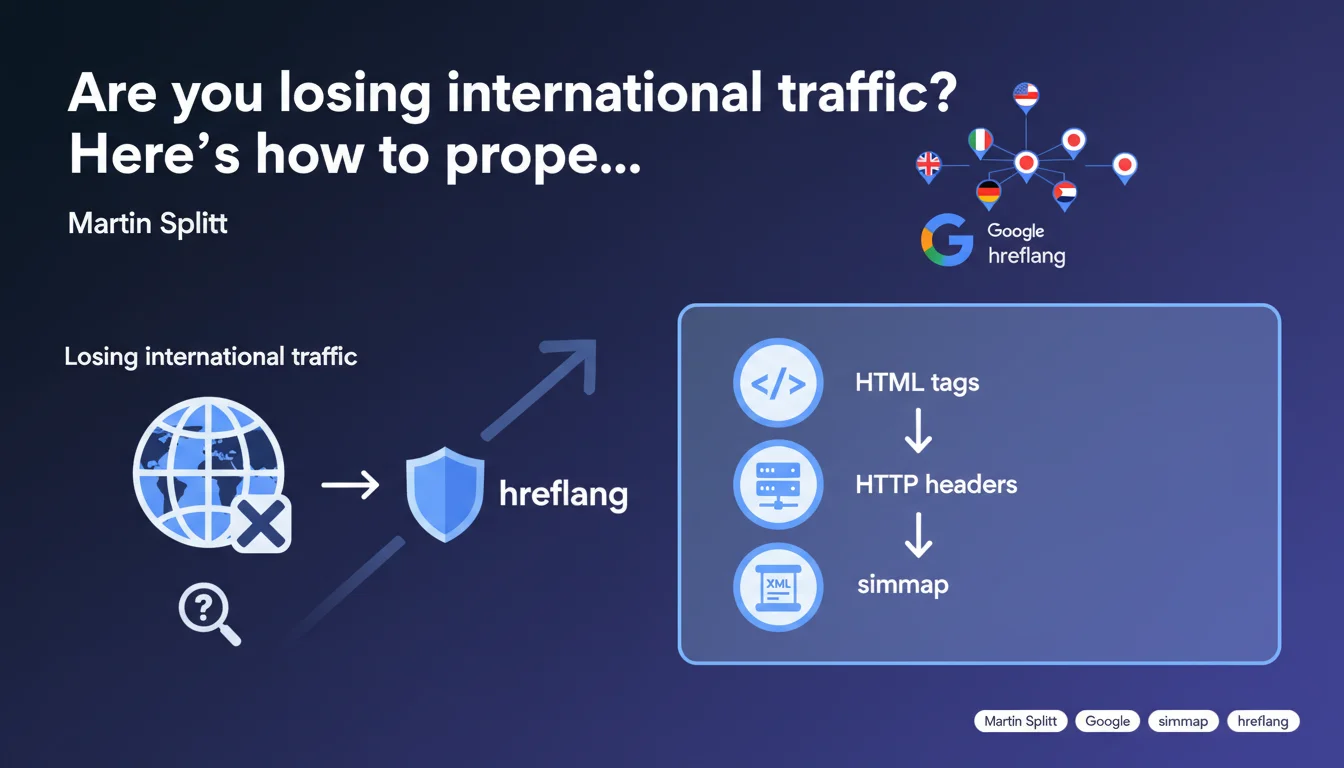
Google recommends using hreflang to link different language versions of a page and display the correct version based on the user's country. Three implementation methods are available: HTML tags, HTTP headers, or XML sitemap. Without hreflang, you risk showing the wrong version of your content to international users, with direct impact on bounce rate and conversions.
What you need to understand
Why does hreflang exist and what problem does it solve?
When you offer content in multiple languages or for different countries, Google needs to know which version to show to which user. Without clear indication, the engine can make mistakes — showing your English page to a French user, or your .fr version to a Quebec visitor.
Hreflang is the signal that tells Google: "This page exists in French for France, in French for Belgium, in English for the United Kingdom." The engine can then route each visitor correctly to the most relevant version based on their language and location.
What are the three implementation methods?
Google accepts three formats for declaring your hreflang tags. HTML tags in the page's <head>, HTTP headers for non-HTML resources (PDFs, etc.), or the XML sitemap that centralizes all annotations.
Each method has its advantages: HTML is simple for small sites, the sitemap is more maintainable at scale, HTTP headers are essential for files without markup. You can mix approaches — what matters is consistency and completeness of the annotations.
Does hreflang only apply to Google?
No, and this is an important point. Martin Splitt explicitly mentions "Google and other engines." Yandex has supported hreflang for a long time. Bing… it's murkier — officially they recognize the attribute but their documentation is less precise.
In practice, hreflang remains primarily a Google standard, even though technically it can benefit other crawlers. It's still a good reason to implement it properly, even if your international Bing traffic is marginal.
- Hreflang guides Google to the correct language or geographic version of a page
- Three possible implementations: HTML tags, HTTP headers, XML sitemap
- Not exclusive to Google — Yandex interprets it as well
- Without hreflang, risk of cannibalization between versions and poor international UX
- Each implementation method has its specific use cases
SEO Expert opinion
Does this statement cover all use cases?
Splitt's statement is factual but intentionally simplified. It doesn't clarify critical points like the need for bidirectional links (each page must point to all other variants, including itself), or handling common errors (broken chains, incorrect country codes).
We also don't discuss the x-default, this crucial annotation that defines the default page when no variant matches the user. In real-world practice, 70% of hreflang implementations I encounter have at least one error — asymmetrical declarations, malformed language/region codes, or plain omission of certain variants.
Are the three methods equivalent in practice?
No. Google has an implicit preference for XML sitemap at scale — easier to crawl than a thousand HTML pages each with 50 hreflang tags in the head. HTTP headers, meanwhile, are underutilized even though they're often the only option for multilingual PDFs.
HTML remains the most common because it's visible and debuggable directly in the source code. But be careful: if you mix methods (HTML + sitemap), Google prioritizes HTML. This can create inconsistencies if the two sources aren't synchronized. [To verify] regularly with validation tools.
What happens if you ignore hreflang?
Let's be honest: Google does its best to guess the correct version even without hreflang, relying on language signals (lang attribute, content), server geolocation, ccTLD or subdirectories. But it's approximate.
I've seen e-commerce sites lose 30% of their organic traffic after a multilingual rollout without hreflang — FR and EN versions cannibalized each other in the SERPs. Conversely, proper implementation can recover lost traffic in weeks. The ROI is there, but it requires rigor.
Practical impact and recommendations
How do you choose the right implementation method?
If you have fewer than 10 language versions and a moderately sized site (a few hundred pages), HTML tags in the <head> are the simplest. Add one line per variant, include x-default, and verify that each page declares all others plus itself.
For large-scale sites or complex architectures, the XML sitemap becomes essential — it centralizes annotations and facilitates maintenance. Google can crawl a single file rather than parse thousands of HTML pages.
HTTP headers are reserved for non-HTML files (PDFs, documents) or sites where modifying HTML is complicated (certain proprietary platforms). Less common, but sometimes it's the only technical option.
What errors must you absolutely avoid?
Error number one: asymmetrical chains. If your FR page points to EN, the EN page must point back to FR. If this isn't reciprocal, Google ignores the annotations. Second pitfall: malformed language-region codes — it's fr-FR, not fr_FR or FR alone.
Another classic: forgetting self-referencing. Each page must declare itself in its hreflang annotations. Google has repeated this several times — it's not optional.
And finally, mixing multiple methods (HTML + sitemap) without total coherence between the two. Google prioritizes HTML, but if the sitemap contains different variants, you create confusion. Choose one approach and stick with it.
How do you verify everything is working?
Search Console displays hreflang errors in the "International Targeting" section — pages without returns, incorrect codes, broken chains. Check this report regularly, especially after each deployment of new variants.
On the third-party tools side, validators like Hreflang Tags Testing Tool or the Screaming Frog crawler let you audit your entire hreflang architecture. A complete crawl often reveals inconsistencies invisible page by page.
Also test manually: search Google with site:yoursite.com from different geolocations (VPN) to verify that the correct variant appears by country. If Google shows your .de version to a user in France, there's a problem.
- Choose the implementation method suited to your scale (HTML, sitemap, headers)
- Verify that each page declares all variants including itself
- Use correct language-region codes (
fr-FR,en-GB, etc.) - Add an x-default annotation for off-target users
- Check reciprocity of links (bidirectional mandatory)
- Audit regularly via Search Console and third-party tools
- Test variant display from different geolocations
❓ Frequently Asked Questions
Peut-on utiliser hreflang uniquement pour des variantes linguistiques sans distinction géographique ?
Faut-il un contenu unique par variante ou peut-on utiliser hreflang pour du contenu similaire ?
Que signifie x-default et est-il obligatoire ?
Hreflang empêche-t-il le contenu dupliqué entre variantes ?
Combien de temps avant que Google prenne en compte les balises hreflang ?
🎥 From the same video 8
Other SEO insights extracted from this same Google Search Central video · published on 15/10/2024
🎥 Watch the full video on YouTube →
💬 Comments (0)
Be the first to comment.