
Official statement
Other statements from this video 8 ▾
- □ Domaines locaux, sous-domaines ou sous-répertoires : quelle structure choisir pour un site international ?
- □ Comment implémenter hreflang pour ne plus perdre de trafic international ?
- □ Les codes hreflang mal formatés peuvent-ils vraiment nuire à votre indexation internationale ?
- □ Pourquoi Google exige-t-il que toutes les versions hreflang se lient entre elles ?
- □ Faut-il vraiment créer des liens visibles entre versions linguistiques pour le SEO ?
- □ Faut-il bloquer les redirections automatiques par langue sur votre site multilingue ?
- □ Faut-il vraiment limiter le nombre de versions linguistiques de son site pour mieux ranker ?
- □ Faut-il vraiment créer du contenu différent pour chaque marché local ou suffit-il de traduire ?
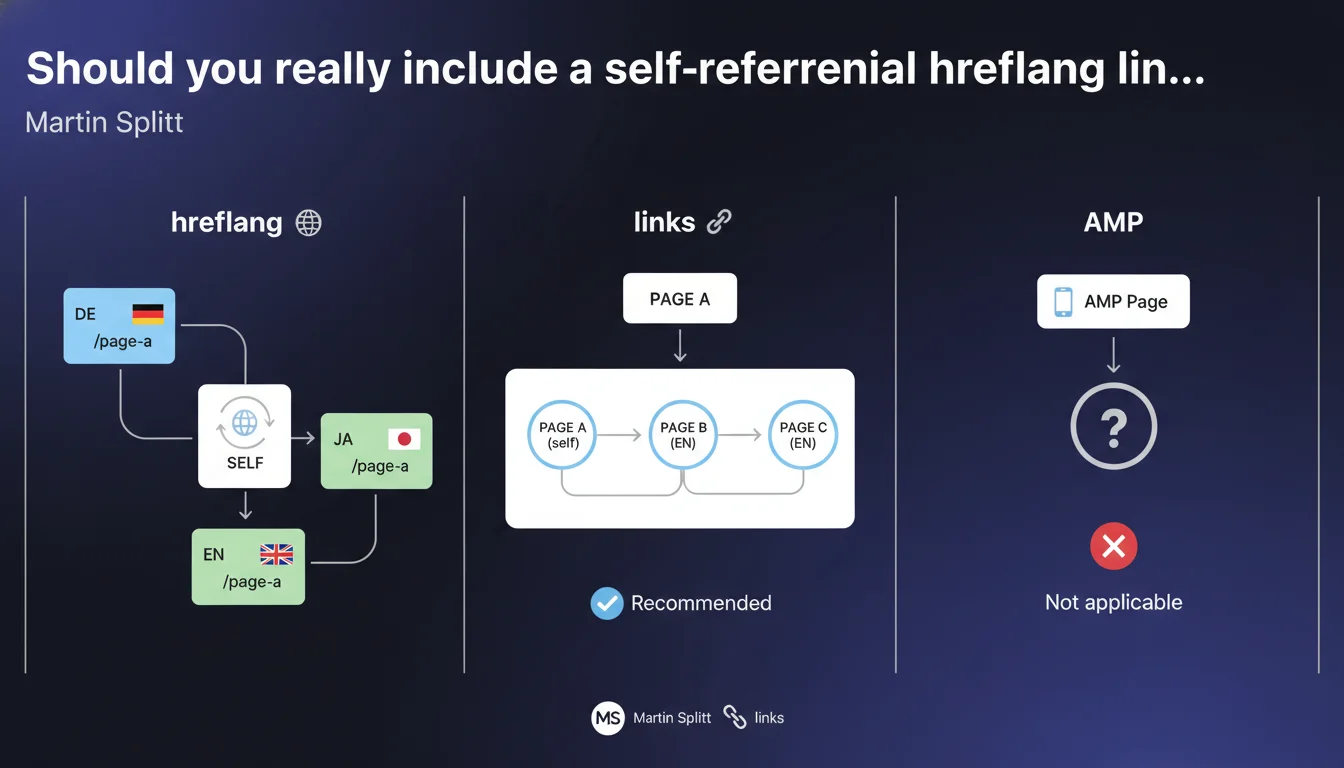
Google recommends including on each page a hreflang link pointing to itself, in addition to links to other language versions. This practice prevents declaration inconsistencies and facilitates hreflang signal processing by crawlers. Concretely: a DE page should reference itself with de-de="self" before pointing to its EN and JA variants.
What you need to understand
Why does Google insist on hreflang self-referencing?
The hreflang system operates on a principle of reciprocity: each page in a language cluster must explicitly declare its relationships with all others. Self-referencing ensures that the page itself appears in its own relationship map.
Without this self-referential link, Google can encounter parsing ambiguities. If the DE page declares only its links to EN and JA, but the EN page does not point back to DE, the engine must arbitrate between contradictory signals. Self-referencing closes this logical loop.
What are the risks of omitting this self-referencing link?
In theory: nothing catastrophic. Google is capable of inferring missing relationships if the rest of the declarations are coherent. In practice, the absence of self-referencing can slow down processing or create fluctuations in cluster interpretation.
The real risk emerges mainly in complex configurations: multi-regional with x-default, partial regional variants (es-ES, es-MX, es-AR), or progressive migrations. The denser the hreflang network, the more self-referencing becomes a structural safeguard.
How does this directive align with other hreflang rules?
It complements three other requirements: strict reciprocity between all pages in the cluster, consistency across the three implementation methods (HTML, HTTP headers, XML sitemap), and declaration of an x-default when a language selection page exists.
Self-referencing is just one brick — but it's the one that closes the system. Without it, the other rules remain applicable but more fragile against declaration errors.
- Each page must reference itself within its hreflang cluster
- This self-referential link uses the same language-region code as the page itself (de-de, en-us, etc.)
- The absence of this link does not block functionality but weakens interpretation
- The principle applies to all three methods: HTML tags, HTTP headers, XML sitemap
- This rule also applies to x-default if it exists
SEO Expert opinion
Is this recommendation universally followed by multilingual websites?
Let's be honest: no. A majority of sites omit the self-referential link, either through lack of knowledge or because automatic generators (WordPress plugins, Shopify modules) don't include it by default. Yet these sites still function.
Google has likely observed enough cases where the absence of self-referencing caused no issues to avoid making it a blocking criterion. This doesn't mean the rule is pointless — it's more of a precautionary principle. Better to apply it than to rely on the engine's tolerance.
In which cases does this rule become truly critical?
Three scenarios where self-referencing makes a difference: progressive migrations (some pages already translated, others not yet), architectures with partial regional variants (not all languages have all regions), and sites with high content volatility (frequent launch/removal of language versions).
In these contexts, the absence of self-referencing can create temporary inconsistencies that Google will struggle to resolve. The engine will eventually converge on the correct interpretation, but with a delay — and during that delay, wrong alternates can be served to wrong users.
Should you fix existing implementations or focus on new projects?
It depends on the site's SEO maturity level. If the current hreflang implementation works correctly (no errors in Search Console, proper language targeting in SERPs), don't touch it. The risk of breaking something by modifying existing code far outweighs the theoretical gain.
Conversely, on a new project or during a redesign, integrating self-referencing from the start costs nothing and constitutes a good defensive practice. It's the kind of detail that prevents hours of debugging when Google reports hreflang errors six months later.
Practical impact and recommendations
How do you concretely implement this self-referential link?
In HTML, add a <link rel="alternate" hreflang="de-de" href="https://example.com/de/page" /> tag in the <head> of your German page — along with links to other versions. The language code must correspond exactly to that of the current page.
Via HTTP headers, include Link: <https://example.com/de/page>; rel="alternate"; hreflang="de-de" in the server response. In XML sitemap, reference the page URL within its own <xhtml:link rel="alternate" hreflang="de-de" href="..." /> block.
What errors should you avoid when adding this link?
First classic mistake: using a different language code in the self-referencing. If your page is declared en-gb elsewhere but you put en-us in the link to itself, you create an inconsistency. The code must be rigorously identical everywhere.
Second trap: forgetting self-referencing on the x-default. If you have a language selection page with hreflang="x-default", it must also reference itself with this code. Last point: don't propagate the modification to only some pages in the cluster — either you do it everywhere or nowhere.
How do you verify that the implementation is correct?
Use Search Console: Experience > International Targeting section. Google reports hreflang errors with sufficient granularity to identify pages without self-referencing (often categorized as "missing return tag").
Supplement with a crawler like Screaming Frog or Oncrawl configured to extract all hreflang links. Export to a spreadsheet, then verify for each URL that its own hreflang appears in its list of alternates. A Python script can automate this verification across thousands of pages.
- Add the self-referential link with the same language-region code as the page
- Apply the modification to all pages in the cluster, not just some
- Include self-referencing in x-default if you use one
- Validate the consistency of hreflang codes across your entire site
- Crawl the site to extract all alternates and verify systematic presence of self-referencing
- Monitor Search Console for potential errors after deployment
❓ Frequently Asked Questions
Le lien hreflang auto-référentiel est-il obligatoire pour que Google comprenne mes alternates ?
Dois-je corriger mes pages existantes qui n'ont pas d'auto-référencement ?
L'auto-référencement s'applique-t-il aussi aux en-têtes HTTP et aux sitemaps XML ?
Que faire si certaines pages de mon cluster n'ont pas encore toutes leurs variantes linguistiques ?
Le x-default doit-il lui aussi inclure un lien vers lui-même ?
🎥 From the same video 8
Other SEO insights extracted from this same Google Search Central video · published on 15/10/2024
🎥 Watch the full video on YouTube →
💬 Comments (0)
Be the first to comment.