
Official statement
Other statements from this video 8 ▾
- □ Domaines locaux, sous-domaines ou sous-répertoires : quelle structure choisir pour un site international ?
- □ Comment implémenter hreflang pour ne plus perdre de trafic international ?
- □ Les codes hreflang mal formatés peuvent-ils vraiment nuire à votre indexation internationale ?
- □ Pourquoi Google exige-t-il que toutes les versions hreflang se lient entre elles ?
- □ Faut-il vraiment inclure un lien hreflang auto-référentiel sur chaque page ?
- □ Faut-il vraiment créer des liens visibles entre versions linguistiques pour le SEO ?
- □ Faut-il bloquer les redirections automatiques par langue sur votre site multilingue ?
- □ Faut-il vraiment limiter le nombre de versions linguistiques de son site pour mieux ranker ?
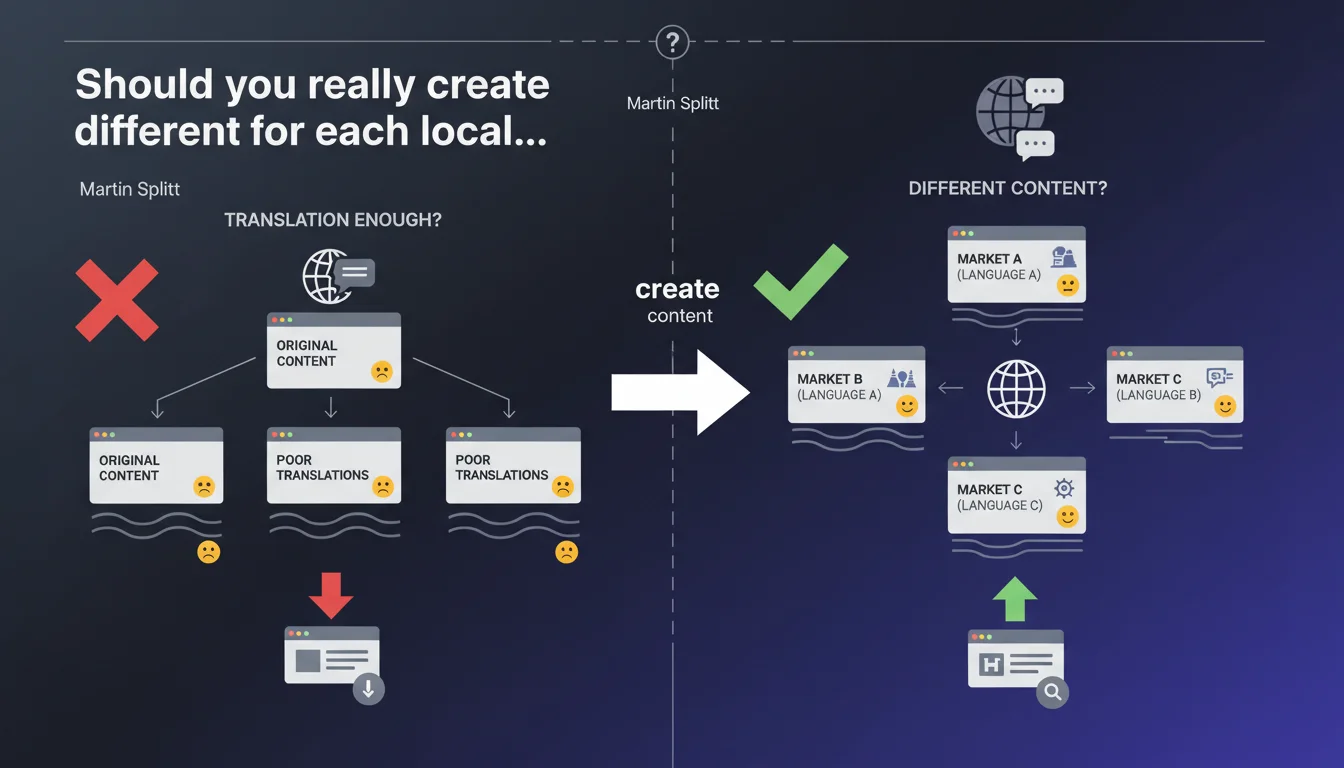
Martin Splitt asserts that Google expects content truly adapted to each local audience, not simple machine translations. User experience must be optimal in each language, with genuine understanding of each market's specific needs. Mere linguistic transposition is no longer sufficient — complete localization strategy is now required.
What you need to understand
Why does Google reject poor translations?
Search engines have evolved: their algorithms now detect the quality of user experience in each language. A page translated word-for-word, without cultural adaptation or consideration of local search intentions, generates negative signals — high bounce rate, low session duration, lack of engagement.
Google measures how users actually interact with content. If a translated page technically answers the query but doesn't resonate with the local audience, it will be penalized in rankings for that specific market.
What does "useful content for each audience" concretely mean?
It's not just about translating, but about recreating the intent of the original content in a different cultural context. An article on "best tax practices for freelancers" cannot simply be translated from English to French — laws, references, and examples must be adapted.
User experience also encompasses technical aspects: date formats, currencies, units of measurement, phone numbers, addresses. Every detail matters so users perceive the content as truly designed for them.
Does Google distinguish between translation and localization?
Yes, and this is exactly what Splitt emphasizes. Translation is a linguistic process, localization is a cultural and strategic process. Google values the latter approach because it produces stronger engagement signals.
Sites that only translate without localizing accumulate misconfigured hreflang tags, duplicated content perceived as low value-added, and mediocre conversion rates that feed the negative algorithm-user feedback loop.
- Translation ≠ localization — Google expects culturally adapted content, not just linguistically translated
- User experience in each language is measured independently via behavioral signals
- Language variations must address specific local search intentions
- Each market has its own references, examples, formats — content must integrate them
- Poorly localized multilingual sites create low value-added content in Google's eyes
SEO Expert opinion
Does this statement reflect real-world observations?
Yes, and it's consistent with Google's evolution toward user experience signals. For several years now, we've observed that high-performing multilingual sites are never those that mechanically translate — they're those that invest in a true localization strategy.
International e-commerce platforms that dominate their local SERPs have understood this: local teams, native writers, product catalog adaptation, even different interfaces depending on markets. Simple translation produces catastrophic ROI.
What are the gray areas of this recommendation?
Splitt remains vague about the minimum adaptation level required. Between "word-for-word translation" and "completely recreate," there's a spectrum — and Google provides no quantified threshold. [To verify]: is quality translation with some cultural adaptations enough, or must 80% of content be rewritten?
Another unclear point: how does Google measure this usefulness for each audience? Via behavioral signals only, or is there linguistic analysis that evaluates localization quality? Splitt doesn't specify, and this is crucial for prioritizing efforts.
In which cases doesn't this rule fully apply?
For highly technical or scientific content, cultural localization has less impact — a mathematical formula remains a mathematical formula. Same for certain product documentation where linguistic precision outweighs cultural adaptation.
Small businesses with limited budgets must make trade-offs. Sometimes 3 perfectly localized languages are better than 15 mediocrely translated ones — but Splitt provides no guidance on these pragmatic compromises.
Practical impact and recommendations
How do you implement a real SEO localization strategy?
First step: audit of search intentions in each target market. Keywords aren't translated — they're searched. What a French user types to find a service may be structurally different from the equivalent English-language query.
Next, build local teams or partners who know the market. A native writer isn't enough — you need someone who understands cultural nuances, popular references, phrasing that builds trust in that country.
Adapt all technical UX elements: formats, currencies, locally accepted payment methods, local phone numbers, physical addresses if relevant. Every technical friction cancels out content localization effort.
What critical mistakes must you absolutely avoid?
Never launch a language version until hreflang is perfectly configured. Hreflang errors on poorly localized multilingual sites create a double penalty: weak content plus technical confusion.
Avoid machine translations even "reviewed" ones — Google detects them better and better. If budget doesn't allow proper localization, it's better to delay launching a language version than to publish content perceived as spam.
Don't duplicate the exact structure from the source site. Each market has its own user journeys, its own navigation priorities — imposing identical architecture everywhere is counterproductive.
How do you verify localization is working?
Analyze behavioral signals by language: bounce rate, session duration, pages per visit. If a language version significantly underperforms others, it's probably a localization problem, not traffic.
Use Search Console to compare organic CTR by country. Low CTR despite decent positions often signals that titles/descriptions don't culturally resonate with local audiences.
- Research search intentions specific to each market, never mechanically translate keywords
- Work with native writers who understand local cultural nuances
- Adapt all technical elements: formats, currencies, contact information, payment methods
- Verify hreflang configuration before any multilingual launch
- Avoid machine translations even if reviewed — invest in original localized content
- Don't duplicate the source site's architecture, adapt structure to each market
- Monitor behavioral signals by language to detect localization issues
- Compare organic CTR by country in Search Console to evaluate cultural relevance
❓ Frequently Asked Questions
Est-ce que Google pénalise directement les traductions automatiques ?
Combien de langues faut-il cibler pour qu'une stratégie multilingue soit rentable ?
La configuration hreflang suffit-elle à indiquer à Google que le contenu est localisé ?
Peut-on localiser progressivement ou faut-il tout adapter dès le lancement ?
Les sites e-commerce doivent-ils adapter leurs fiches produits à chaque marché ?
🎥 From the same video 8
Other SEO insights extracted from this same Google Search Central video · published on 15/10/2024
🎥 Watch the full video on YouTube →
💬 Comments (0)
Be the first to comment.