
Official statement
Other statements from this video 8 ▾
- □ Domaines locaux, sous-domaines ou sous-répertoires : quelle structure choisir pour un site international ?
- □ Comment implémenter hreflang pour ne plus perdre de trafic international ?
- □ Pourquoi Google exige-t-il que toutes les versions hreflang se lient entre elles ?
- □ Faut-il vraiment inclure un lien hreflang auto-référentiel sur chaque page ?
- □ Faut-il vraiment créer des liens visibles entre versions linguistiques pour le SEO ?
- □ Faut-il bloquer les redirections automatiques par langue sur votre site multilingue ?
- □ Faut-il vraiment limiter le nombre de versions linguistiques de son site pour mieux ranker ?
- □ Faut-il vraiment créer du contenu différent pour chaque marché local ou suffit-il de traduire ?
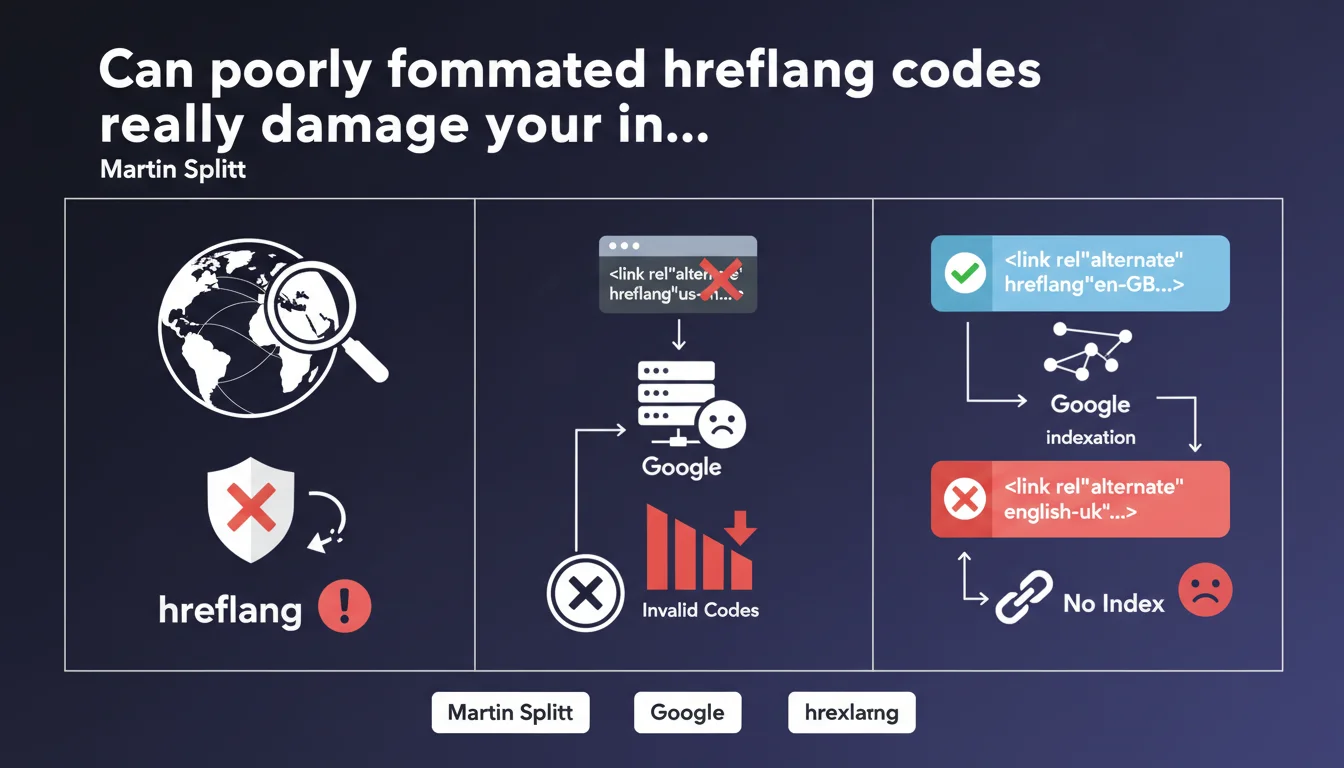
Google requires language-country codes that comply with ISO standards in hreflang attributes to correctly identify your language versions. An incorrectly formatted code (e.g., 'en-UK' instead of 'en-GB') prevents Google from understanding the relationship between your international pages. Without strict validation, your geographic targeting signals fall apart.
What you need to understand
Why does Google insist so much on the validity of hreflang codes?
Hreflang attributes serve to tell Google that a page exists in multiple language or regional versions. The search engine must be able to automatically associate these variants to display the right version to the right user based on their language and location.
The problem: Google doesn't guess. If you use a made-up code like 'en-UK' or 'fr-FRA', the robot simply ignores the attribute entirely. Result? Your British users land on the American version, your French users on generic content. Your international targeting logic collapses.
What exactly are these standards Martin Splitt is talking about?
Google refers to two precise ISO standards: ISO 639-1 for languages (two letters: 'en', 'fr', 'de') and ISO 3166-1 Alpha 2 for countries (two letters as well: 'GB', 'FR', 'US'). The expected format is 'language-COUNTRY' with the country in uppercase.
You can also use the language alone ('fr') without specifying a country if your content targets all French speakers without geographic distinction. But as soon as you're targeting a specific national market, the country code becomes essential.
What actually happens when a code is invalid?
Google silently ignores the malformed hreflang attribute. No visible error in Search Console most of the time — just a signal that isn't taken into account. It's particularly sneaky.
Your international pages end up competing with each other in the SERPs. Google may display the wrong language version, waste your crawl budget exploring variants it can't connect, or accidentally create cannibalization between markets.
- Language-country codes must comply with ISO 639-1 and ISO 3166-1 Alpha 2
- An invalid code is silently ignored by Google — no systematic alert
- Strict format expected: 'language-COUNTRY' with language in lowercase and country in uppercase
- Without valid hreflang, your international versions conflict in search results
- Code validation is a non-negotiable technical prerequisite for any multilingual site
SEO Expert opinion
Is Google's requirement really enforced in practice?
Let's be honest: yes, and it's one of the rare points where Google applies binary logic with no gray area. Invalid code = attribute ignored. No case-by-case handling, no artificial intelligence guessing that 'en-UK' meant 'en-GB'.
I've seen international sites lose 30 to 40% of organic traffic on certain markets because of silly hreflang code errors. The worst part? Technical teams didn't even realize it for months — no red flags in Search Console, just gradual erosion of qualified traffic.
Why do these errors go unnoticed so often?
Because Search Console doesn't systematically surface invalid codes as critical errors. You may see alerts about conflicts between hreflang declarations or orphaned pages, but an 'en-UK' code can remain invisible in your reports for entire quarters.
And that's where it hurts. Teams focus on what Google shows them in red, while real structural issues — malformed codes, missing self-referential tags, non-reciprocal variations — quietly sabotage their international strategy.
Are all multilingual sites affected the same way?
No. If you manage 2-3 language versions on a small site, manual validation remains manageable. But once you exceed 5 markets with hundreds or thousands of pages, implementation becomes an operational nightmare.
Poorly configured CMS platforms regularly generate broken hreflang codes — some WordPress plugins default to 'en-UK', others randomly mix uppercase and lowercase. [To verify]: Google claims to ignore invalid codes, but on massive sites, I've observed erratic behavior where certain pages seem to benefit from temporary tolerance before correction. Nothing officially documented.
Practical impact and recommendations
How do you verify your hreflang codes are compliant?
First step: manually audit a representative sample of your international pages. View source code, locate <link rel="alternate" hreflang="..."> tags and verify each code against official ISO lists.
Use tools like Merkle's hreflang validator or Screaming Frog's internationalization report. These tools detect non-compliant codes, non-reciprocal declarations, and orphaned pages. But be careful — no tool replaces human verification of your geographic targeting business logic.
What are the most common formatting errors to fix?
Error number one: using 'UK' instead of 'GB' for the United Kingdom. Second place: 'en-us' in lowercase instead of 'en-US'. Third: inventing three-letter codes like 'FRA' or 'ENG' that don't exist in ISO 3166-1.
Another classic trap: mixing generic language and country codes inconsistently. For example, declaring 'fr' for France but 'en-CA' for Canadian English — technically valid, but strategically messy if you also have Canadian French content.
What should you concretely do to fix these issues?
First, map your language-country matrix: which markets are you targeting, with which language variations? Document this structure before touching code — otherwise you'll create more problems than you solve.
Then systematically clean your templates, XML sitemaps, and HTTP hreflang tags if you use them. Test on a staging environment, validate with third-party tools, then gradually deploy by market to monitor impact.
- Audit all current hreflang codes with a technical crawler (Screaming Frog, Oncrawl, Botify)
- Verify compliance with ISO 639-1 standards (language) and ISO 3166-1 Alpha 2 (country)
- Fix the most common invalid codes: 'UK' → 'GB', lowercase countries → uppercase
- Ensure reciprocity: each page declared in an hreflang must link back to other versions
- Implement a self-referential page (x-default or default language) to handle uncovered cases
- Document your language-country matrix to avoid future inconsistencies
- Monitor Search Console 'International targeting' reports after deployment
- Set up automated tests to detect any regression during CMS updates
❓ Frequently Asked Questions
Peut-on utiliser uniquement le code langue sans spécifier le pays ?
Google corrige-t-il automatiquement les erreurs mineures dans les codes hreflang ?
Les balises hreflang dans le HTML sont-elles prioritaires sur celles dans le sitemap XML ?
Faut-il déclarer un hreflang x-default en plus des codes langue-pays ?
Combien de temps faut-il à Google pour prendre en compte des corrections de hreflang ?
🎥 From the same video 8
Other SEO insights extracted from this same Google Search Central video · published on 15/10/2024
🎥 Watch the full video on YouTube →
💬 Comments (0)
Be the first to comment.