
Official statement
Other statements from this video 8 ▾
- □ Domaines locaux, sous-domaines ou sous-répertoires : quelle structure choisir pour un site international ?
- □ Comment implémenter hreflang pour ne plus perdre de trafic international ?
- □ Les codes hreflang mal formatés peuvent-ils vraiment nuire à votre indexation internationale ?
- □ Faut-il vraiment inclure un lien hreflang auto-référentiel sur chaque page ?
- □ Faut-il vraiment créer des liens visibles entre versions linguistiques pour le SEO ?
- □ Faut-il bloquer les redirections automatiques par langue sur votre site multilingue ?
- □ Faut-il vraiment limiter le nombre de versions linguistiques de son site pour mieux ranker ?
- □ Faut-il vraiment créer du contenu différent pour chaque marché local ou suffit-il de traduire ?
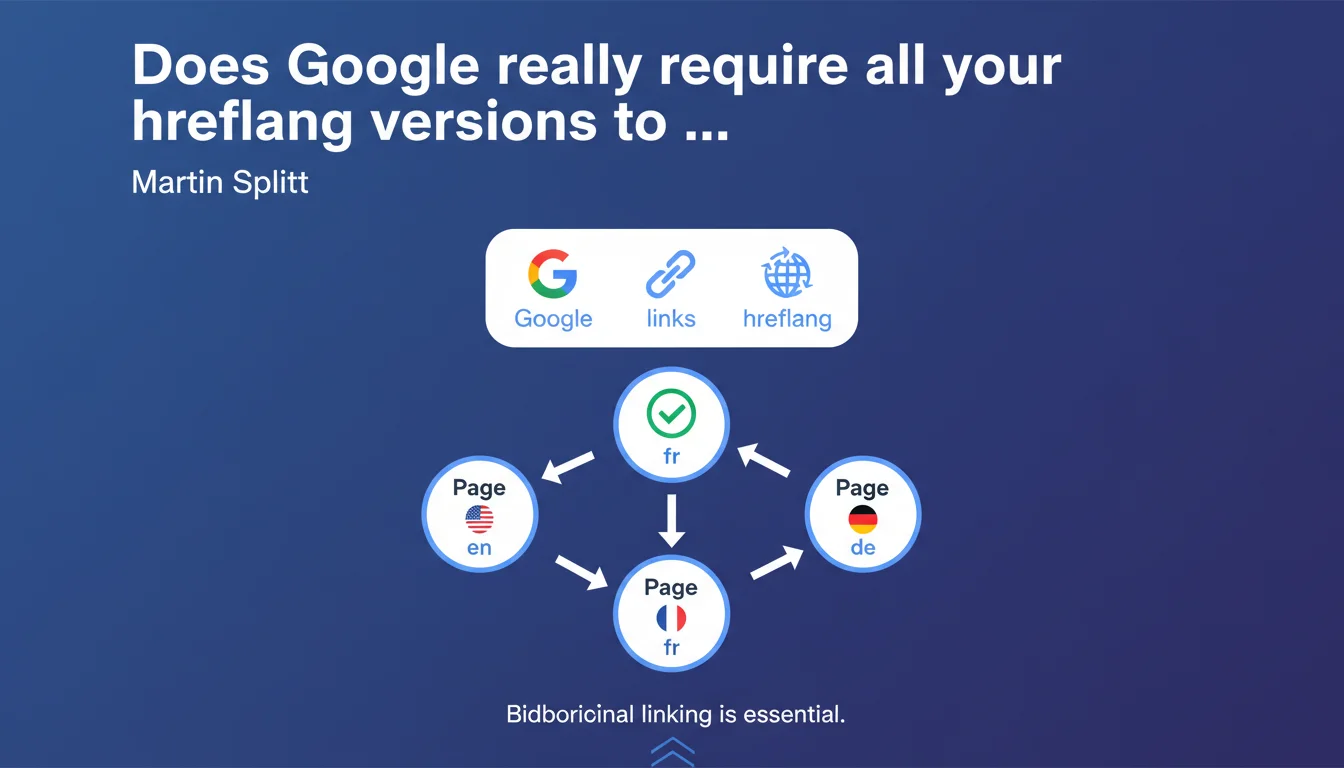
Google confirms that each language version of a page must point to all other versions via hreflang, including pointing to itself. Without this complete bidirectional linking, your hreflang implementation risks failing and Google may ignore your tags entirely. A single missing link in the chain is enough to compromise the entire system.
What you need to understand
What is complete bidirectional linking in hreflang?
Martin Splitt emphasizes a principle that is often misunderstood: each page must declare all its language equivalents, without exception. If you have 5 versions of a page (FR, EN, DE, ES, IT), each one must contain 5 hreflang tags — including a self-reference to itself.
This rule of total reciprocity is not a weak recommendation. It's a technical condition for Google to validate your annotations. A missing link breaks the chain of trust that the search engine establishes between your versions.
Why does Google impose this technical constraint?
The engine uses these cross-signals to verify the consistency of your multilingual structure. If the FR page points to EN, but EN doesn't point back to FR, Google suspects a configuration error and may ignore all the tags.
This bidirectional validation prevents inconsistent declarations where two pages would compete for the same linguistic role. It's a security mechanism against conflicting annotations.
What errors is this declaration designed to correct?
Many sites implement hreflang asymmetrically — often through negligence when progressively adding languages. A new ES version is created, but existing pages (FR, EN, DE) aren't updated to reference it.
Another common mistake: forgetting the self-reference. Some developers think a page doesn't need to point to itself. Wrong. Google expects this tag as explicit confirmation of the canonical URL for that language.
- Mandatory reciprocity: If A points to B, then B must point to A
- Exhaustiveness: All versions must be declared on each page
- Self-reference: Each page must include its own hreflang
- Global consistency: A single missing link can potentially invalidate the entire structure
- Cross-validation: Google verifies the symmetry of declarations across pages
SEO Expert opinion
Is this rule systematically enforced by Google?
In practice, we observe that Google sometimes tolerates partial implementations — especially on large sites where a few links are missing. But this tolerance is neither documented nor guaranteed. [To be verified] to what extent a minor discrepancy actually compromises the entire setup.
What is certain: massive errors (50% of links missing) trigger outright rejection. Google Search Console then reports inconsistencies, but doesn't always specify precisely which page is the problem.
Does implementation via XML sitemap change anything?
Splitt doesn't clarify whether this requirement applies differently depending on the implementation method (HTML, HTTP headers, sitemap). From experience, XML sitemap offers more flexibility for managing global consistency — all relationships are centralized in a single file.
In HTML or HTTP headers, maintaining synchronization becomes a technical nightmare on sites with thousands of pages. A structure change forces you to regenerate or deploy all pages, with risks of temporary inconsistency during gradual rollout.
What if your architecture makes complete linking impossible?
Some CMS or legacy architectures don't easily allow declaring all variants on each page — especially when language versions live on separate databases or distinct domains.
In these cases, hreflang sitemap remains the most reliable fallback solution. It contains less contextual information than a tag in the <head>, but it centralizes the logic and facilitates maintenance. Let's be honest: a consistent sitemap beats 10,000 HTML pages with missing links.
Practical impact and recommendations
How do you audit the reciprocity of your hreflang tags?
Use a crawler (Screaming Frog, Oncrawl, Botify) configured to extract hreflang tags and map the relationships between pages. Then export a cross-tabulation: each row = one page, each column = one expected language. Empty cells reveal missing links.
Google Search Console provides an "International Targeting" report that flags obvious errors, but it remains superficial. It doesn't detect all cases of subtle asymmetry. A complete audit requires exhaustive crawling of all language versions.
What technical errors should you absolutely avoid?
Never deploy a new language without simultaneously updating all existing pages. This creates temporary inconsistency that Google can interpret as a permanent error.
Avoid loops or contradictions: two pages cannot mutually declare themselves as alternatives to each other if they target the same language. Google will reject both. If you use x-default, make sure it points to a real page (often a language selector), not a 404.
Which implementation method should you choose for your situation?
For sites with fewer than 1,000 pages and centralized content management: HTML tags in the <head>. It's the most straightforward and easiest to verify manually.
For large sites, multi-domain or with frequent deployments: dedicated XML sitemap. You generate a relationships file, simpler to maintain and audit than manual editing of thousands of templates.
- Crawl all your language versions to extract hreflang tags
- Verify that each page references all its variants, including itself
- Check symmetry: if A → B, then B → A
- Test implementation on a small subset before global rollout
- Monitor Google Search Console for reported errors
- Document the hreflang logic to facilitate future changes (language additions)
- Automate tag generation through your CMS or build pipeline
❓ Frequently Asked Questions
Dois-je inclure un lien hreflang d'une page vers elle-même ?
Que se passe-t-il si une seule page oublie de pointer vers les autres ?
Le sitemap XML est-il soumis à la même règle de réciprocité ?
Comment Google réagit-il si j'ajoute une nouvelle langue sans mettre à jour les anciennes pages ?
Puis-je utiliser hreflang uniquement sur certaines pages du site ?
🎥 From the same video 8
Other SEO insights extracted from this same Google Search Central video · published on 15/10/2024
🎥 Watch the full video on YouTube →
💬 Comments (0)
Be the first to comment.