
Official statement
Other statements from this video 8 ▾
- □ Local domains, subdomains, or subdirectories: which structure should you choose for an international website?
- □ Are you losing international traffic? Here's how to properly implement hreflang
- □ Can poorly formatted hreflang codes really damage your international indexation?
- □ Does Google really require all your hreflang versions to link to each other bidirectionally?
- □ Should you really include a self-referential hreflang link on every page?
- □ Should you really create visible links between language versions for SEO?
- □ Should you block automatic language-based redirects on your multilingual website?
- □ Should you really create different content for each local market or is translation enough?
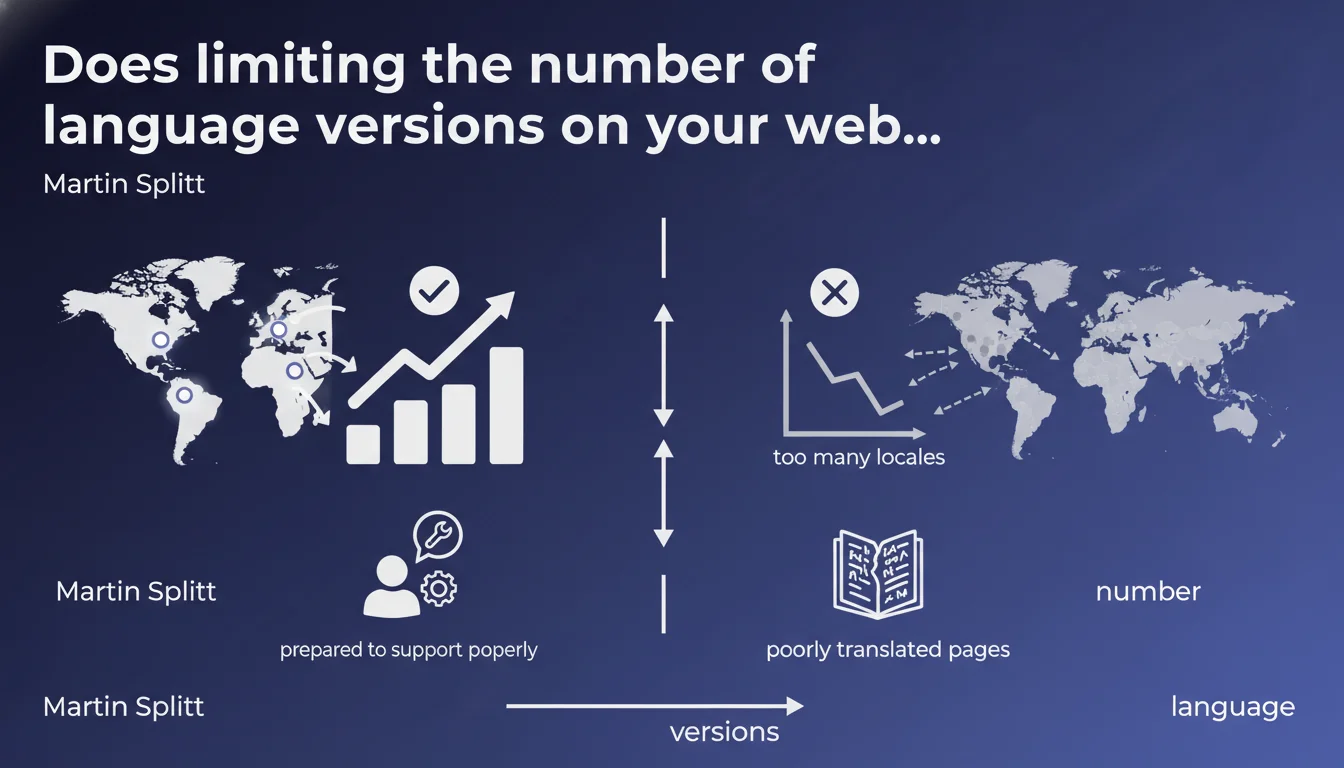
Google recommends prioritizing a few well-targeted markets rather than multiplying poor-quality language versions. Excessive internationalization dilutes resources and harms content quality, which penalizes SEO performance. It's better to concentrate efforts on strategic locales you can genuinely support.
What you need to understand
Why does Google warn against multiplying language versions?
The message from Martin Splitt targets a recurring problem: sites that launch 15 language versions opportunistically, without means or strategy. The result? Auto-translated content, unmaintained pages, degraded user experience.
Google detects these low-quality signals — ridiculous time on site, explosive bounce rates, absence of local backlinks. These versions become deadweight for the entire domain.
What does "properly support" a locale mean according to Google?
It means human resources to manage content, answer local questions, moderate comments. Not just an automatic translation plugin.
You also need to adapt examples, currencies, and cultural references. A Spanish page from Spain doesn't work in Argentina without adjustments. Google values this local relevance.
How does this approach impact crawl budget and indexation?
Multiplying language versions creates hundreds — sometimes thousands — of additional pages. If these pages are mediocre, Googlebot wastes time on them at the expense of priority content.
The risk? Strategic pages poorly crawled, partial indexation, degraded quality signals. Concentration beats dispersion.
- Quality > Quantity : better 3 impeccable locales than 15 rushed ones
- Auto-translations without human review harm ranking
- Each locale must have a content strategy and dedicated resources
- Google penalizes mediocre user experience, regardless of language
- Crawl budget spreads thin across valueless pages
SEO Expert opinion
Is this recommendation aligned with what we observe in the field?
Yes, massively so. Sites that crush it internationally often have fewer language versions than their competitors, but executed much better. Airbnb doesn't translate into 50 languages — they target the markets that matter.
Conversely, we regularly see sites with 20 inactive versions, never updated, with approximate translations. Their overall performance? In free fall. Google doesn't forgive mediocrity deployed at scale.
What nuances should be added to this directive?
Splitt's advice targets SMEs and sites without the resources to match their ambitions. For a major e-commerce giant with local teams in 30 countries, things change — but that's not most players.
Be careful too: limiting languages doesn't mean ignoring emerging markets. If you detect real demand in Polish and can support it, go for it. The trap is launching on speculation without data.
[To verify] Google doesn't provide a precise threshold for defining "mediocre quality." Is human translation without localization enough? Or do you need original content per locale? The boundary remains fuzzy.
In what cases doesn't this rule apply?
If your business model relies on multilingual long tail (e.g., aggregators, comparators, marketplaces), you have no choice. But even then, you need robust industrial processes, not improvisation.
For institutional or B2B sites, the logic differs. Three versions (English, French, German) done well can cover 80% of opportunities in Europe.
Practical impact and recommendations
What should you do concretely if you already have 15 active language versions?
Audit ruthlessly : for each locale, check organic traffic, conversions, bounce rate. If a version generates 0.2% of revenue and no one maintains it, it's a candidate for deletion.
Keep locales where you have true commercial presence, local partners, or significant search volume. Delete or redirect the rest. A 301 to the English version beats a poor Italian page.
What mistakes should you avoid when launching a new language version?
Never launch a locale "just in case." Each new version must be justified by market data (search volume, competition, commercial potential).
Avoid auto-translations without review. Google detects word-for-word translated content patterns — weird syntax, non-idiomatic expressions. It doesn't cut it anymore.
And most importantly: don't launch 5 locales at once if you only have one writer. Realistic scalability or you crash.
- Analyze traffic and conversions by existing locale
- Identify underperforming versions and decide their fate (improvement or removal)
- Validate that each locale has an identified manager and allocated resources
- Implement a translation/localization process with mandatory human review
- Verify proper hreflang tag implementation across retained versions
- Create an editorial calendar specific to each priority locale
- Monitor monthly KPIs (organic traffic, rankings, bounce rate) by language version
- Document cultural specifics and necessary adaptations for each market
❓ Frequently Asked Questions
Combien de versions linguistiques est-ce trop pour un site e-commerce de taille moyenne ?
Peut-on utiliser la traduction automatique si on fait relire par un natif ?
Faut-il supprimer les versions linguistiques qui performent mal ou les améliorer ?
Les balises hreflang sont-elles obligatoires même avec peu de versions linguistiques ?
Google pénalise-t-il directement un site qui a trop de versions linguistiques de faible qualité ?
🎥 From the same video 8
Other SEO insights extracted from this same Google Search Central video · published on 15/10/2024
🎥 Watch the full video on YouTube →
💬 Comments (0)
Be the first to comment.