
Official statement
Other statements from this video 8 ▾
- □ Comment implémenter hreflang pour ne plus perdre de trafic international ?
- □ Les codes hreflang mal formatés peuvent-ils vraiment nuire à votre indexation internationale ?
- □ Pourquoi Google exige-t-il que toutes les versions hreflang se lient entre elles ?
- □ Faut-il vraiment inclure un lien hreflang auto-référentiel sur chaque page ?
- □ Faut-il vraiment créer des liens visibles entre versions linguistiques pour le SEO ?
- □ Faut-il bloquer les redirections automatiques par langue sur votre site multilingue ?
- □ Faut-il vraiment limiter le nombre de versions linguistiques de son site pour mieux ranker ?
- □ Faut-il vraiment créer du contenu différent pour chaque marché local ou suffit-il de traduire ?
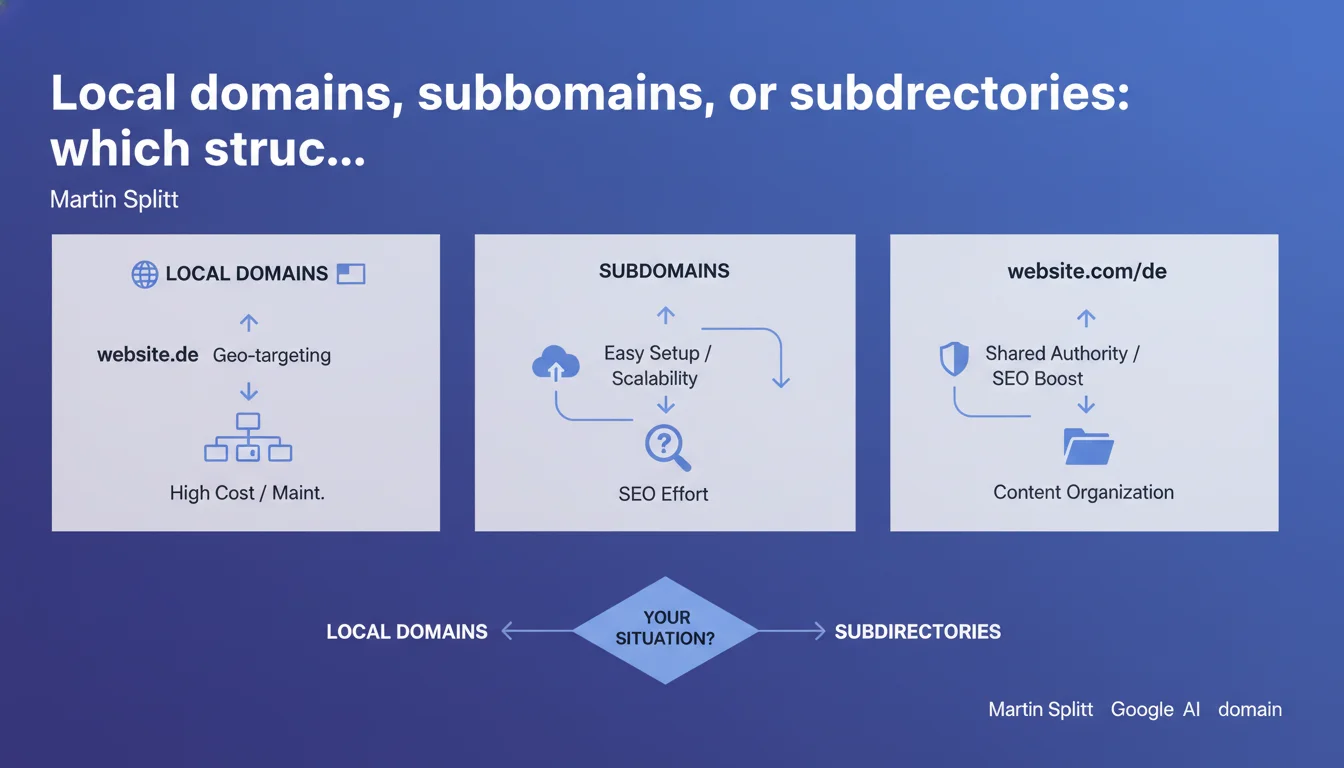
Google won't pick a winner: local country-code domains (.de, .it), subdomains, and subdirectories are all equally valid for international targeting. Your choice depends on technical infrastructure, available resources, and brand strategy. No approach is inherently superior — your specific context dictates the answer.
What you need to understand
Why does Google refuse to designate one structure as the best?
Google's stance is intentionally neutral. Each architecture presents specific technical advantages and operational constraints. A ccTLD (.de, .it) sends a strong geographic signal, but requires managing multiple domain names, each with its own crawl budget and domain authority.
A subdomain (fr.site.com) enables clean segmentation while pooling the main domain. A subdirectory (site.com/fr/) concentrates authority on a single domain — but potentially mixes geographic signals if the structure isn't clear.
What technical criteria influence this choice?
The ability to implement hreflang correctly is critical. With ccTLDs, implementation is usually simpler since each country has its own domain. With subdirectories, implementation can become cumbersome when you multiply language versions.
Server performance also matters. Hosting ccTLDs on local servers improves speed for users in that country. With subdomains or subdirectories, you typically depend on a centralized server — unless you use a CDN that largely compensates for this disadvantage.
Does geographic targeting in Search Console change the game?
With a gTLD (.com) and subdirectories or subdomains, you must manually set geographic targeting in Search Console. A ccTLD sends this signal automatically — that's an advantage, but also a constraint: it's difficult to target multiple countries with a single ccTLD.
Some markets require local presence for user trust reasons. In Germany or Japan, a .de or .jp often inspires more credibility than a .com. This isn't a direct SEO criterion, but the impact on click-through rates can be real.
- ccTLD: strong geographic signal, separate authority by country, complex DNS management
- Subdomains: clear segmentation, distinct crawl budgets, partial authority pooling
- Subdirectories: concentrated authority on one domain, potentially complex hreflang, centralized server unless CDN is used
- No structure is inherently better — operational context takes priority
SEO Expert opinion
Does Google's neutrality mask implicit preferences?
Let's be honest: Google says everything is equal, but real-world observations show that ccTLDs dominate local SERPs in certain countries. In Germany, Switzerland, or Austria, .de, .ch, .at domains carry considerable weight. Is this purely due to the geographic signal, or a hidden algorithmic preference? [Needs verification]
In other markets — especially English-speaking ones — .com domains with subdirectories rank first without difficulty. The reality is that consistency of implementation (hreflang, Search Console targeting, hosting) matters more than the structure chosen.
What are the pitfalls Google doesn't mention?
Google omits a critical point: managing migrations. Switching from one structure to another — for example from ccTLD to subdirectories — is a massive undertaking with significant traffic loss risks. Once your architecture is chosen, you're locked in for years.
Another deafening silence: the implications for crawl budget. With ccTLDs, each domain has its own budget. With subdomains, Google can theoretically treat them separately — but nothing is guaranteed. Subdirectories share a single budget: if your site has 50,000 pages across 10 languages, the crawler must prioritize. This is not trivial.
When does this recommendation not apply?
If your brand is global and uniform (like B2B SaaS), a .com with subdirectories is often more sensible. If you're targeting markets with strong localization requirements (physical e-commerce, local services), ccTLDs can make a difference.
The problem is that Google provides no metrics to settle the question. No data on the real impact of ccTLDs vs. subdirectories in local SERPs. You're navigating blind, relying on observed correlations — not established causality.
Practical impact and recommendations
What should you do concretely to choose the right structure?
First, audit your technical resources. Do you have the capacity to manage multiple domains, multiple hosting environments, multiple DNS configurations? If not, subdirectories are probably more realistic. If yes, ask yourself: does your brand strategy benefit from strengthened local presence?
Next, analyze the content volume per country. If certain markets represent only tens of pages, creating a dedicated ccTLD is overkill. A subdirectory is enough. Conversely, if you have 10,000 pages per country, ccTLDs or subdomains allow better segmentation of authority and crawl.
What mistakes should you absolutely avoid?
Never mix structures. Some sites combine ccTLD for Germany, subdomain for France, and subdirectory for Spain. Result: complete inconsistency that confuses Google and dilutes authority. Choose a logic and apply it everywhere.
Another classic pitfall: neglecting hreflang. Whatever structure you choose, if your hreflang tags are poorly implemented (missing URLs, loops, language/region errors), you lose most of the benefit from international targeting. Test with Search Console, fix errors before scaling.
How do you verify your configuration is optimal?
- Check geographic targeting in Search Console for each subdomain or ccTLD
- Audit hreflang tags: each page must reference all its language variants, including itself
- Verify that XML sitemaps are properly segmented by language/region and submitted correctly
- Test loading speed from targeted countries: a CDN can offset centralized hosting
- Monitor server logs to identify any crawl disparities between language versions
- Ensure that local backlinks point to the correct version (ccTLD, subdomain, or subdirectory)
❓ Frequently Asked Questions
Un ccTLD est-il automatiquement mieux classé dans les recherches locales ?
Peut-on mélanger ccTLD et sous-répertoires selon les pays ?
Les sous-domaines sont-ils traités comme des sites distincts par Google ?
Faut-il héberger chaque ccTLD dans son pays respectif ?
Quelle structure privilégier pour un SaaS international B2B ?
🎥 From the same video 8
Other SEO insights extracted from this same Google Search Central video · published on 15/10/2024
🎥 Watch the full video on YouTube →
💬 Comments (0)
Be the first to comment.