
Official statement
Other statements from this video 5 ▾
- □ Do you really need to master web development to succeed in SEO?
- □ Does Google really prioritize user experience over everything else in its ranking algorithm?
- □ Is cutting back on JavaScript really the secret to better SEO performance?
- □ Why is applying the same SEO recommendations to every website a strategic mistake?
- □ Is your crawl budget being wasted on plugin-generated URLs you don't need?
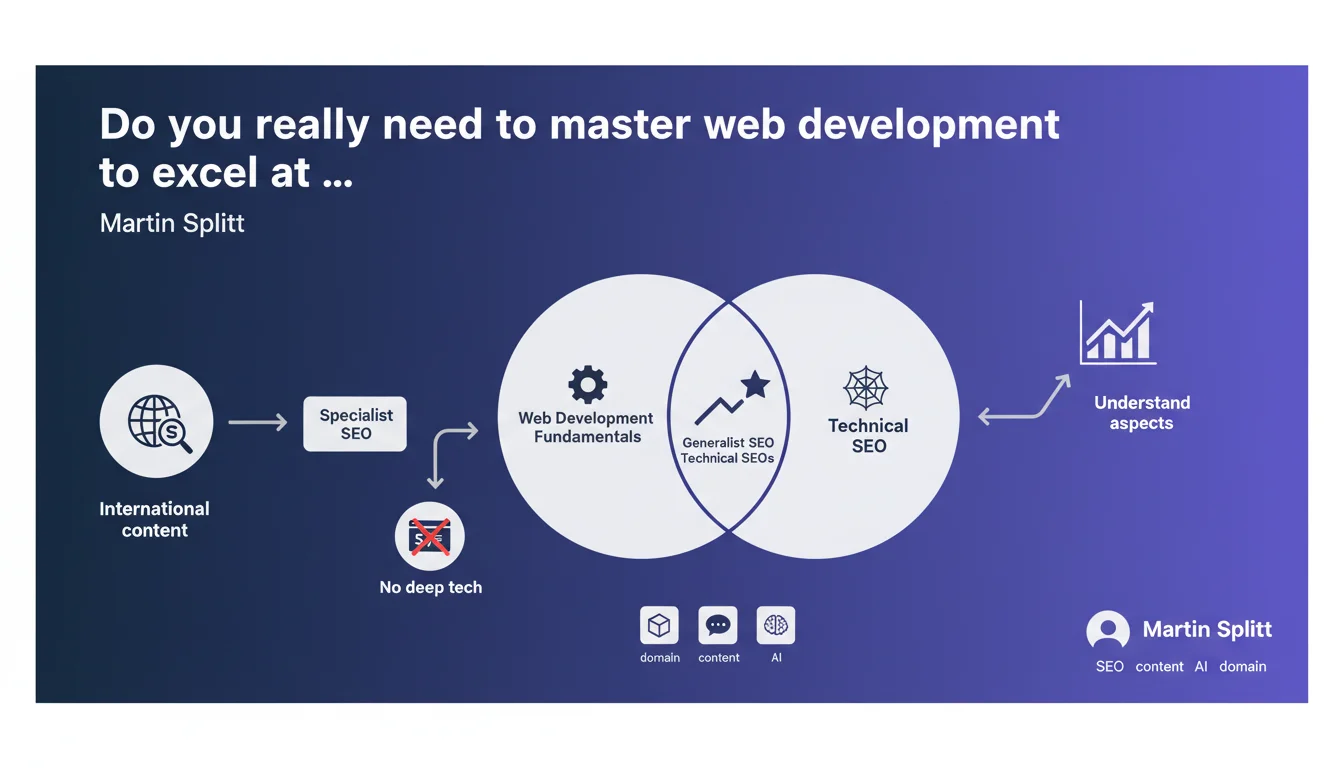
Martin Splitt argues that technical and generalist SEOs should understand web development aspects, unlike niche specialists such as international content experts. The line between SEO and development is blurring — but how far should you push this skill?
What you need to understand
Why is Google now linking technical SEO and web development together?
The statement from Martin Splitt is not trivial. It reflects a ground reality: modern SEO levers directly touch the technical infrastructure of websites. Client-side JavaScript, Core Web Vitals, dynamic rendering, crawl budget management via HTTP headers — all these topics require understanding how code and servers work.
Google isn't saying you need to become a full-stack developer. But a technical SEO who doesn't understand the difference between SSR and CSR rendering, or who ignores what poorly configured lazy loading means, risks missing critical blockers.
Do specialized SEOs escape this requirement?
Splitt makes a distinction: certain domains like international content or editorial SEO can focus on other skills. An expert in hreflang or editorial strategy doesn't necessarily need to debug JavaScript.
But this distinction raises questions. Even a content specialist can run into indexation issues caused by improper technical implementation of hreflang tags. The boundary is porous.
- Technical and generalist SEO: web development knowledge is essential
- Specialized niches (international, editorial): less critical, but useful for identifying blockers
- Understanding ≠ coding: it's about knowing how to diagnose, not necessarily implementing yourself
- Key topics: JS rendering, web performance, server architecture, resource management
SEO Expert opinion
Is this statement consistent with practices observed in the field?
Yes, absolutely. Technical SEO audits increasingly resemble application performance audits. You spend as much time in the network console as in Screaming Frog. Complex projects — JavaScript framework sites, e-commerce platforms with dynamic rendering — require critical reading of source code.
SEOs who stay confined to title tags and meta descriptions struggle to add value on modern projects. [To be verified]: Google doesn't specify exactly what level of competency is needed. Knowing how to read code? Understanding architecture? Being able to patch a bug?
What nuances should be added to this statement?
Let's be honest — this statement can be interpreted as a broadening of the expected scope for an SEO, which actually suits Google well. The more technically competent SEOs are, the fewer absurd support tickets Google has to manage.
But there's a trap: trying to master everything leads to scattered focus. An excellent technical SEO knows how to diagnose a JavaScript rendering problem and collaborate effectively with a developer to solve it. They don't need to code the solution themselves.
In what cases doesn't this rule really apply?
For strategy consultants, pure link-building specialists, or editorial optimization experts, dev skills remain secondary. A link-building expert who negotiates with publishers doesn't need to debug JavaScript.
Same goes for SEOs working on heavily templated CMSs (WordPress with builders) where technical infrastructure is already optimized. Their playing field is elsewhere.
Practical impact and recommendations
What should you do concretely to develop these skills?
Start with web fundamentals: understanding how HTML, CSS, and the DOM work. No need to become a developer — just know how to read a page source and identify anomalies.
Get comfortable with browser developer tools: the Network tab to analyze requests, the Performance tab to diagnose slowdowns, the JavaScript console to spot errors.
Learn the basics of client-side vs server-side rendering. You should be able to explain why a pure React site can cause indexation issues, and what technical alternative to suggest (SSR, pre-rendering, hydration).
What mistakes should you avoid if you don't have a technical background?
Don't play developer if you don't know what you're doing. An SEO who modifies code directly without understanding the implications can break a live site. Diagnose, prioritize, then hand off the implementation.
Avoid vague technical recommendations like "improve site speed". Be specific: "The main.js file is 2.3 MB unminified and blocks initial render — it needs to be split and non-critical modules lazy-loaded."
- Learn to read basic HTML, CSS, and JavaScript code
- Master browser DevTools (Network, Performance, Console)
- Understand the differences between SSR, CSR, SSG, and hydration
- Know how to diagnose JS rendering and indexation issues
- Collaborate effectively with developers: speak their language, provide precise specs
- Keep learning continuously: frameworks evolve fast (Next.js, Nuxt, Astro...)
❓ Frequently Asked Questions
Un SEO technique doit-il savoir coder lui-même ?
Quels langages web un SEO technique doit-il connaître en priorité ?
Cette exigence s'applique-t-elle aussi aux consultants SEO freelance ?
Comment vérifier qu'un site rendu en JavaScript est bien indexable par Google ?
Faut-il maîtriser les frameworks JavaScript comme React ou Vue.js ?
🎥 From the same video 5
Other SEO insights extracted from this same Google Search Central video · published on 12/06/2025
🎥 Watch the full video on YouTube →
💬 Comments (0)
Be the first to comment.