
Official statement
Other statements from this video 5 ▾
- □ Do you really need to master web development to succeed in SEO?
- □ Do you really need to master web development to excel at technical SEO?
- □ Is cutting back on JavaScript really the secret to better SEO performance?
- □ Why is applying the same SEO recommendations to every website a strategic mistake?
- □ Is your crawl budget being wasted on plugin-generated URLs you don't need?
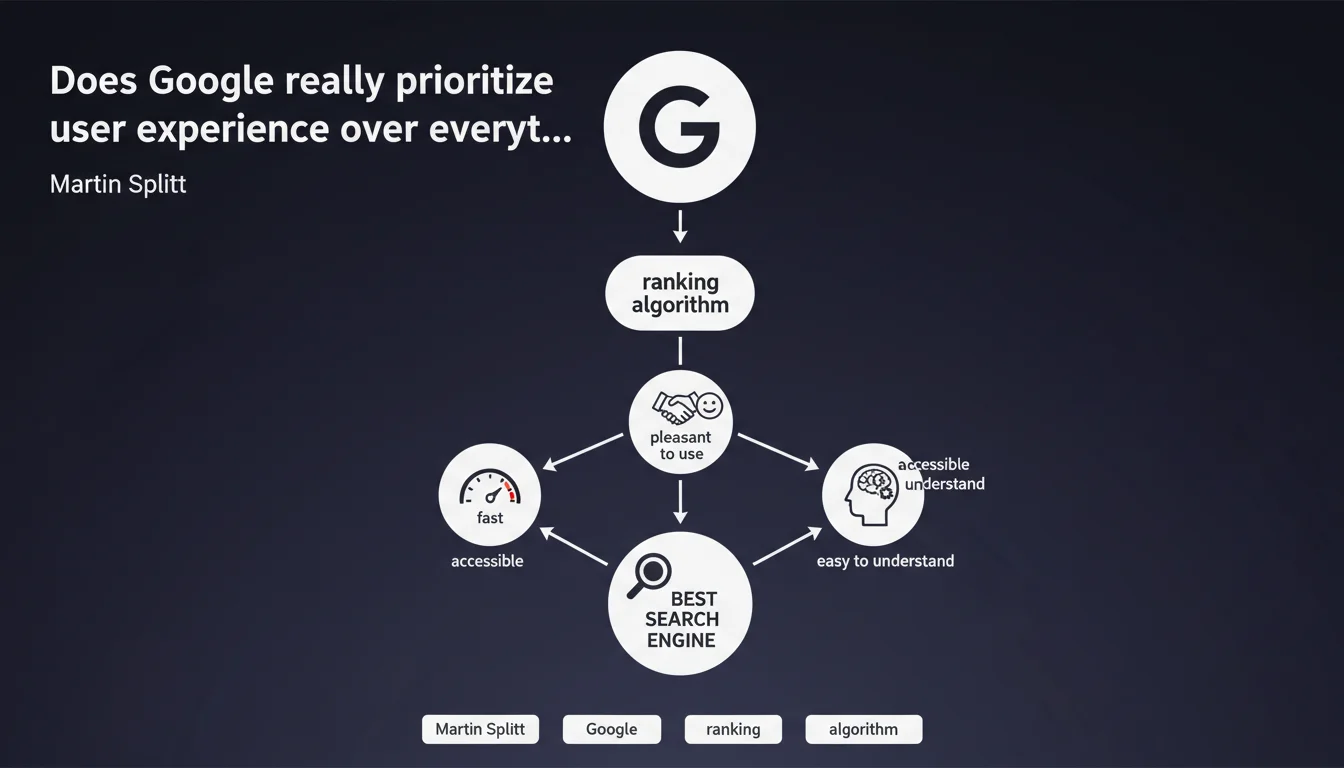
Martin Splitt reminds us that Google's agenda as a search engine is built on a web that is accessible, fast, and pleasant to use. This is a restatement of official doctrine: Google optimizes for the end user, not for publishers. Practical translation: aligning your objectives with UX remains the royal road to ranking.
What you need to understand
What's the business logic behind this statement?
Google builds a search engine, not a philanthropic platform. Its value depends on the satisfaction of users who click on its results.
If the web becomes slow, inaccessible, or painful to use, users will abandon Google for faster, smoother alternatives. The company therefore has a direct economic interest in pushing publishers toward high quality standards.
How does this doctrine translate into ranking signals?
Google has progressively integrated Core Web Vitals (LCP, CLS, INP), mobile-first indexing, and penalties for non-HTTPS sites. These signals are far from trivial: they directly measure speed, visual stability, and interactivity.
Accessibility — though rarely mentioned as a direct ranking factor — indirectly influences rankings through bounce rate, time on page, and Googlebot's ability to crawl an efficient HTML structure effectively.
What does "pleasant to use" mean in measurable terms?
This is the most subjective part of the statement. Google never clearly defines what makes a site "pleasant" beyond technical metrics.
In practice, this overlaps with behavioral signals: click-through rate from SERPs, session duration, return rate. But Google remains vague about their exact weighting — leaving room for interpretation. [To be verified]
- Google optimizes for its own survival: quality web = loyal users
- Core Web Vitals are the technical translation of this doctrine
- Accessibility indirectly influences ranking through UX and crawl efficiency
- The concept of "pleasant" remains deliberately vague
SEO Expert opinion
Is this statement consistent with what we observe in practice?
Overall, yes. Fast, well-structured, and accessible sites tend to perform better in SERPs. But reality is more nuanced than what Splitt suggests.
We regularly observe slow sites, filled with intrusive ads, that dominate commercial queries thanks to overwhelming domain authority and a massive backlink profile. Speed and UX don't always compensate for a backlink deficit.
What are the limitations of this Google agenda?
Google wants an "accessible" web — yet deploys technologies like JavaScript rendering that create barriers for low-budget technical sites. The irony is glaring.
Mobile-first indexing penalized high-performing desktop sites that lacked the resources to overhaul their mobile version. Accessibility, sure — but mainly for those who can afford competent front-end developers.
In what cases doesn't this rule really apply?
On ultra-competitive transactional queries ("car insurance", "home mortgage"), Core Web Vitals are a minor factor compared to the weight of backlinks from government or major news sites.
Niche sites with a captive audience can afford middling UX if their content is unique. Google won't demote an essential specialized forum just because it loads in 4 seconds.
Practical impact and recommendations
What concretely should you do to align your site with this agenda?
Start with a technical audit focused on Core Web Vitals via Google Search Console and PageSpeed Insights. Identify critical pages (landing pages, product pages) and prioritize optimizations where ROI is highest.
Run your HTML through the W3C validator and check semantic structure: alt tags on images, coherent heading hierarchy, explicit form labels. A Googlebot that understands your page better will crawl it more efficiently.
What mistakes should you avoid at all costs?
Don't sacrifice content depth on the altar of speed. Compressing your images excessively or removing useful sections to gain 0.2 seconds on LCP is counterproductive if it destroys engagement.
Also avoid the "mobile-only" trap: some sites remove essential desktop features to simplify their mobile version. Google indexes mobile, but desktop users still exist.
How can you verify your site respects these principles?
- Run a Lighthouse audit on your 10 most strategic pages
- Check your Core Web Vitals in Google Search Console ("Web Vitals" section)
- Test your site with a screen reader (NVDA or JAWS) to spot accessibility issues
- Analyze real loading time via a tool like WebPageTest from different locations
- Compare your UX metrics (bounce rate, session duration) with competitors via SimilarWeb or industry benchmarks
- Audit your JavaScript: identify third-party scripts blocking render and assess their necessity
❓ Frequently Asked Questions
Les Core Web Vitals sont-ils un facteur de ranking direct ou indirect ?
Un site lent mais autoritaire peut-il quand même bien ranker ?
L'accessibilité (WCAG) influence-t-elle directement le SEO ?
Faut-il prioriser la vitesse ou la profondeur du contenu ?
Google pénalise-t-il activement les sites lents ?
🎥 From the same video 5
Other SEO insights extracted from this same Google Search Central video · published on 12/06/2025
🎥 Watch the full video on YouTube →
💬 Comments (0)
Be the first to comment.