
Official statement
Other statements from this video 5 ▾
- □ Faut-il vraiment maîtriser le développement web pour faire du SEO ?
- □ Faut-il vraiment maîtriser le développement web pour faire du SEO technique ?
- □ Pourquoi Google insiste-t-il autant sur l'accessibilité, la vitesse et l'expérience utilisateur du web ?
- □ Faut-il vraiment éviter JavaScript pour améliorer ses performances SEO ?
- □ Pourquoi l'ajout massif d'URLs peut-il paralyser votre budget de crawl ?
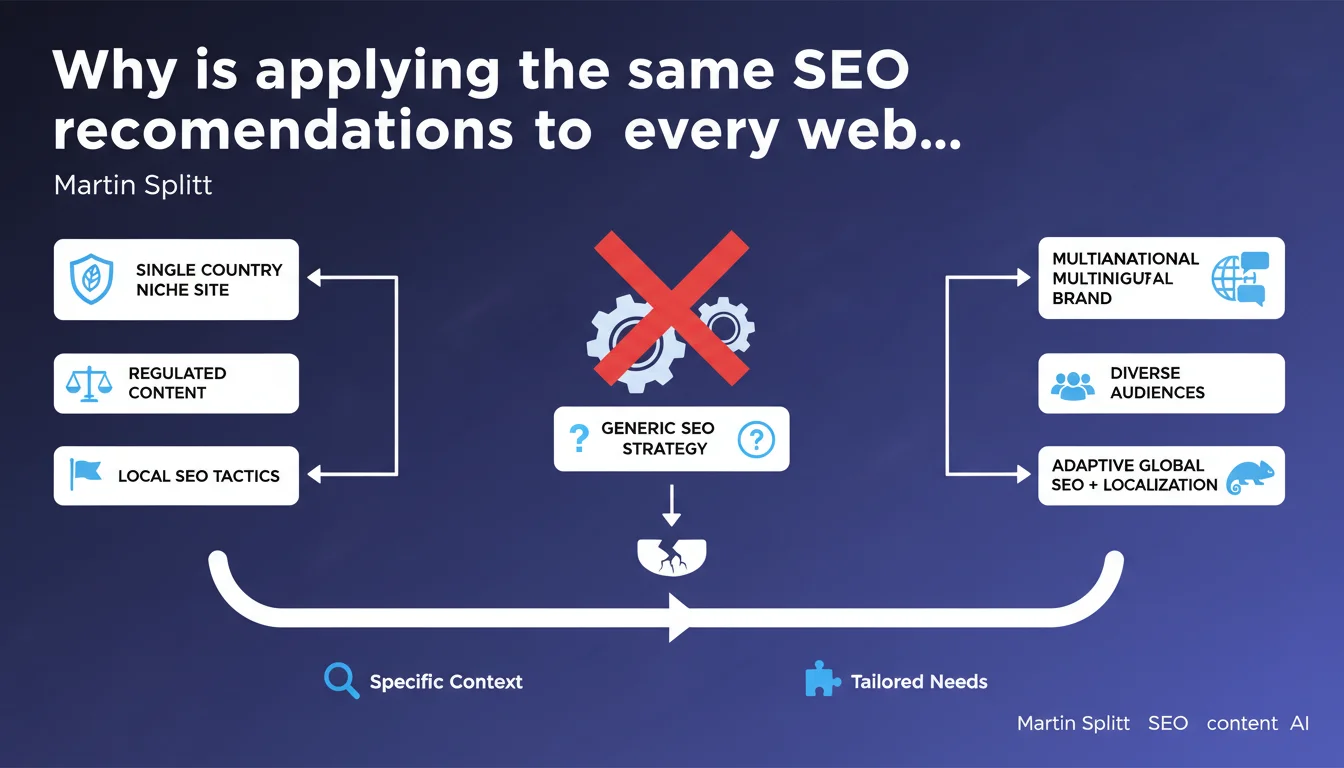
Google confirms that SEO recommendations cannot be standardized — a regulated niche site is worlds apart from an international brand. Context dictates strategy: country, language, industry, legal constraints. Copy-pasting "best practices" without prior analysis is a recipe for disaster.
What you need to understand
Why does Google insist on the contextual dimension of SEO?
Because the algorithm doesn't treat all sites the same way. A medical site subject to strict regulations (YMYL-type) is evaluated with far more demanding criteria than a lifestyle blog. A pure-play multilingual e-commerce player faces technical issues (hreflang, inventory management, duplication) that are completely absent from a local brochure site.
Splitt's statement is primarily aimed at discouraging the mechanical application of generic checklists. What works for Amazon won't work for a small Breton craft shop — and vice versa.
What contextual factors really influence SEO strategy?
Industry sector determines the level of EAT requirements, sensitivity to algorithmic penalties, and SERP competition. A pharmaceutical site must prove its expertise differently than a recipe website.
Geography and language impose technical constraints: multilingual management, geographic targeting via Search Console, cultural content adaptations. A French-only site doesn't need hreflang. A site active in 30 countries can't get by without it.
Business model conditions priorities: a media outlet seeks massive traffic on informational keywords, an e-commerce business optimizes transactional product pages, a B2B SaaS targets ultra-qualified queries with low volume.
- The regulatory environment shapes content production (health, finance, legal require editorial safeguards)
- Technical architecture varies dramatically: a Shopify site doesn't have the same levers as a custom-built site
- The site's SEO maturity level — a brand new site vs. one established for 10 years don't have the same optimization priorities
- Available resources (budget, team, tech expertise) dictate what's realistic in the short term
What's the real message behind this statement?
Caution against "template" SEO audits where the same recommendations come out regardless of context. Google is implicitly pushing for a diagnostic approach: understand the site first, its market, its constraints — then and only then define the roadmap.
It's also a reminder that SEO is not an exact science. Universal "rules" exist (load time, mobile-first, quality content), but their concrete application depends entirely on the ground reality.
SEO Expert opinion
Is this contextual approach really new?
No. Any serious practitioner has been adapting recommendations accordingly for years. What's interesting is that Google is verbalizing it officially — probably to counter the proliferation of "miracle methods" being sold as turnkey solutions.
But let's be honest: this statement remains vague. Splitt provides no concrete examples of how approaches should differ based on context. How does Google evaluate a regulated niche site differently? Which signals carry more weight? [To be verified] — we have no hard data on these weighting mechanisms.
What nuances should we add to this statement?
Some fundamentals remain universal regardless of context: content accessibility for Googlebot, clean HTML structure, HTTPS, absence of massive duplicate content. Claiming that "everything depends" can serve as an excuse for ignoring the basics.
Another point: context evolves. A niche site can go international, a single-product site can diversify its catalog. SEO strategy must remain flexible — what was relevant 6 months ago can become obsolete after a business pivot.
Finally, be cautious about "vastly different needs." Yes, priorities change. No, that doesn't mean a local site can ignore Search Console or a multilingual site can skimp on content quality. The levers differ, not the quality requirement.
In what cases does this contextual logic reach its limits?
When it becomes an excuse to justify anything. I've seen agencies defend technically catastrophic sites by invoking "the client's specific context." No way. A site with 80% 404 errors, exploded crawl budget, and zero proper title tags is a problem — regardless of context.
Practical impact and recommendations
What should you concretely do before any SEO optimization?
Map out the context: what industry? What geography? What legal constraints? What business model? What technical resources available? Answering these questions conditions everything that follows.
Next, prioritize. A multilingual international e-commerce site with hreflang and cannibalization issues must address that before optimizing meta descriptions. A local single-language site should first secure its Google Business Profile and local citations.
What mistakes should you avoid when dealing with this contextual logic?
Don't fall into paralysing over-customization. Yes, every site is unique — but certain patterns repeat. Leveraging experience from similar cases remains valuable, as long as you validate hypotheses on your own site.
Also avoid neglecting data. Context is good — but numbers decide. If a standard optimization (improving Core Web Vitals, enriching content) shows measurable results, it doesn't matter that it's "generic."
Last trap: believing an SEO audit from 2 years ago still holds. Context shifts: algorithm updates, market evolution, CMS changes. Reassess regularly.
How can you ensure your SEO strategy truly fits the context?
- Document in writing: industry, geographic targets, languages, legal constraints, tech stack
- Identify 3-5 direct competitors and analyze their SEO approach — what actually works in this specific context?
- List universal quick wins (obvious technical fixes) vs. heavy-lift initiatives specific to your situation (e.g., multilingual overhaul)
- Prioritize by expected ROI and feasibility — not by a generic checklist
- Test, measure, adjust — contextual SEO is iterative, not fixed
- Validate that each recommendation serves a clear business objective (traffic, conversions, awareness)
Contextualizing SEO is not optional — it's a strategic necessity. Adapting priorities based on industry, geography, resources, and business goals helps avoid wasting time on pointless optimizations.
In practice: start with thorough diagnosis, prioritize actions, measure impact, adjust continuously. These optimizations can be complex to orchestrate alone, especially on multilingual sites or those subject to strict regulatory constraints. Working with a specialized SEO agency lets you benefit from proven industry expertise and personalized guidance to navigate these specifics — without spinning your wheels on dead ends.
❓ Frequently Asked Questions
Un site local a-t-il vraiment besoin d'une stratégie SEO différente d'un site international ?
Les fondamentaux SEO restent-ils valables quel que soit le contexte ?
Comment identifier les optimisations SEO prioritaires pour mon contexte spécifique ?
Les audits SEO génériques sont-ils devenus inutiles ?
Faut-il réévaluer sa stratégie SEO régulièrement même si le site ne change pas ?
🎥 From the same video 5
Other SEO insights extracted from this same Google Search Central video · published on 12/06/2025
🎥 Watch the full video on YouTube →
💬 Comments (0)
Be the first to comment.