
Official statement
Other statements from this video 8 ▾
- □ Local domains, subdomains, or subdirectories: which structure should you choose for an international website?
- □ Are you losing international traffic? Here's how to properly implement hreflang
- □ Can poorly formatted hreflang codes really damage your international indexation?
- □ Does Google really require all your hreflang versions to link to each other bidirectionally?
- □ Should you really include a self-referential hreflang link on every page?
- □ Should you block automatic language-based redirects on your multilingual website?
- □ Does limiting the number of language versions on your website really help you rank better?
- □ Should you really create different content for each local market or is translation enough?
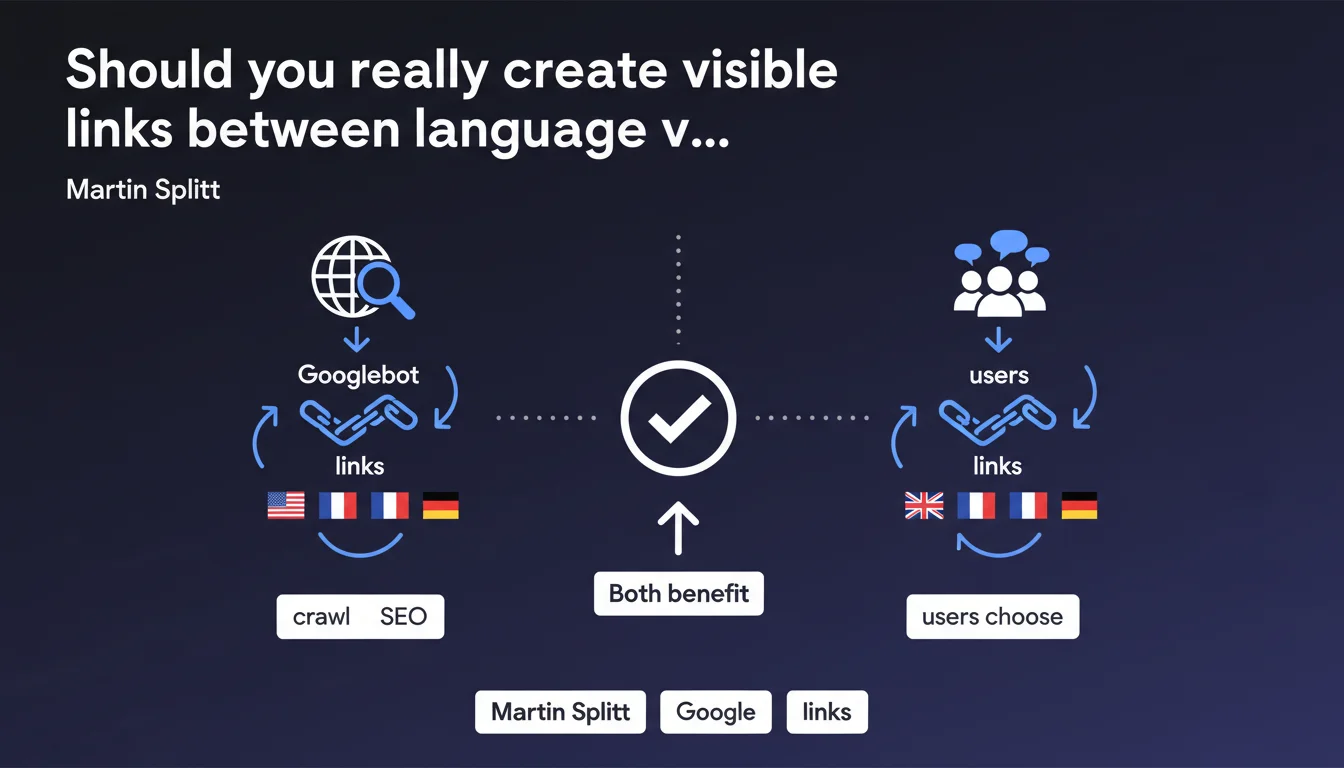
Google recommends displaying visible links to different language versions of a website, not only for user experience but also to facilitate Googlebot crawling. This approach complements hreflang tags by enabling active discovery of variants by the search bot. In practice, a visible language selector improves detection of alternative versions.
What you need to understand
Why does Google insist on the visibility of language links?
Martin Splitt points out a frequent gap in multilingual implementation: relying solely on hreflang tags. While these annotations theoretically indicate relationships between versions, they don't guarantee that Googlebot discovers all variants.
By creating visible HTML links between language versions, you provide a direct crawl path. The bot follows these links like any other internal link, ensuring exhaustive discovery even if hreflang tags have errors or are incomplete.
What counts as a "visible" link in this context?
A visible link means accessible in the standard HTML DOM, not hidden behind complex JavaScript or generated only client-side after user interaction. A simple language selector in the header or footer is sufficient.
The goal isn't to impose heavy UX, but to ensure that each language version contains clickable HTML anchors to its alternatives. Even if discreet, these anchors must exist in the source code.
How does this concretely help crawling?
Googlebot discovers URLs through several mechanisms: sitemaps, internal links, backlinks, declaration files like hreflang. By adding standard internal links between versions, you multiply entry points.
If a language version appears neither in the sitemap nor via external backlinks, these internal links become the only reliable way to get it indexed. This is a reassuring redundancy that compensates for frequent implementation errors on multilingual sites.
- Double your signals: hreflang + visible HTML links to maximize discovery
- Facilitate crawling: Googlebot follows internal links, even if annotations are defective
- Improve UX: a visible selector also meets the real needs of visitors
- Avoid isolation: each version should point to its alternatives, not just from the homepage
SEO Expert opinion
Does this recommendation reveal a weakness in hreflang tags?
Let's be honest — if Google insists on visible links, it's because hreflang implementations are massively flawed. Reciprocity errors, incomplete chains, incorrect language codes: so many reasons why Googlebot struggles to correctly map language versions.
By recommending standard HTML links, Google returns to a more robust and universal mechanism. It's an indirect admission that declarative annotations alone aren't enough. [To verify]: this statement doesn't specify whether visible links can replace hreflang or only complement it. In practice, both approaches remain necessary.
What are the risks if you ignore this recommendation?
A multilingual site without internal links between versions exposes itself to incomplete crawling. If Googlebot only detects one language via your sitemap or backlinks, other versions risk remaining invisible or being explored with significant delay.
More serious: without visible links, you complicate the robot's job and increase the time needed for your variants to be indexed. On massive sites with limited crawl budget, this inefficiency can be costly for international visibility.
In which cases does this rule apply with the most impact?
International e-commerce sites and multilingual media benefit most from this approach. Their catalogs or archives often contain thousands of pages in multiple languages, and hreflang errors are frequent there.
Conversely, a 5-page brochure site in 3 languages with perfect hreflang implementation will see marginal impact. Splitt's advice primarily targets complex architectures where discovery of version variants poses problems.
Practical impact and recommendations
What specifically needs to be implemented on your site?
Add a visible language selector in the header or footer of each page. This selector must display standard HTML links (<a href="...">) to available language versions, including the active version.
Avoid complex JavaScript dropdowns that generate URLs only after user interaction. Favor a standard dropdown menu or a list of flags/language codes with crawlable HTML anchors from page load.
How do you verify the implementation works for Googlebot?
Use the URL inspection tool in Search Console and check the HTML code as Google sees it. Links to language versions must appear in the DOM without requiring JavaScript execution.
Also test with curl or a text-mode browser. If language links don't display without JavaScript, Googlebot won't be able to follow them efficiently. Simple test: disable JS in Chrome DevTools and verify the selector remains functional.
What errors should you avoid when implementing?
Don't limit language links to the homepage only. Each page must point to its equivalents in other languages, otherwise Googlebot will need to rebuild the mapping manually via hreflang, slowing everything down.
Also avoid automatic redirects based on geolocation without manual choice option. A French visitor wanting to view the English version must be able to do so easily — and Googlebot must be able to access all versions without geographic constraint.
- Add a visible language selector in the header/footer of all pages
- Verify links are standard HTML (
<a href>), not only JavaScript - Test with Search Console's URL inspection tool
- Ensure each page points to its language equivalents, not just the homepage
- Disable automatic geographic redirects without manual choice option
- Maintain hreflang tags in parallel — visible links complement but don't replace
❓ Frequently Asked Questions
Les liens visibles remplacent-ils les balises hreflang ?
Un sélecteur de langue JavaScript pose-t-il problème ?
Dois-je lier toutes les versions depuis chaque page ?
Les redirections automatiques géographiques sont-elles compatibles ?
Cette recommandation concerne-t-elle aussi les versions régionales ?
🎥 From the same video 8
Other SEO insights extracted from this same Google Search Central video · published on 15/10/2024
🎥 Watch the full video on YouTube →
💬 Comments (0)
Be the first to comment.