
Official statement
Other statements from this video 11 ▾
- □ Does broken HTML really hurt your search rankings?
- □ Are broken metadata silently sabotaging your SEO without triggering indexation failures?
- □ Should you still use the meta keywords tag for SEO in 2025?
- □ Do CSS class names really affect your search rankings?
- □ Is your WordPress theme silently destroying your SEO without you knowing it?
- □ Are Core Web Vitals Really a Ranking Factor in Google?
- □ Is your JavaScript content actually being indexed by Google, or is it invisible to Googlebot?
- □ Why does Google's Indexing API remain locked down to only two content types?
- □ Does Google really give Angular special treatment in search rankings?
- □ Are you really leaving all those Google scripts slowing down your site?
- □ Does semantic HTML structure really matter for Google's content understanding?
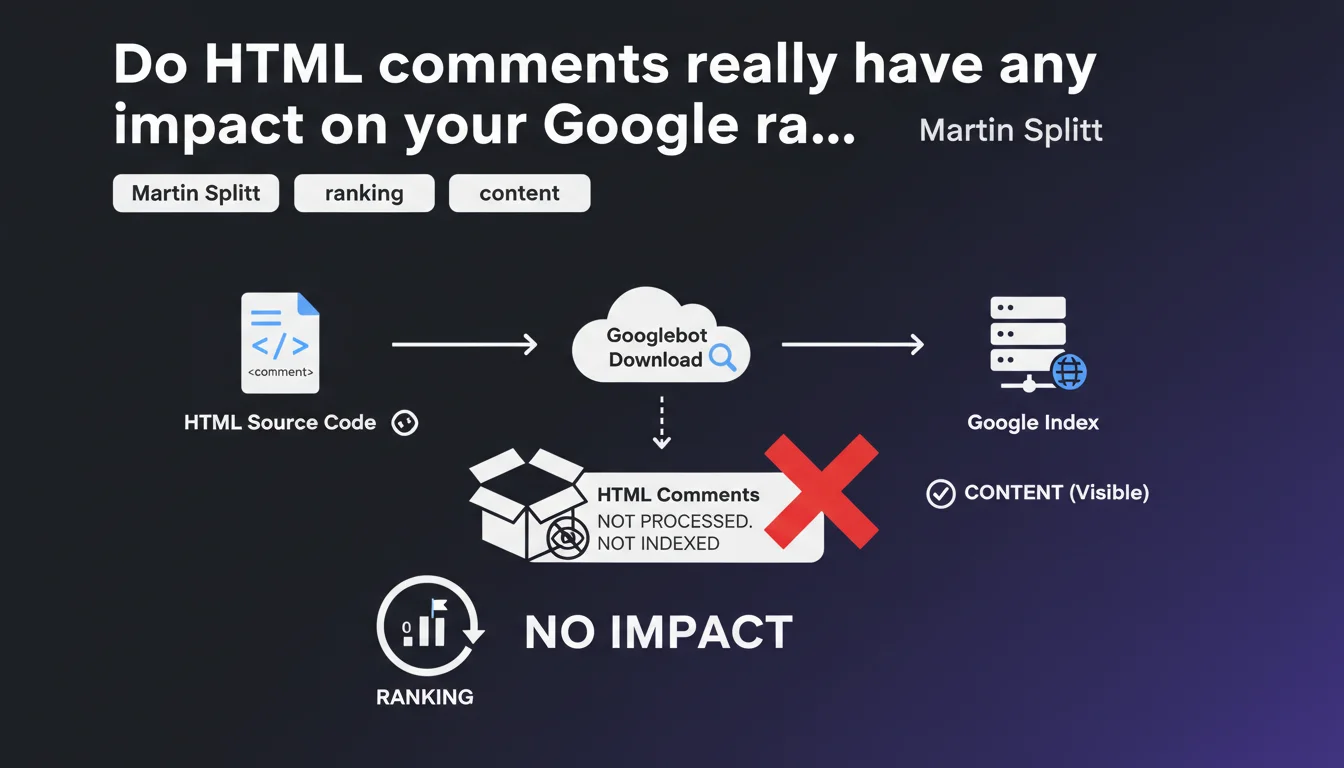
Google downloads HTML comments because they're part of the source code, but it doesn't process or index them. Their content has absolutely no influence on your SEO. There's no point in stuffing them with keywords or hoping to sneak SEO signals in there.
What you need to understand
Why does Google download comments without indexing them?
Google crawls the entire HTML source code of a page, including comments. This is a mechanical consequence: the bot retrieves everything that makes up the file. But downloading doesn't mean processing.
Once the code is analyzed, the algorithm deliberately ignores <!-- --> tags. Their content will never be indexed or taken into account when evaluating relevance. They never appear in search results.
Does this rule apply to all types of comments?
Yes. Whether you insert notes for your developers, hidden keywords, or even entire blocks of text as comments, Google won't read them. This applies to static HTML as well as dynamically generated pages.
Comments in other languages (CSS, JavaScript) follow the same logic: Google doesn't exploit their content for SEO purposes. It's not a communication channel with the search engine.
What are the key takeaways?
- Google downloads HTML comments but never indexes them
- No positive or negative SEO impact — they're transparent to the algorithm
- No point in placing keywords, alt text, or metadata there
- Comments can bloat your code without any SEO benefit
- They remain useful for code maintenance and documentation
SEO Expert opinion
Is this statement consistent with what we observe in the field?
Absolutely. No documented test has ever shown that an HTML comment influences rankings. Attempts to insert keywords in comments — an old black hat technique — have never produced measurable results.
What's interesting is that Martin Splitt explicitly states that Google downloads these comments. This confirms that crawling is exhaustive, even if processing is selective. A useful reminder: what Googlebot retrieves isn't necessarily what it exploits.
Are there cases where comments could cause problems?
Let's be honest — an indirect problem does exist: file weight. Excessive HTML comments bloat your source code without adding any value. This can degrade load time, a factor that does impact SEO through Core Web Vitals.
Some developers leave behind commented code blocks, bulky annotations, or entire disabled sections. If this represents tens of kilobytes, you're wasting crawl budget and slowing down rendering — with no benefit.
<script> tags, are read and exploited by Google. HTML comments, on the other hand, are completely ignored.Can you use comments to communicate with Google?
No. Some webmasters hope to signal intentions through comments ("this block is temporary", "this section will be updated"). Google doesn't read these messages. If you want to transmit information to the search engine, use meta tags, robots.txt directives, or structured annotations.
Comments remain an internal development tool. They should only serve your team, never as an SEO channel.
Practical impact and recommendations
What should you concretely do with HTML comments?
First action: clean up unnecessary code. Review your templates and remove obsolete comments, disabled code blocks that haven't been used in months, or development notes that no longer serve a purpose.
Second action: limit their use to legitimate cases. Documenting complex logic, marking sections to facilitate maintenance — yes. Filling your code with useless notes or hoping to influence Google — no.
What mistakes should you absolutely avoid?
Never place strategic content in comments thinking it will be indexed "later" or "partially". Google won't read it, period. If text needs to be crawled, it must be visible in the DOM, not hidden in a comment.
Also avoid leaving sensitive information in comments (passwords, tokens, internal references). Google won't index them, but they remain visible in the source code for anyone who inspects the page.
- Audit your source code to identify large or unnecessary comments
- Remove commented code blocks that are no longer useful
- Never use HTML comments as an SEO technique
- Verify that JSON-LD structured data isn't placed in comments
- Limit annotations to actual maintenance needs
- Monitor your total HTML file weight to optimize load time
How can you verify that your site follows these best practices?
Use your browser's inspector to examine the raw source code. Look for <!-- --> tags and assess their relevance. If they represent more than a few lines per page, that's probably excessive.
Run a performance audit with PageSpeed Insights or GTmetrix. If your HTML weight is abnormally high, comments could be the culprit. Compare before/after cleanup to measure the impact.
❓ Frequently Asked Questions
Les commentaires HTML peuvent-ils pénaliser mon référencement ?
Puis-je cacher du texte en commentaire HTML pour le faire indexer plus tard ?
Les données structurées JSON-LD insérées dans des balises script sont-elles considérées comme des commentaires ?
Faut-il supprimer tous les commentaires HTML de mon site ?
Google pénalise-t-il les sites qui utilisent des commentaires HTML pour tenter de manipuler le référencement ?
🎥 From the same video 11
Other SEO insights extracted from this same Google Search Central video · published on 26/06/2025
🎥 Watch the full video on YouTube →
💬 Comments (0)
Be the first to comment.