
Official statement
Other statements from this video 15 ▾
- □ Does hreflang really boost your ranking in a targeted country?
- □ Should you really reduce the number of pages to optimize your international SEO?
- □ Does Google really use only main content to identify language on multilingual pages?
- □ Does Google really ignore your page titles when the language doesn't match your content?
- □ Is your content trapped behind buttons that Googlebot refuses to click?
- □ Are JavaScript interstitials really safe for your SEO?
- □ Can a technical bug during a Core Update really cause your site to crash in rankings?
- □ Can technical problems really trigger a ranking drop during a Core Update?
- □ Does Google penalize you for translating content between languages?
- □ Can poor machine translations really sabotage your international SEO strategy?
- □ Should you really use Google's Indexing API for all your content?
- □ Can Googlebot actually access your .htaccess file?
- □ Does Google really give its own platforms an unfair advantage in search results?
- □ Does the meta description really impact your Google rankings?
- □ Should you really choose your structured data based on the rich results you're targeting in the SERPs?
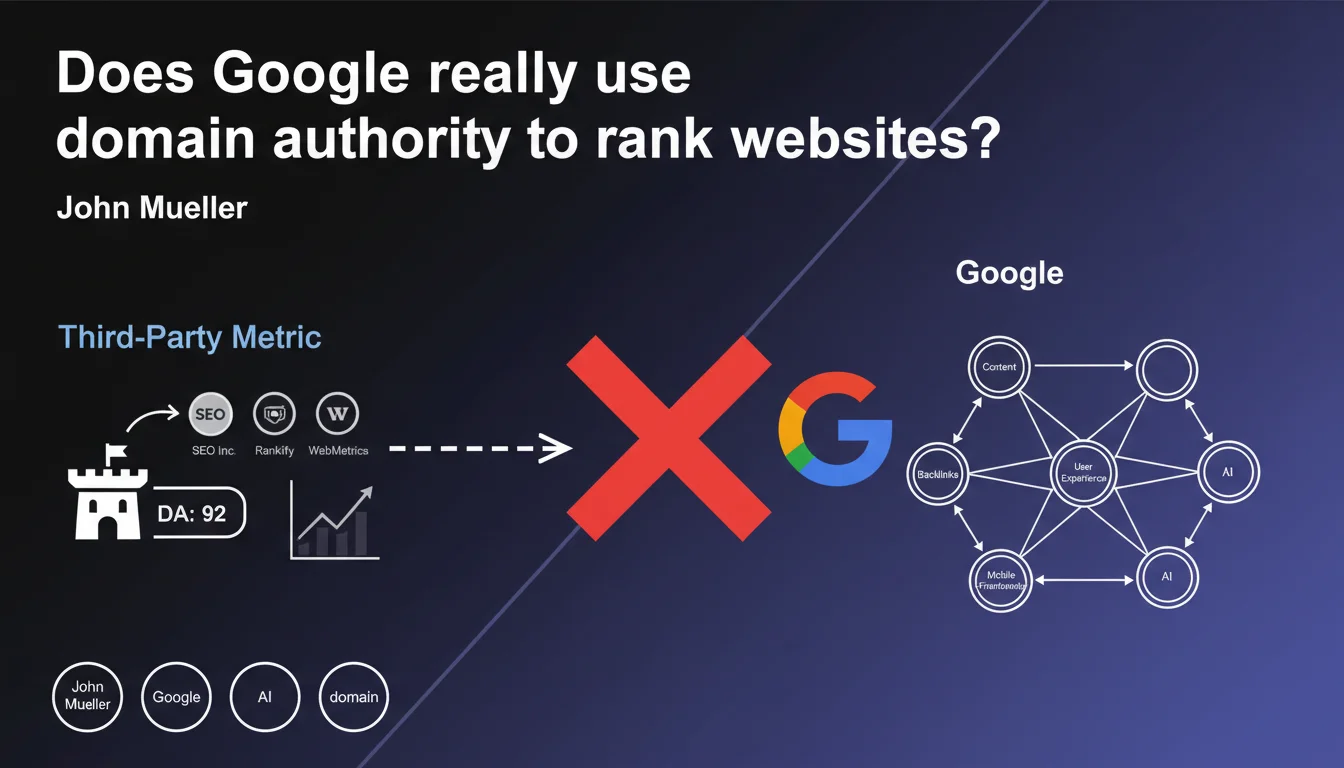
Google states it doesn't use a domain authority (DA) metric in its ranking algorithm. DA is an invention of third-party SEO tools like Moz, not a Google signal. This doesn't mean a site's overall reputation has no impact — but it's not measured by a single score.
What you need to understand
Why does Google reject the domain authority concept?
The Domain Authority (DA) is a metric created by Moz, rated from 0 to 100, supposed to predict a site's ability to rank in search results. Other tools offer equivalents: Domain Rating at Ahrefs, Authority Score at Semrush.
Google clarifies that it uses no overall domain score in its algorithm. No single rating that would summarize a site's "strength." This statement aims to clarify a frequent confusion: what third-party tools measure doesn't necessarily reflect what Google values.
What does Google use instead?
Google evaluates relevance and quality page by page, based on hundreds of signals. Backlinks matter, content quality matters too, user experience, freshness — but there is no single aggregated metric at the domain level.
The PageRank, often confused with DA, still exists internally at Google. But it applies to each URL individually, not to the domain as a whole. And it represents only one signal among many, far from being decisive on its own.
Does this mean a domain's reputation doesn't count?
No. Even if Google doesn't calculate a DA score, a well-established site with a history of quality content and a solid link profile will tend to perform better. But this "authority" results from the accumulation of positive signals, not from a magic number.
SEO tools use DA as a practical proxy to quickly assess a competitor's competitiveness or the potential value of a backlink. It's useful, as long as you don't confuse correlation and causation.
- Google doesn't use a "domain authority" metric in its algorithm
- DA/DR/AS scores are creations of third-party tools, based on their own calculations
- Google evaluates each page individually according to hundreds of signals
- A recognized domain benefits indirectly from positive history, without a global score existing
- Internal PageRank still exists, but applies per URL, not per domain
SEO Expert opinion
Does this statement contradict what we observe in the field?
Not really. Experienced SEOs have known for a long time that DA is not a Google signal. But confusion persists because in practice, a site with high DA often performs better. Correlation, not causation.
A strong domain naturally accumulates signals that Google values: quality backlinks, regular content, user engagement. Third-party tools attempt to model this reality with a synthetic score. It works as a shortcut, but it's not what Google calculates internally.
Why does Google insist so much on this point?
Because too many practitioners optimize for the wrong objective. Chasing DA as an end in itself — buying backlinks to inflate the score, targeting only high-DA sites — diverts from real work: creating relevant content, earning natural links, improving user experience.
Google wants to refocus attention on what really matters. The risk is that this statement is interpreted as "domain reputation doesn't matter at all," which would be false. [To verify]: Google doesn't detail how it aggregates a domain's positive signals without using a unified metric — and that's where the confusion persists.
In what cases does DA remain useful despite everything?
As a quick benchmarking tool. If you compare two competitors, the one with a DA of 70 will probably have a stronger link profile than the one at 20. It's an imperfect but practical indicator to prioritize your actions.
The pitfall is making it an obsession. Optimize for Google, not for Moz. If your DA stagnates but your organic traffic climbs, you're on the right track. The opposite should alert you.
Practical impact and recommendations
Should you stop monitoring Domain Authority?
No, but change how you use it. Use DA as a relative indicator to compare sites with each other, not as an end goal. If you're prospecting for link building, a high DA suggests an interesting link profile — but always manually verify the site's actual quality.
Never base a SEO strategy solely on improving DA. Google doesn't see it, so you'd be optimizing for a metric invisible to its eyes.
What mistakes should you avoid after this statement?
First mistake: believing that a domain's overall reputation no longer matters. It does matter, but Google doesn't measure it with a single score. A recent site can beat an old established site on specific queries, if its content is better and its page-level signals are stronger.
Second mistake: buying backlinks from "high DA" sites without checking their thematic relevance, actual traffic, editorial quality. A link from a DA 60 site but off-topic and full of spam is worthless — or worse.
What should you concretely do?
Focus on the fundamentals: quality content, naturally earned links, optimal user experience. If your domain gains real authority, third-party metrics will follow — not the other way around.
Analyze your competitors with DA/DR/AS tools to understand the competitive landscape, but never compare yourself directly on this metric alone. Instead look at: their backlink profile (quality, diversity, anchors), their publishing frequency, their internal linking strategy.
- Use DA as a relative benchmarking tool, not as your primary KPI
- Prioritize the quality and relevance of backlinks over the source site's score
- Evaluate each page individually: a strong page can exist on a weak domain
- Audit your link profile regularly to detect toxic signals, independent of DA
- Measure your SEO performance on Google indicators: organic traffic, positions, conversions
- Don't artificially chase DA through link networks or spam
❓ Frequently Asked Questions
Le Domain Authority de Moz influence-t-il vraiment le classement Google ?
Google utilise-t-il une métrique équivalente en interne ?
Dois-je ignorer complètement le Domain Authority dans mon analyse SEO ?
Un site avec un DA faible peut-il surpasser un concurrent à DA élevé ?
Pourquoi les sites à DA élevé performent-ils mieux en général ?
🎥 From the same video 15
Other SEO insights extracted from this same Google Search Central video · published on 29/04/2022
🎥 Watch the full video on YouTube →
💬 Comments (0)
Be the first to comment.