
Official statement
Other statements from this video 14 ▾
- □ Does Google really rewrite your title tags however it wants?
- □ Should you really remove prices and stock levels from your title tags?
- □ Is your title tag really showing up the way you think it is in Google's search results?
- □ Why does Google really require 1200 pixels for product images to appear in rich results?
- □ Should you really be using the Max Image Preview tag to control how your images appear in Google?
- □ Are structured data really essential to avoid missing out on rich snippets?
- □ Why does Google really insist on 6 minimum fields in product structured data?
- □ Why aren't your rich snippets showing up even though you have Schema.org markup in place?
- □ Does combining structured data and Merchant Center feeds really unlock maximum e-commerce visibility?
- □ Does Google really calculate price drops independently from what merchants declare?
- □ Why does Google reject price ranges in product structured data?
- □ Why doesn't Google display every single price drop you markup?
- □ Do GTIN Identifiers Really Boost Your Product Visibility on Google?
- □ Are structured data and Merchant Center really the most profitable SEO strategy in the long run?
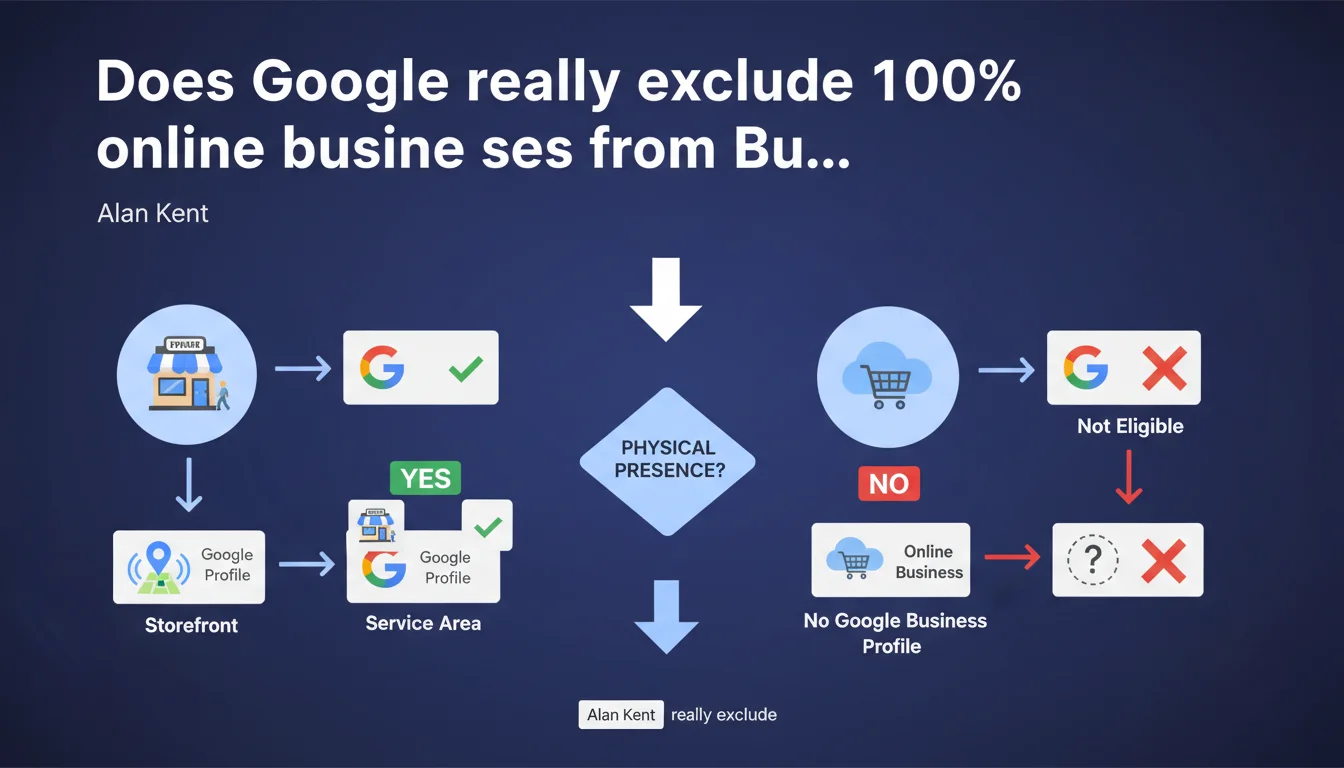
Google strictly reserves Google Business Profile to businesses with a physical presence — a store, office open to the public, or defined service area. Purely online businesses are not eligible. This policy aims to maintain the integrity of Google's local ecosystem, but raises questions for many e-commerce players.
What you need to understand
Why does Google enforce a physical presence requirement?
Google's logic is straightforward: Google Business Profile (formerly Google My Business) exists to connect users with physical locations. Google's local algorithm relies on geolocation, proximity, and territorial relevance.
Allowing 100% online businesses would create significant noise in local search results. A user searching "plumber Paris 15" expects to find someone who can physically intervene, not a national e-commerce site selling pipes.
What exactly does Google mean by "physical presence"?
Two scenarios are accepted: a premises open to the public (shop, restaurant, medical office) with a visible address, or a service business (plumber, electrician, delivery) covering a defined geographic area.
In the second case, the address can remain hidden from the public, but Google requires it for verification purposes. "SABs" (Service Area Businesses) must define their service perimeter — neighborhoods, cities, departments.
What are the concrete consequences of this restriction?
- Pure e-commerce players cannot create a profile, even with thousands of customers
- Marketplaces, SaaS, 100% remote agencies, nomadic consultants are excluded
- A hybrid business (physical store + e-commerce) remains eligible, but only for the physical address
- Attempts to circumvent (fake addresses, mail forwarding services) violate guidelines and expose businesses to permanent suspensions
SEO Expert opinion
Is this policy enforced consistently?
On paper, yes. In reality — it's murkier. We regularly observe profiles belonging to businesses without genuine physical presence that slip through the cracks for months before being suspended.
Google's verification system relies on several mechanisms: postal delivery of a PIN card, phone validation, live video verification for certain sectors. But these controls aren't foolproof. Savvy operators use mail forwarding addresses, shared offices, or "friends" to obtain an address — technically, it works until Google detects the anomaly.
Should we consider this rule definitive?
Probably not. Google has already evolved its eligibility criteria in the past. Certain hybrid sectors — like neobanks with limited physical branches — raise questions. [To verify]: we lack clarity on edge cases like temporary pop-up stores, showrooms by appointment only, or companies with headquarters not open to the public.
Alan Kent's position reflects official doctrine, but it doesn't address these gray areas. Google's public guidelines remain intentionally vague on certain points — likely to retain flexibility for manual review of borderline cases.
Are there alternatives for 100% online businesses?
Frankly? Not really within Google's local ecosystem. These businesses must rely on traditional organic SEO, Google Ads, marketplace listings, social media. Some attempt to compensate through partnerships with physical pickup points, but that doesn't grant access to a GBP profile anyway.
Practical impact and recommendations
What should I do if my business has legitimate physical presence?
Create your profile without delay. Fill in all fields: primary category, secondary categories, hours, quality photos, description optimized with local keywords. Add attributes specific to your sector.
Enable real-time verification: respond to reviews (positive and negative alike), post regularly, add your products or services. An active profile outperforms a ghost profile — this is documented in several local correlation studies.
How can I avoid mistakes that lead to suspension?
- Never use a PO box or virtual address service as your primary address
- Don't create multiple profiles for the same entity (except legitimate multi-location businesses)
- Don't stuff keyword fields (e.g., "Plumber Paris cheap 24/7" as business name)
- Don't lie about opening hours or hide your address if you receive customers
- Verify your NAP (Name, Address, Phone) is exactly identical across your website, directories, legal notices
What if my business is 100% online — any solutions?
Two options — neither miraculous. Either you genuinely open a physical touchpoint (showroom, accessible office), or you forgo GBP and invest elsewhere. Some consultants suggest gray-area setups, but the risks far outweigh potential gains.
Focus your efforts on accessible channels: organic SEO on transactional keywords, optimization of your product pages, quality link building, presence on sector-specific comparison sites and marketplaces. Local traffic via GBP is just one lever — if you don't have access, double down on those still available.
❓ Frequently Asked Questions
Puis-je créer un profil Google Business si je travaille uniquement de chez moi ?
Les bureaux virtuels ou espaces de coworking sont-ils acceptés par Google ?
Que risque-t-on si Google détecte une fausse adresse ?
Un e-commerçant avec un entrepôt peut-il créer un profil ?
Google peut-il faire évoluer cette règle à l'avenir ?
🎥 From the same video 14
Other SEO insights extracted from this same Google Search Central video · published on 28/07/2022
🎥 Watch the full video on YouTube →
💬 Comments (0)
Be the first to comment.