
Official statement
Other statements from this video 14 ▾
- □ Google réécrit-il vraiment vos balises title à sa guise ?
- □ Faut-il vraiment bannir les prix et stocks des balises title ?
- □ Comment vérifier efficacement l'affichage réel de vos title links dans les SERP Google ?
- □ Pourquoi Google impose-t-il un seuil de 1200 pixels pour les images produits ?
- □ Faut-il vraiment utiliser la balise Max Image Preview pour contrôler l'affichage de vos images dans Google ?
- □ Les données structurées sont-elles vraiment indispensables pour éviter de passer à côté des rich snippets ?
- □ Pourquoi vos rich snippets n'apparaissent-ils pas malgré un balisage Schema.org en place ?
- □ Faut-il vraiment combiner données structurées et flux Merchant Center pour le SEO produit ?
- □ Comment Google calcule-t-il réellement les baisses de prix affichées dans les résultats enrichis ?
- □ Pourquoi Google refuse-t-il les fourchettes de prix dans les données structurées produit ?
- □ Pourquoi Google n'affiche-t-il pas toutes les baisses de prix que vous balisez ?
- □ Les GTIN boostent-ils vraiment l'exposition produit sur Google ?
- □ Google Business Profile : pourquoi les entreprises 100% en ligne sont-elles exclues ?
- □ Les données structurées et Merchant Center sont-elles vraiment la stratégie SEO la plus rentable sur le long terme ?
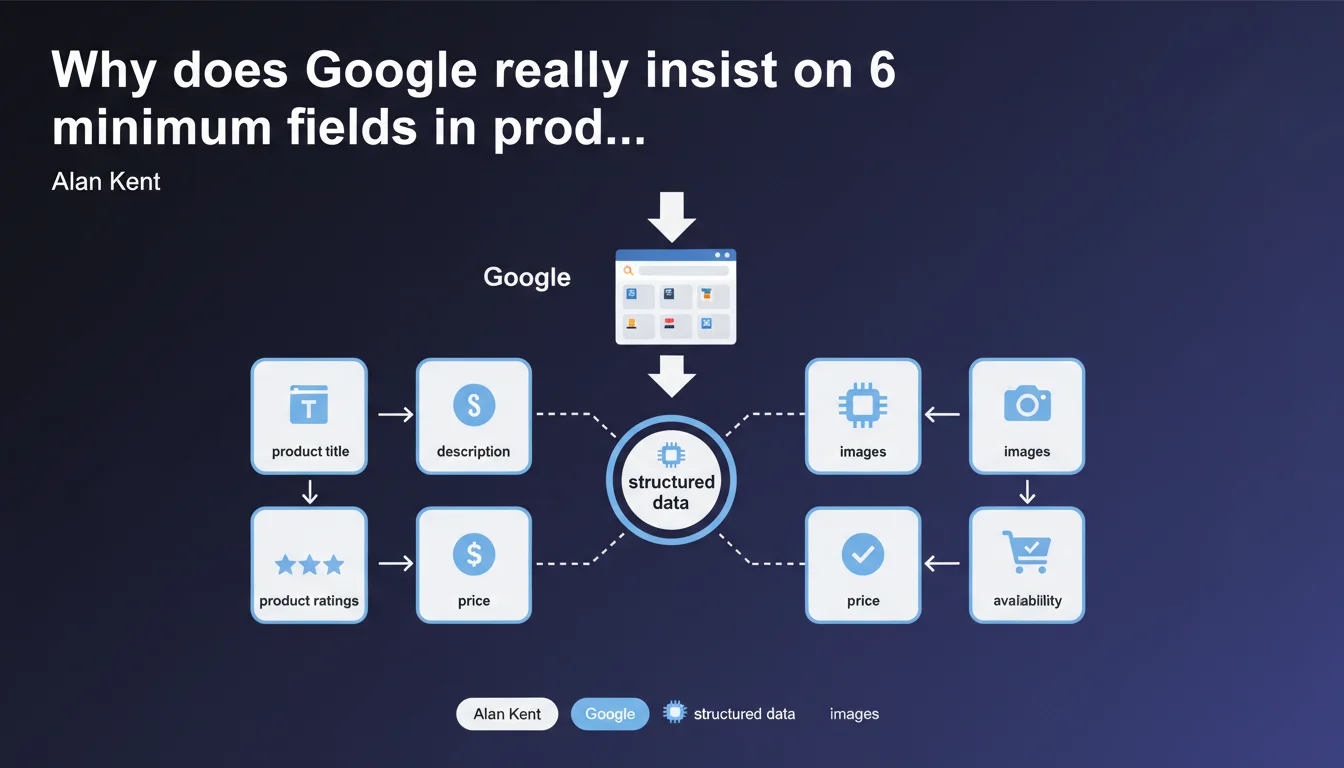
Google officially recommends including a minimum of 6 properties in structured data Product: title, description, images, ratings, price, and availability. This recommendation aims to guarantee sufficient information richness to trigger rich features in the SERPs. The absence of any one of these fields can compromise eligibility for rich results, even if the markup is technically valid.
What you need to understand
Does Google set a minimum standard or a mandatory prerequisite?
The wording "recommends including at minimum" leaves a deliberately vague ambiguity. Technically, the schema.org Product does not require these 6 fields to be valid — only the name is strictly required. But in practice, Google uses these properties as implicit eligibility criteria to display rich results (rich snippets, Google Shopping, product surfaces).
In other words: your markup can pass Schema.org validation and remain invisible in the SERPs if you skip price or availability. Alan Kent isn't talking here about technical validation, but about the threshold for activating features. That's the nuance most people miss.
Why these 6 fields specifically?
These properties correspond to the transactional intent signals that Google exploits to qualify a product as "ready to purchase." Price and availability allow filtering of active and relevant products. Ratings influence CTR and perceived relevance. Images are essential for visual surfaces (Google Images, Lens).
Without this data, Google cannot build a coherent user experience in its results. A product without price or availability is informational content, not a shoppable item — and Google consistently favors what looks like an actionable e-commerce catalog.
What are the concrete risks of partial implementation?
- Loss of eligibility for rich snippets: Google may ignore your Product markup if critical fields are missing, even if Search Console reports no errors.
- Exclusion from Shopping surfaces: without price and availability, it's impossible to appear in Shopping tabs or product carousels.
- Competitive disadvantage: competitors with complete markup capture enriched clicks while you don't — even at equal ranking.
- Degraded quality signals: incomplete markup can be interpreted as a signal of low e-commerce maturity, indirectly impacting algorithmic trust.
SEO Expert opinion
Is this recommendation consistent with field observations?
Let's be honest: yes, absolutely. Tests show that the display of stars, price, and availability in SERPs depends directly on the presence of these fields in the markup. No offers with price and availability? No mention of "In stock" or displayed price, even if your product ranks in position 1.
What's more insidious is that Google generates no alerts in Search Console if you omit these fields. The markup is considered valid, but you're silently depriving yourself of rich features. It's a classic trap for sites that implement bare-minimum Schema.org without verifying actual impact in results.
What nuances should be added to this recommendation?
Some products cannot display price or availability — think auctions, quote-based products, unique vintage items. In these cases, you need to adapt the markup: use PriceSpecification with a range, or mark the offer as PreOrder / Discontinued. Complete absence of structured data Offer remains penalizing.
Another rarely mentioned point: images. Google recommends "images," plural, but how many exactly? The official documentation remains vague. Tests show that a single image is technically sufficient, but 3-5 images increase chances of display in carousels and Google Lens. [To verify]: no Google source precisely quantifies the impact of image quantity on eligibility.
In what cases does this rule not apply?
For informational products (free books, open-source software, technical documentation), Product markup can be counterproductive. Better to use SoftwareApplication, Book, or Course depending on context. Google doesn't seek to display a price where there isn't one — forcing Product markup with empty or fictitious offers can be misinterpreted.
Practical impact and recommendations
What should you do concretely on an existing e-commerce site?
First step: audit the existing setup. Use Google's Rich Results Test tool on a representative sample of product pages. Verify that all 6 fields (name, description, image, aggregateRating, offers.price, offers.availability) are properly detected and without errors or warnings.
Next, cross-reference with Google Search Console — Enhancements > Products section. Identify errors, warnings, and especially valid products not displayed in rich snippets. That's often where the problem lurks: markup technically OK, but incomplete according to Google's criteria.
What mistakes should you absolutely avoid?
- Don't duplicate Product markup if you're already using a Google Merchant Center feed — the two must be consistent, but the GMC feed takes priority for Shopping.
- Avoid descriptions that are too short (less than 50 characters) or low-resolution images (less than 300px) — Google may ignore the markup if it judges content insufficient.
- Never leave availability empty or on a generic default value — use InStock, OutOfStock, PreOrder, etc. based on the product's actual state.
- Don't forget aggregate ratings (aggregateRating) if you display customer reviews — without this field, stars never appear in SERPs, even with 1000 visible reviews on the page.
How do you verify that implementation actually works?
The decisive test: search for your flagship products on Google in private browsing. Do stars, price, and availability mention appear under the title? If not, your markup is incomplete or ignored. Follow up with URL inspection in Search Console to see what Googlebot actually sees — sometimes poorly executed JavaScript prevents markup from being read.
Also monitor impressions and clicks in Search Console, segment "Appearance in search results > Rich result." If your products generate impressions but zero enriched display, that's a clear signal your markup needs completion.
Rigorous implementation of the 6 fields recommended by Google isn't a technical detail — it's a direct visibility lever in e-commerce SERPs. Sites that neglect this standard lose clicks to better-marked competitors, at equivalent content quality.
For sites with thousands of references or complex catalogs, deploying and maintaining this structured data consistently and compliantly represents a significant technical project. If your team lacks resources or expertise in schema.org, engaging an SEO-specialized agency can accelerate compliance and prevent costly errors that go unnoticed for months.
❓ Frequently Asked Questions
Le balisage Product est-il obligatoire pour apparaître dans Google Shopping ?
Peut-on baliser un produit sans prix si celui-ci varie selon les options choisies ?
Les avis clients doivent-ils obligatoirement provenir de Google pour activer les étoiles ?
Si mon produit est en rupture de stock, dois-je retirer le balisage Product ?
Les données structurées Product impactent-elles directement le ranking organique ?
🎥 From the same video 14
Other SEO insights extracted from this same Google Search Central video · published on 28/07/2022
🎥 Watch the full video on YouTube →
💬 Comments (0)
Be the first to comment.