
Official statement
Other statements from this video 14 ▾
- □ Google réécrit-il vraiment vos balises title à sa guise ?
- □ Faut-il vraiment bannir les prix et stocks des balises title ?
- □ Comment vérifier efficacement l'affichage réel de vos title links dans les SERP Google ?
- □ Pourquoi Google impose-t-il un seuil de 1200 pixels pour les images produits ?
- □ Faut-il vraiment utiliser la balise Max Image Preview pour contrôler l'affichage de vos images dans Google ?
- □ Les données structurées sont-elles vraiment indispensables pour éviter de passer à côté des rich snippets ?
- □ Pourquoi Google insiste-t-il sur 6 champs minimaux dans les données structurées produits ?
- □ Pourquoi vos rich snippets n'apparaissent-ils pas malgré un balisage Schema.org en place ?
- □ Faut-il vraiment combiner données structurées et flux Merchant Center pour le SEO produit ?
- □ Comment Google calcule-t-il réellement les baisses de prix affichées dans les résultats enrichis ?
- □ Pourquoi Google refuse-t-il les fourchettes de prix dans les données structurées produit ?
- □ Pourquoi Google n'affiche-t-il pas toutes les baisses de prix que vous balisez ?
- □ Les GTIN boostent-ils vraiment l'exposition produit sur Google ?
- □ Google Business Profile : pourquoi les entreprises 100% en ligne sont-elles exclues ?
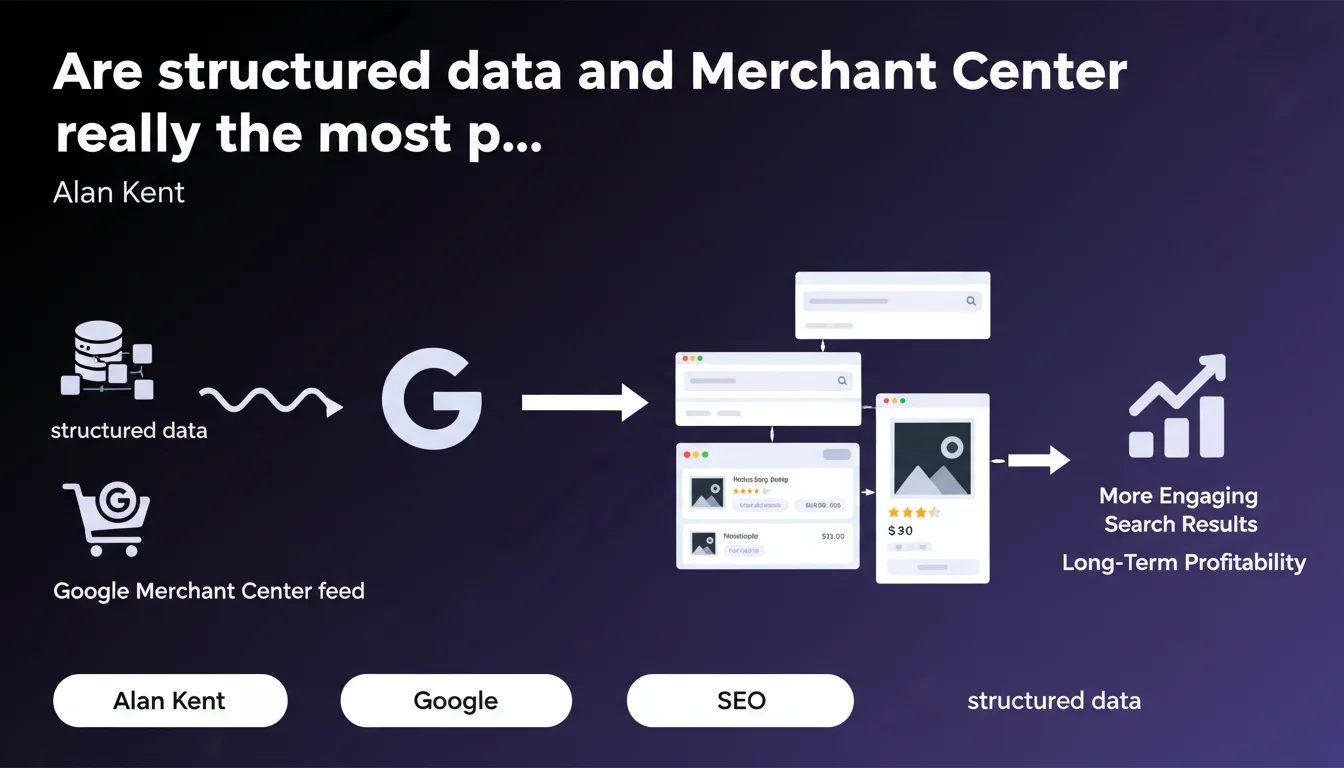
Google officially recommends combining rich structured data on your product pages and an updated Merchant Center feed. This dual approach would enable enriched displays in the SERPs. The question remains whether the technical investment is worth it for all types of e-commerce sites.
What you need to understand
Why does Google insist so heavily on product structured data?
Google seeks to structure product information to better understand and leverage it across its various result formats: rich snippets, Google Shopping, visual search, voice assistant. The clearer and more standardized your data, the more creatively Google can use it in its SERPs.
This statement from Alan Kent (Developer Advocate at Google) explicitly targets e-commerce sites. It positions the combination schema.org Product + Merchant Center feed as a non-negotiable standard, not as an optional feature.
What does "rich structured data" concretely mean?
We're talking about schema.org Product-type tags incorporating as many properties as possible: price, availability, customer reviews, ratings, images, product variants, identifiers (GTIN, SKU), categories. The bare minimum (name + image + price) isn't enough — Google wants granularity.
The Merchant Center feed complements this approach by providing real-time updates on stock, prices, and promotions. According to Google, it's the combination of both that creates maximum leverage.
Why is this a "long-term" strategy rather than a tactic?
Google doesn't promise immediate results or position guarantees. The argument is different: you make your data exploitable for all current and future formats Google will develop. It's a bet on the evolution of search.
Unlike classic on-page optimizations that can lose effectiveness with algorithm updates, structured data constitutes sustainable infrastructure. At least in theory.
- Product structured data: schema.org with detailed properties (price, stock, reviews, variants, identifiers)
- Merchant Center feed: regular updates of product data (stock, prices, promotions)
- Objective: make your products eligible for enriched formats in SERPs (snippets, Shopping, image search)
- Positioning: infrastructure strategy rather than short-term tactic
SEO Expert opinion
Does this recommendation really apply to all e-commerce sites?
Let's be honest: Google is talking here about an optimal strategy for standard product catalogs selling identifiable physical references. If you sell custom services, unique digital products, or complex B2B solutions, the equation changes dramatically.
The Merchant Center feed imposes constraints (public pricing, immediate availability, standardized purchase process) that don't fit all business models. And Product structured data is designed for mainstream retail, not custom-quoted offers. [To verify] the extent to which these formats are evolving toward complex B2B.
What proof do we have that this really works?
Google provides no numerical data on the real SEO impact of this dual approach. We know rich snippets increase CTR — but by how much exactly, on what types of queries, with what variance across sectors? Complete silence.
Field observations show highly heterogeneous results. Some sites see enriched snippets appear within 48 hours, others wait months with perfectly compliant data. The triggering criteria remains opaque. Google speaks of "presenting your pages in a more engaging way" — deliberately vague language that commits to nothing.
Isn't the Merchant Center feed primarily an advertising tool?
Here, we need to distinguish two uses. Merchant Center effectively serves as database for Google Shopping Ads, but it also feeds organic enriched results (free Shopping tab, Discovery surfaces). Google deliberately blurs the two to encourage adoption.
The issue: maintaining a clean and updated Merchant Center feed requires non-negligible technical resources. Is it worth the effort if you're not running Shopping Ads? The answer depends on your sector and current visibility in product SERPs.
Practical impact and recommendations
What should you implement first on an e-commerce site?
Start with Product structured data on your product pages. That's the foundation. Use Search Console to verify that Google detects it without errors. Focus first on critical properties: name, image, price, availability, aggregateRating if you have reviews.
Next, if your catalog contains referenced physical products (with GTIN, MPN, SKU), create a Merchant Center feed. Automate updates to avoid stock or price discrepancies — this is non-negotiable for Google.
What errors most often block rich snippet display?
Inconsistencies between the markup and visible content on the page. If your schema.org shows a different price than what's visible to the user, Google rejects the snippet. Same logic for availability: don't mark "InStock" if the button shows "Out of Stock".
Another common trap: fake or auto-generated reviews. Google increasingly detects sites that create their own star ratings without a verifiable review collection system. Result: rich snippet deindexing, or even manual action in severe cases.
How can you verify that your structured data strategy is paying off?
Use the "Enhancements" report in Search Console to track detection of your Product and Review structured data. Monitor errors and warnings — Google is strict about schema.org specification compliance.
To measure real impact, compare average CTR of your product pages before/after in Search Console. If you get enriched snippets, CTR should increase significantly on product queries — otherwise, it means the enriched display isn't triggering or your offer isn't competitive.
- Implement schema.org Product with complete properties (price, availability, aggregateRating, image, name)
- Verify consistency between structured data and user-visible content
- Create an automated Merchant Center feed if you sell referenced physical products
- Add product identifiers (GTIN, MPN, SKU) to both feed and schema.org
- Set up a verifiable customer review system (Trustpilot, Verified Reviews, Reviews.io...)
- Monitor the "Enhancements" report in Search Console to catch errors and warnings
- Measure CTR evolution on product pages after deployment
❓ Frequently Asked Questions
Les données structurées Product améliorent-elles directement le positionnement dans les SERP ?
Faut-il obligatoirement utiliser Merchant Center même sans faire de Google Ads ?
Peut-on utiliser les données structurées Offer à la place de Product ?
Google affiche-t-il toujours les extraits enrichis quand les données structurées sont valides ?
Les données structurées JSON-LD sont-elles préférables aux microdonnées ou RDFa ?
🎥 From the same video 14
Other SEO insights extracted from this same Google Search Central video · published on 28/07/2022
🎥 Watch the full video on YouTube →
💬 Comments (0)
Be the first to comment.