
Official statement
Other statements from this video 14 ▾
- □ Google réécrit-il vraiment vos balises title à sa guise ?
- □ Faut-il vraiment bannir les prix et stocks des balises title ?
- □ Pourquoi Google impose-t-il un seuil de 1200 pixels pour les images produits ?
- □ Faut-il vraiment utiliser la balise Max Image Preview pour contrôler l'affichage de vos images dans Google ?
- □ Les données structurées sont-elles vraiment indispensables pour éviter de passer à côté des rich snippets ?
- □ Pourquoi Google insiste-t-il sur 6 champs minimaux dans les données structurées produits ?
- □ Pourquoi vos rich snippets n'apparaissent-ils pas malgré un balisage Schema.org en place ?
- □ Faut-il vraiment combiner données structurées et flux Merchant Center pour le SEO produit ?
- □ Comment Google calcule-t-il réellement les baisses de prix affichées dans les résultats enrichis ?
- □ Pourquoi Google refuse-t-il les fourchettes de prix dans les données structurées produit ?
- □ Pourquoi Google n'affiche-t-il pas toutes les baisses de prix que vous balisez ?
- □ Les GTIN boostent-ils vraiment l'exposition produit sur Google ?
- □ Google Business Profile : pourquoi les entreprises 100% en ligne sont-elles exclues ?
- □ Les données structurées et Merchant Center sont-elles vraiment la stratégie SEO la plus rentable sur le long terme ?
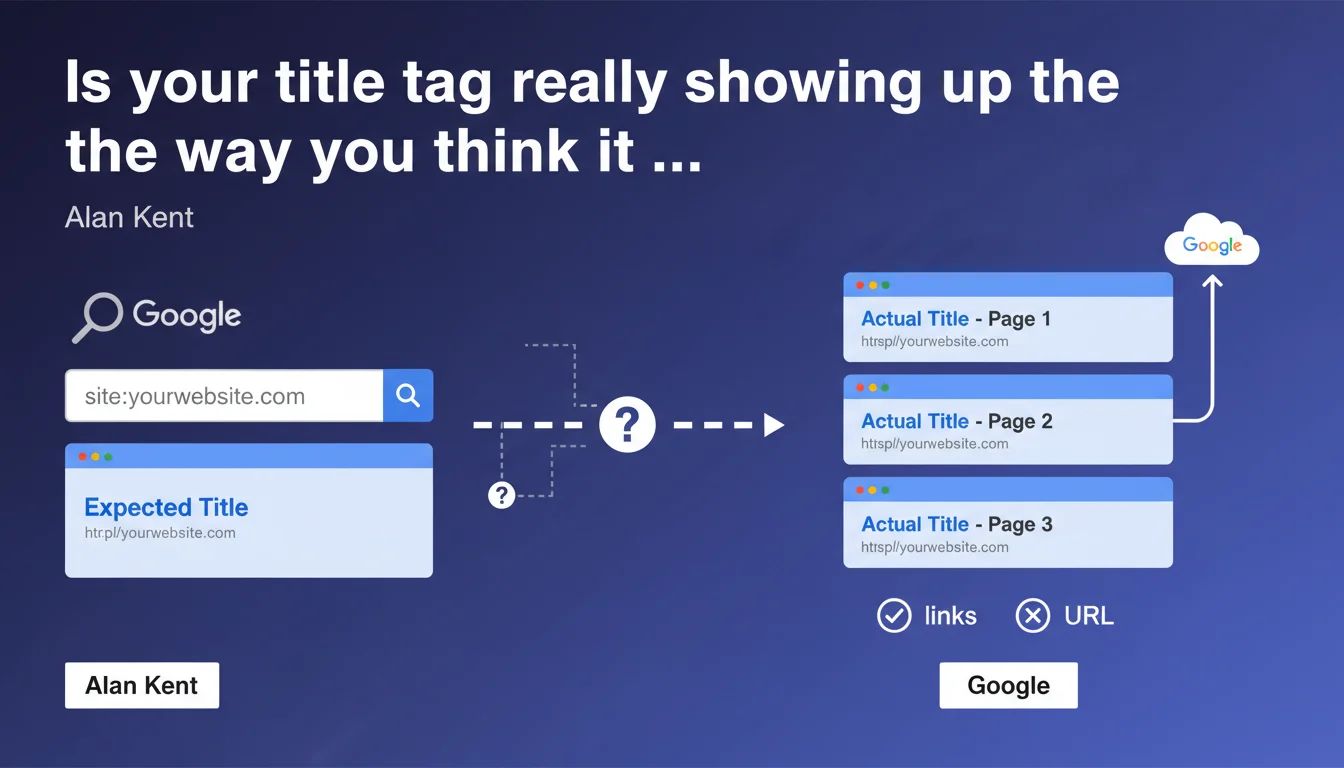
Google recommends using the site: operator to verify how your titles actually display in search results. Alan Kent emphasizes the need to test multiple pages, since Google can rewrite your title tags according to its own criteria. It's basic advice but underutilized by many practitioners.
What you need to understand
Why does Google insist on checking title links?
For several years now, Google has been massively rewriting the title tags of pages in its search results. Studies show that 60 to 70% of the titles displayed differ from the original title tag.
Alan Kent's statement reminds us of an often-overlooked truth: what matters is what the user sees in the SERPs, not what you coded in your HTML. The difference can be minor (brand name addition) or radical (complete rewrite based on H1s or content).
Is the site: operator really reliable for this test?
The site: operator shows how Google indexes your pages, but with an important caveat: title links can vary depending on the user's search query. A site: search gives you a generic view, not necessarily the one a user will see when typing a specific query.
In practice? Google sometimes adapts the displayed title based on query relevance. Your site: test remains valid as a first indicator, but it doesn't replace verification on actual target queries.
What should you take away from this recommendation?
- Test multiple pages, not just your homepage — category pages and product sheets are often the most rewritten
- Systematically compare the title tag in the source code with the display in SERPs
- Document discrepancies to identify rewrite patterns specific to your site
- Don't panic if Google rewrites: sometimes it's neutral or even better for CTR
- Check regularly, as Google can change its behavior without notice
SEO Expert opinion
Is this verification method enough for a serious audit?
Let's be honest: the site: operator is a useful but incomplete starting point. It shows you a generic version of your title links, the one Google displays when it has no specific query context.
The problem? Title links are dynamic. For the same URL, Google can display different titles depending on whether the user types "men's running shoes" or "Nike Pegasus 40". The site: operator doesn't capture this variability. [To verify]: no Google study has precisely documented the frequency and extent of this contextual adaptation.
Why does Google rewrite our titles so much?
Google invokes user relevance — titles that are too short, keyword-stuffed, or non-descriptive are systematically rewritten. But in practice, we also see rewrites on perfectly optimized titles.
Two real-world explanations: either Google detects a mismatch between the title and actual content (and it's right), or its algorithm gets it wrong because it prioritizes an H1 or internal anchor text it deems more relevant. In 30-40% of observed cases, the rewrite objectively damages CTR — but you have no recourse.
Do you really need to "check multiple pages" as Kent suggests?
Absolutely. Rewrite patterns vary enormously by page type. E-commerce product sheets are hammered (Google often adds brand + category), blog articles less so (unless the title is clickbait), category pages unpredictably.
A pragmatic tip: sample 20-30 URLs per type (homepage, categories, products, content) and document discrepancies in a spreadsheet. You'll quickly see patterns emerge — for example, Google systematically adds your brand name at the end of the title if you omit it, or it pulls from your meta description if your title is less than 40 characters.
Practical impact and recommendations
What should you concretely do to audit your title links?
Implement a monthly verification process, not just a one-time check. Google's rewrites evolve, especially after algorithm updates or changes to your site.
Use the site:yourdomain.com operator for a quick overview, then cross-reference with tools like Screaming Frog (which can scrape SERPs) or custom scripts that compare title tag to actual display. Search Console doesn't show you the title links displayed — it's a blind spot.
What errors should you avoid when optimizing your titles?
- Don't stuff keywords to "force" Google to keep your title — that's precisely what triggers rewrites
- Avoid titles that are too short (less than 40 characters): Google often fills in with content pulled from elsewhere
- Don't duplicate title and H1 word-for-word — vary slightly to give Google options
- Skip generic titles like "Home" or "Products" — they'll be systematically rewritten
- Don't change your titles every week to "test" — give Google time to stabilize
How do you build titles less likely to be rewritten?
Favor a descriptive + benefit + brand structure (example: "Waterproof Trail Shoes – Long Distance Comfort | MyBrand"). Aim for 50-60 characters to balance readability and control.
Make sure the title accurately reflects the page content — any inconsistency will trigger a rewrite. If your H1 says one thing and your title another, Google will decide for you.
❓ Frequently Asked Questions
L'opérateur site: montre-t-il exactement ce que voient les utilisateurs ?
Pourquoi Google réécrit-il mes titres alors qu'ils sont bien optimisés ?
Peut-on empêcher Google de réécrire nos title links ?
Combien de pages faut-il vérifier pour un audit représentatif ?
Faut-il modifier mes titres si Google les réécrit systématiquement ?
🎥 From the same video 14
Other SEO insights extracted from this same Google Search Central video · published on 28/07/2022
🎥 Watch the full video on YouTube →
💬 Comments (0)
Be the first to comment.