
Official statement
Other statements from this video 14 ▾
- □ Google réécrit-il vraiment vos balises title à sa guise ?
- □ Faut-il vraiment bannir les prix et stocks des balises title ?
- □ Comment vérifier efficacement l'affichage réel de vos title links dans les SERP Google ?
- □ Pourquoi Google impose-t-il un seuil de 1200 pixels pour les images produits ?
- □ Faut-il vraiment utiliser la balise Max Image Preview pour contrôler l'affichage de vos images dans Google ?
- □ Les données structurées sont-elles vraiment indispensables pour éviter de passer à côté des rich snippets ?
- □ Pourquoi Google insiste-t-il sur 6 champs minimaux dans les données structurées produits ?
- □ Faut-il vraiment combiner données structurées et flux Merchant Center pour le SEO produit ?
- □ Comment Google calcule-t-il réellement les baisses de prix affichées dans les résultats enrichis ?
- □ Pourquoi Google refuse-t-il les fourchettes de prix dans les données structurées produit ?
- □ Pourquoi Google n'affiche-t-il pas toutes les baisses de prix que vous balisez ?
- □ Les GTIN boostent-ils vraiment l'exposition produit sur Google ?
- □ Google Business Profile : pourquoi les entreprises 100% en ligne sont-elles exclues ?
- □ Les données structurées et Merchant Center sont-elles vraiment la stratégie SEO la plus rentable sur le long terme ?
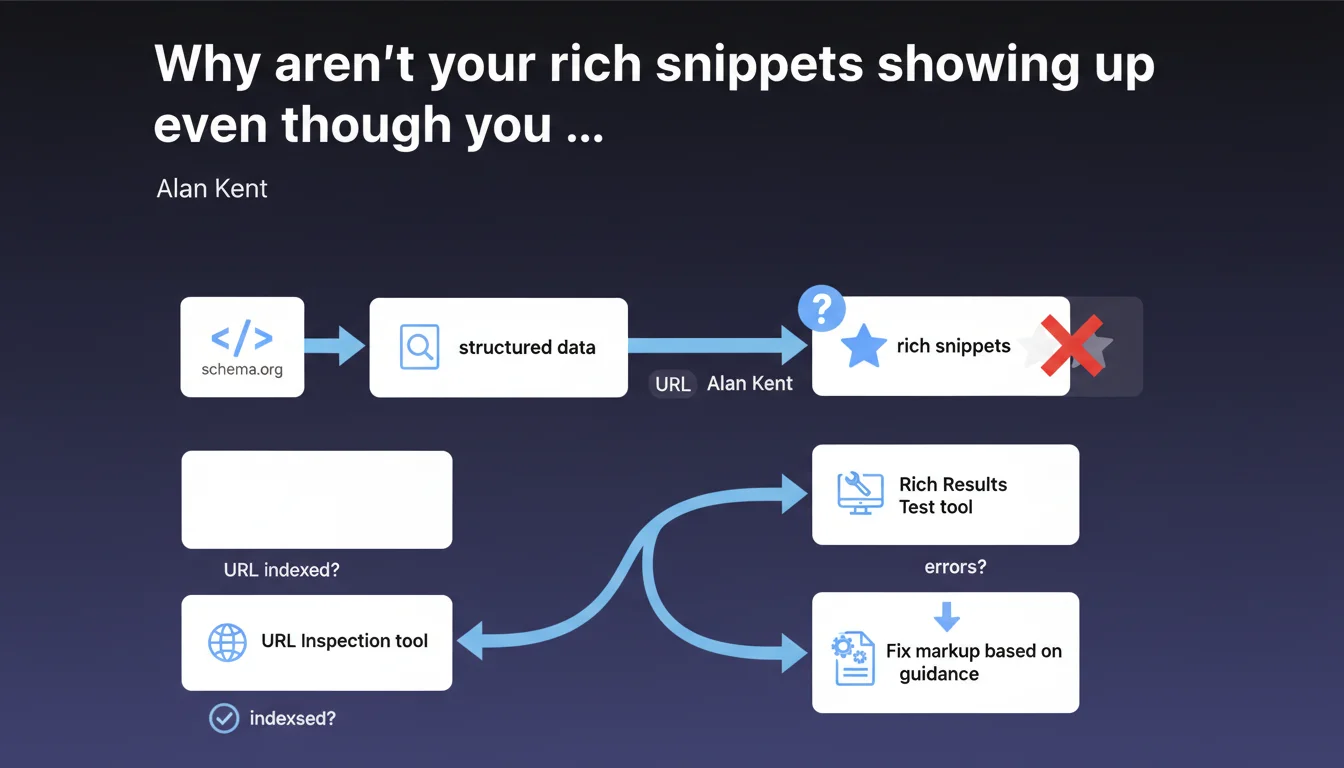
Google emphasizes that the absence of rich results doesn't automatically signal a structured data problem. Before diagnosing your markup, first verify that the page is actually indexed using the URL Inspection Tool. Once indexation is confirmed, the Rich Results Test becomes your primary diagnostic tool for identifying and fixing structured data errors.
What you need to understand
Why does indexation come before markup diagnosis?
The logic is relentless: an unindexed page cannot generate rich results, no matter how solid your Schema.org markup is. Google emphasizes this verification sequence because many SEOs waste time debugging perfectly valid JSON-LD on pages that Googlebot has simply never indexed.
The URL Inspection Tool gives you a binary but critical view: is the page in the index or not? If the answer is no, your problem isn't the markup—it's indexation itself. And that completely changes your diagnosis.
Is the Rich Results Test really sufficient to diagnose all errors?
Google positions this tool as the reference for identifying structured data errors. Concretely, it parses your markup and flags missing properties, invalid data types, and violations of specific guidelines for each rich result type.
The tool provides contextual advice—but let's be honest, the level of detail varies enormously depending on the type of error. Some errors return cryptic messages that require deep dives into the Schema.org documentation.
What exactly does Google mean by "special presentation"?
The wording is deliberately vague. Google uses "special presentation" rather than "rich snippet" or "rich result"—probably to cover the full range of visual enhancements in the SERPs: rating stars, breadcrumbs, carousels, expandable FAQs, and more.
This phrasing also gives Google an out: having valid markup doesn't guarantee rich result display. The algorithm can decide not to show it for reasons of relevance, quality, or editorial policy.
- Indexation is an absolute prerequisite—check it systematically before debugging markup
- The Rich Results Test detects technical errors but doesn't guarantee actual rich result display
- Google implicitly distinguishes between technical validation and algorithmic eligibility
- Correction advice varies in clarity depending on the error type encountered
SEO Expert opinion
Is this sequential approach aligned with real-world practices?
Absolutely. The classic mistake is obsessing over JSON-LD syntax when the page is noindex or blocked by robots.txt. The methodology proposed by Alan Kent is pragmatic and reflects exactly what we observe in the field: 60-70% of "rich snippet problems" reported by clients are actually indexation issues.
What's missing from this statement? An important nuance: even with an indexed page and valid markup, Google may choose not to display your rich results. And there, you're in a complete gray zone. [Needs verification]: no official tool tells you why valid markup isn't being transformed into enriched display.
What limitations does the Rich Results Test have that you should know about?
Several. First, it only tests rich result types supported by Google—certain valid Schema.org vocabularies trigger no special display. Second, it doesn't simulate editorial policy rules: your FAQ might be technically perfect and get denied display for never-explained "content quality" reasons.
Critical point: the tool tests the live version of the page, not necessarily the version Googlebot crawled. If you have JavaScript injecting markup, the gap between what the tool sees and what the crawler sees can create false positives. Always test in parallel with Mobile-Friendly Test or URL Inspection.
Do you really need to wait for indexation before fixing markup?
No, and that's where the statement can be misleading. You can absolutely fix your markup before the page is even indexed—that's part of a sound pre-launch checklist. What Google is saying is: "If you don't see rich results, start by checking indexation."
In practice, we work in parallel: validate markup with Rich Results Test while Search Console confirms indexation. But if you're debugging an existing problem, the logical sequence remains: indexation first, markup second.
Practical impact and recommendations
How do you diagnose rich results issues effectively?
Follow this sequence in order. First step: URL Inspection Tool in Search Console. Enter the exact URL, check the indexation status. If "URL is not on Google", stop there—your problem isn't the markup.
Second step: if the page is indexed, move to Rich Results Test. Paste the URL (or source code if testing on staging), run the test. The tool shows you detected rich results and blocking errors. Fix one error at a time, retest immediately.
What are the most common markup errors?
The classics we see in audits: missing required properties (example: a Product without "offers" or "review"), incorrect value types (putting text in a field that expects a number), and invalid date format (Schema.org is very strict about ISO 8601).
Sneaky error: incorrectly nested tags. You put a "Review" at the root instead of nesting it inside the parent "Product"—technically valid, but Google doesn't interpret it the way you intended. The Rich Results Test doesn't always flag these logic errors.
What if the markup is valid but rich results still don't appear?
This is the most frustrating scenario. Your markup is technically correct, the page is indexed, but nothing displays. Check Search Console first, in the "Enhancements" section—sometimes Google detects the markup but flags warnings (not errors) that block display.
If even Search Console doesn't help, you're in the gray zone. Google can decide your content doesn't deserve a rich result for quality, duplication, or editorial policy reasons. There, no tool will give you a clear answer. [Needs verification]: test on less competitive queries; sometimes display depends on search context.
- Verify indexation via URL Inspection Tool before analyzing any markup
- Use Rich Results Test on the exact URL, not just isolated source code
- Fix errors one at a time and retest immediately after each change
- Check the "Enhancements" section in Search Console for non-blocking warnings
- Test JavaScript rendering with Mobile-Friendly Test if markup is injected dynamically
- Compare markup detected by the tool with what's visible in source code (View Page Source)
- Wait 2-3 weeks after corrections before concluding there's an algorithmic issue
The methodology is simple but often overlooked: indexation then validation. The Rich Results Test is your primary ally, but it doesn't replace a deep understanding of Schema.org and the specific Guidelines for each rich result type.
Let's be pragmatic: diagnosing and fixing complex structured data errors, especially on multi-template sites with dynamic generation, requires pointed technical expertise. If you find yourself stuck after multiple iterations, or if you're managing a catalog of thousands of pages with Product, FAQ, or HowTo markup, working with a specialized SEO agency can save you precious time and prevent costly visibility mistakes.
❓ Frequently Asked Questions
Le Rich Results Test remplace-t-il l'ancien Structured Data Testing Tool ?
Pourquoi mon balisage est-il valide dans Rich Results Test mais pas détecté dans Search Console ?
Peut-on avoir plusieurs types de structured data sur la même page ?
Les rich results influencent-ils directement le classement organique ?
Faut-il utiliser JSON-LD, Microdata ou RDFa pour les données structurées ?
🎥 From the same video 14
Other SEO insights extracted from this same Google Search Central video · published on 28/07/2022
🎥 Watch the full video on YouTube →
💬 Comments (0)
Be the first to comment.