
Official statement
Other statements from this video 14 ▾
- □ Should you really remove prices and stock levels from your title tags?
- □ Is your title tag really showing up the way you think it is in Google's search results?
- □ Why does Google really require 1200 pixels for product images to appear in rich results?
- □ Should you really be using the Max Image Preview tag to control how your images appear in Google?
- □ Are structured data really essential to avoid missing out on rich snippets?
- □ Why does Google really insist on 6 minimum fields in product structured data?
- □ Why aren't your rich snippets showing up even though you have Schema.org markup in place?
- □ Does combining structured data and Merchant Center feeds really unlock maximum e-commerce visibility?
- □ Does Google really calculate price drops independently from what merchants declare?
- □ Why does Google reject price ranges in product structured data?
- □ Why doesn't Google display every single price drop you markup?
- □ Do GTIN Identifiers Really Boost Your Product Visibility on Google?
- □ Does Google really exclude 100% online businesses from Business Profile — and why?
- □ Are structured data and Merchant Center really the most profitable SEO strategy in the long run?
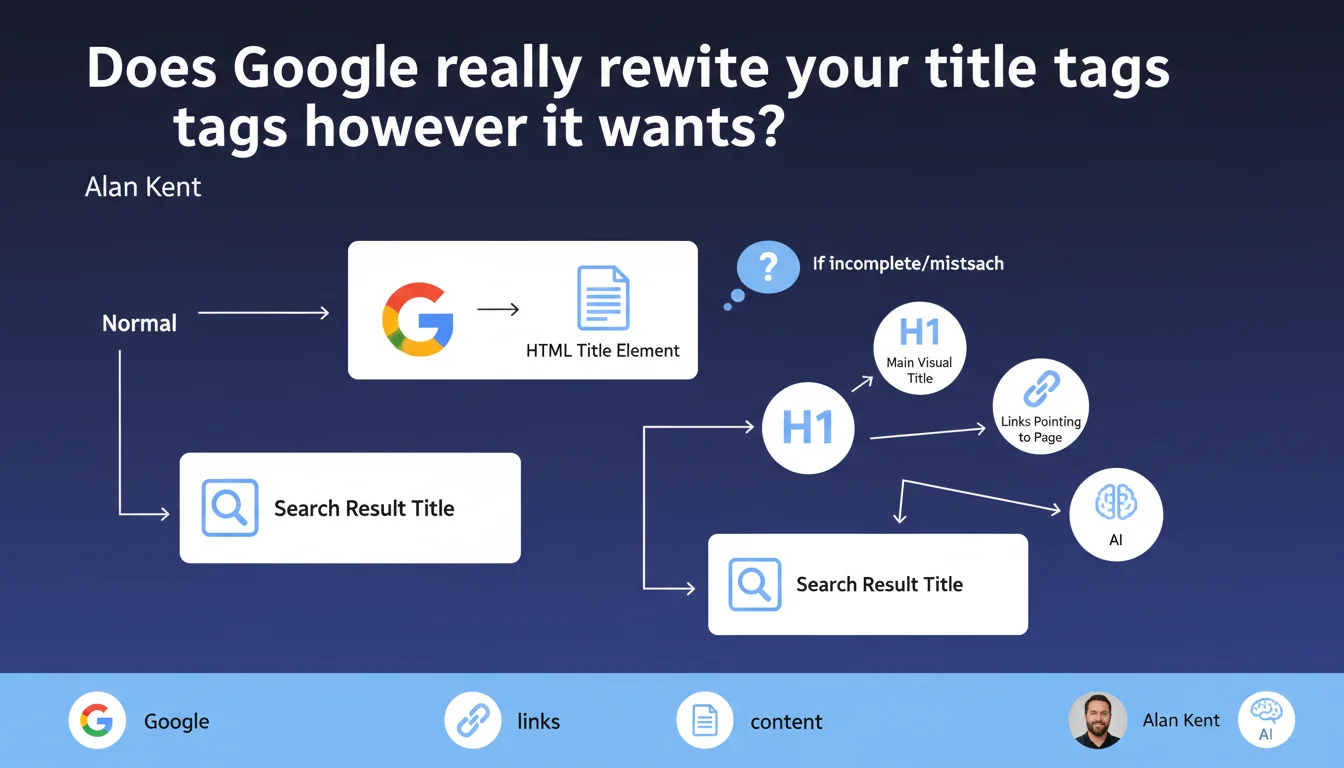
Google prioritizes the HTML <title> tag to generate title links in search results, but reserves the right to replace it if it deems it incomplete or unsuitable for the content. Alternative sources include the main visual title (H1, often) or even the anchor text of backlinks. In other words: you suggest, Google decides.
What you need to understand
Why doesn't Google simply stick to the title tag every time?
The <title> tag remains the primary source for title links displayed in the SERPs. But Google applies a quality logic: if the HTML title seems misleading, incomplete, or disconnected from the actual content, it will look elsewhere.
Concretely, the algorithm analyzes other signals — the visible H1, subheadings, or even the anchor text of external links pointing to the page. The stated objective is to improve user experience by avoiding clickbait titles, truncated ones, or generic ones.
What alternative sources does Google use?
Google doesn't provide an exhaustive list (obviously), but Alan Kent explicitly mentions two alternative sources: the main visual title of the page (typically the H1) and the text of incoming links.
This means that a well-written H1 can compensate for an approximate title tag — or vice versa. As for backlink anchors, their influence remains unclear: Google doesn't specify how often it uses them or in what specific contexts.
What criteria trigger the replacement of a title tag?
The wording is deliberately vague: "Google believes a title is incomplete or does not match the content". No numerical threshold, no public criteria grid.
In practice, observed triggers include: keyword stuffing, generic titles ("Home"), titles that are too long (truncated beyond ~60 characters), or titles that don't reflect the user's search query. But the boundary remains fuzzy and arbitrated by the algorithm.
- Google prioritizes the HTML
<title>tag, but doesn't guarantee it 100% - The H1 and backlink anchors can serve as alternative sources
- The criteria for replacement are not precisely documented
- The stated objective is to improve perceived relevance to the user
SEO Expert opinion
Is this statement consistent with real-world observations?
Yes, generally — but with nuances. Since the late August 2021 update, we indeed observe that Google massively rewrites title tags, sometimes up to 60-80% of pages in certain niches. Alan Kent's statement merely officially confirms what practitioners are already experiencing.
The problem? Google provides no metrics to quantify this phenomenon, nor tools to preview what will be displayed. SEOs must therefore juggle optimizing for the code (HTML title) and optimizing for display (H1, semantic consistency). [To verify]: the actual frequency of using backlink anchors as a replacement source remains undocumented.
Backlink anchors as a source: truly credible?
Mentioning incoming link anchors as an alternative source is interesting — and concerning. If a competitor sends you links with toxic or misleading anchors, could that influence your displayed title link? Google doesn't clarify.
In practice, we rarely observe this scenario, except on pages with minimal text content (minimalist landing pages, for example). But the lack of precise documentation on the activation conditions of this rule makes any optimization based on this point highly speculative.
Should you still optimize the title tag if Google rewrites it?
Absolutely. The HTML title remains the primary source, and it's the one you control directly. Neglecting this tag under the pretext that Google can modify it would be a strategic error.
The pragmatic approach is to align title and H1 around the same intent, while avoiding keyword stuffing. If Google sees strong consistency between these two elements, it will have less reason to replace them. But let's be honest: you don't control the final rendering.
Practical impact and recommendations
What should you concretely do to limit rewrites?
First rule: align title tag and H1 around the same semantic target. If the two diverge too much, Google will likely favor the visible H1. Second rule: avoid generic titles ("Home", "Contact") or keyword-stuffed ones.
Third rule: respect the 60-character limit (approximately) to avoid truncation. A title that is too long increases the risk of automatic rewriting. Finally, regularly test the actual display in the SERPs — and adjust if necessary.
How do you verify if Google is replacing my titles?
No official Google tool alerts you to modifications. You must therefore manually monitor the SERPs or use third-party tools (SEMrush, Ahrefs, Screaming Frog via post-indexation checks).
Systematically compare the HTML title (site source) with the title link displayed in the results. If you notice a discrepancy, analyze the H1, text content, and any backlink anchors to identify the source used by Google.
What mistakes should you absolutely avoid?
Never duplicate the same title tag across multiple pages — Google may differentiate them itself in an unpredictable way. Avoid vague formulations ("Products", "Services") that provide no context.
Don't count on backlink anchors to "fix" a poor title: this lever is unpredictable and undocumented. Finally, don't neglect consistency between title, H1, and text content — it's the foundation of any defensive strategy against rewrites.
- Align
<title>tag and<h1>around the same search intent - Limit title length to 60 characters maximum
- Avoid generic, duplicate, or keyword-stuffed titles
- Regularly monitor actual display in the SERPs (no automatic alert)
- Strengthen semantic consistency between title, H1, and main content
- Avoid relying on backlink anchors as an optimization lever
❓ Frequently Asked Questions
Google peut-il remplacer mon title même s'il respecte toutes les bonnes pratiques ?
Le H1 a-t-il plus de poids que la balise title pour l'affichage dans les SERP ?
Est-ce que Google utilise souvent les ancres de backlinks comme title link ?
Puis-je forcer Google à afficher mon title HTML exact ?
La Search Console indique-t-elle quand un title est remplacé ?
🎥 From the same video 14
Other SEO insights extracted from this same Google Search Central video · published on 28/07/2022
🎥 Watch the full video on YouTube →
💬 Comments (0)
Be the first to comment.