
Official statement
Other statements from this video 14 ▾
- □ Does Google really rewrite your title tags however it wants?
- □ Is your title tag really showing up the way you think it is in Google's search results?
- □ Why does Google really require 1200 pixels for product images to appear in rich results?
- □ Should you really be using the Max Image Preview tag to control how your images appear in Google?
- □ Are structured data really essential to avoid missing out on rich snippets?
- □ Why does Google really insist on 6 minimum fields in product structured data?
- □ Why aren't your rich snippets showing up even though you have Schema.org markup in place?
- □ Does combining structured data and Merchant Center feeds really unlock maximum e-commerce visibility?
- □ Does Google really calculate price drops independently from what merchants declare?
- □ Why does Google reject price ranges in product structured data?
- □ Why doesn't Google display every single price drop you markup?
- □ Do GTIN Identifiers Really Boost Your Product Visibility on Google?
- □ Does Google really exclude 100% online businesses from Business Profile — and why?
- □ Are structured data and Merchant Center really the most profitable SEO strategy in the long run?
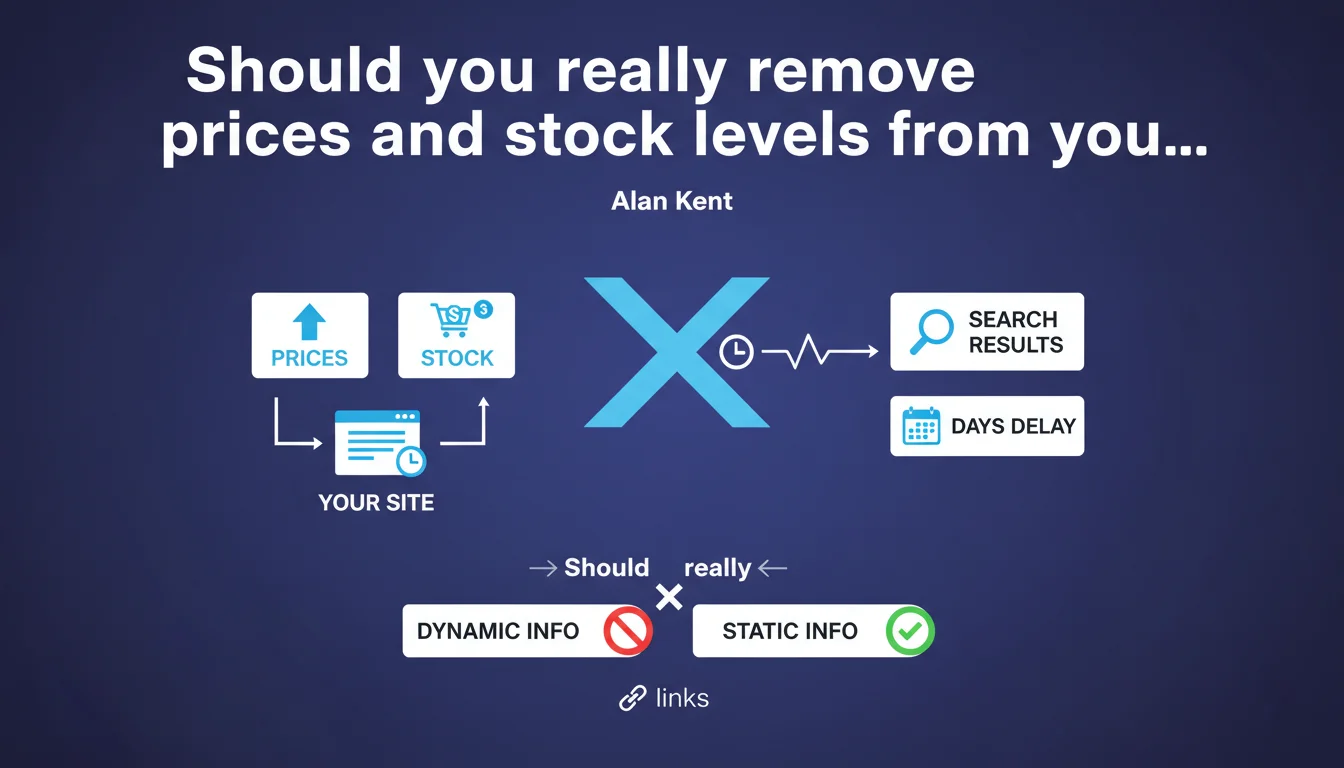
Google advises against including prices and stock levels in title tags because there can be a delay of several days between when content is crawled and indexed. As a result, your SERPs display outdated information that hurts click-through rates and user trust. This recommendation aims to prevent gaps between what appears in search results and what actually exists on your site.
What you need to understand
Why does Google insist on this specific point?
The answer lies in indexation latency. When you modify a title tag, Googlebot must first recrawl the page, then reindex it, before the change appears in the SERPs. This process rarely takes less than 48-72 hours, sometimes much longer depending on your crawl budget.
Imagine a product displayed as "In Stock - 15 Units" in the title. Two days later, the stock is depleted on your site, but Google still displays the old title. The user clicks, discovers the product is unavailable, and leaves. You lose a qualified click and increase your bounce rate.
What dynamic information is affected?
Alan Kent explicitly targets prices and stock levels. But the logic extends to any data that fluctuates rapidly: flash promotions, ephemeral discount percentages, real-time availability.
Event dates or "New" mentions are less problematic if they remain valid for several weeks. The real danger is what changes daily or weekly.
Does this recommendation apply only to e-commerce?
No. While the examples target e-commerce, the principle covers any site with volatile data in titles. A booking site displaying "12 seats available" or a news outlet indicating "Updated 2 hours ago" creates the same lag.
The logic remains identical: if your title promises regularly updated information that Google cannot reflect in real time, you generate user friction.
- Indexation delay: several days between title modification and its display in SERPs
- Dynamic information affected: prices, stock, flash promotions, real-time availability
- Main risk: display of outdated information that degrades click-through rate and user satisfaction
- Scope: e-commerce but also booking, news outlets, any site with volatile data
SEO Expert opinion
Is this statement consistent with practices observed in the field?
Yes, and it's actually one of the rare pieces of advice from Google that rests on an objective technical constraint. The crawl and indexation delay is not a theory — it's measurable in Search Console, under Coverage or Indexation sections.
I've seen e-commerce sites lose 15-20% CTR on product pages whose titles displayed "In Stock" when the product had been out of stock for a week. The user clicks, finds a grayed-out button, and Google records pogo-sticking that tanks behavioral signals.
What nuances should be added to this recommendation?
Alan Kent's statement remains generic. He doesn't specify whether certain sites benefit from a more generous crawl budget that would reduce the lag. [To verify]: could a site crawled daily afford dynamic titles with weekly updates?
Second nuance — and this one is critical: Google rewrites titles in 60-70% of cases according to several studies. If you remove prices and stock from your title, there's no guarantee Google won't pull this info from elsewhere (H1, meta description, content) and inject it itself. Result: you lose control without gaining freshness.
Third point: this recommendation says nothing about structured data. Using Schema.org Product with real-time price and availability remains relevant — Google displays this data in rich snippets with much shorter latency.
In what cases does this rule not strictly apply?
If your catalog has fewer than 100 products and you generate significant daily traffic on each product page, Google will likely crawl these pages several times per week. The lag remains manageable.
Another exception: categories with strong editorial value. A title like "iPhone 15 Pro: Price comparison and availability" on a comparison page aggregating 20 merchants remains valid — users expect to find multiple prices, not a single fixed figure.
Practical impact and recommendations
What should you do concretely on an existing e-commerce site?
Start with an audit of title templates. Identify all dynamic variables injected: {{price}}, {{stock_status}}, {{discount_percentage}}. List the affected pages and their crawl frequency in Search Console.
Replace these variables with static but differentiated elements. Instead of "Nike Air Max 90 - $129 - In Stock", switch to "Nike Air Max 90 | Fast Shipping & Free Returns". You keep a differentiating element (the logistical promise) without risking obsolescence.
For large sites, prioritize best-sellers and strategic pages. No need to overhaul 50,000 titles at once — focus on the 20% of products generating 80% of organic traffic.
How do you manage price and stock information without putting it in the title?
Use Schema.org structured data of the Product type. The price, priceCurrency, and availability properties are crawled more frequently and feed rich snippets. Google displays this information directly in SERPs without passing through the title.
Also consider the meta description, which better tolerates semi-dynamic information if it remains valid for a few days. "Starting at $129 - Ships within 24h" in the description works better than an exact price fixed in the title.
Finally, leverage sitelinks and featured snippets. Well-structured content (comparison tables, FAQs with pricing) can win enriched positions that display updated data.
What errors should you avoid when redesigning titles?
Don't fall into the trap of identical generic titles. "Nike Air Max 90 | Sneakers" on 500 different color variants is hidden duplicate content. Find other angles: material, usage, customer benefit.
Also avoid removing all urgency or appeal. If you strip out the price, compensate with a reassurance element or clear value proposition. "24h Shipping" or "30-Day Returns" work well.
Final error: changing titles without monitoring impact. Set up before/after tracking in Analytics and Search Console. If your CTR drops after the redesign, it means your new titles lack punch.
- Audit title templates to identify dynamic variables (prices, stock, promotions)
- Replace these variables with static differentiating elements (USP, benefits, reassurance)
- Prioritize best-sellers and high-traffic pages for redesign
- Implement Schema.org Product with price and availability for rich snippets
- Use meta description for semi-dynamic info with short lifespan
- Avoid identical generic titles on product variants
- Monitor CTR and positions before/after changes in Search Console
- Test multiple title formulations on strategic pages
❓ Frequently Asked Questions
Les rich snippets affichant prix et stock contredisent-ils cette recommandation ?
Puis-je garder un prix indicatif du type 'À partir de...' dans le title ?
Cette règle s'applique-t-elle aussi aux H1 et meta descriptions ?
Comment vérifier la fréquence de crawl de mes fiches produits ?
Google pénalise-t-il algorithmiquement les titles avec prix et stock ?
🎥 From the same video 14
Other SEO insights extracted from this same Google Search Central video · published on 28/07/2022
🎥 Watch the full video on YouTube →
💬 Comments (0)
Be the first to comment.