
Official statement
Other statements from this video 14 ▾
- □ Does Google really rewrite your title tags however it wants?
- □ Should you really remove prices and stock levels from your title tags?
- □ Is your title tag really showing up the way you think it is in Google's search results?
- □ Why does Google really require 1200 pixels for product images to appear in rich results?
- □ Should you really be using the Max Image Preview tag to control how your images appear in Google?
- □ Are structured data really essential to avoid missing out on rich snippets?
- □ Why does Google really insist on 6 minimum fields in product structured data?
- □ Why aren't your rich snippets showing up even though you have Schema.org markup in place?
- □ Does Google really calculate price drops independently from what merchants declare?
- □ Why does Google reject price ranges in product structured data?
- □ Why doesn't Google display every single price drop you markup?
- □ Do GTIN Identifiers Really Boost Your Product Visibility on Google?
- □ Does Google really exclude 100% online businesses from Business Profile — and why?
- □ Are structured data and Merchant Center really the most profitable SEO strategy in the long run?
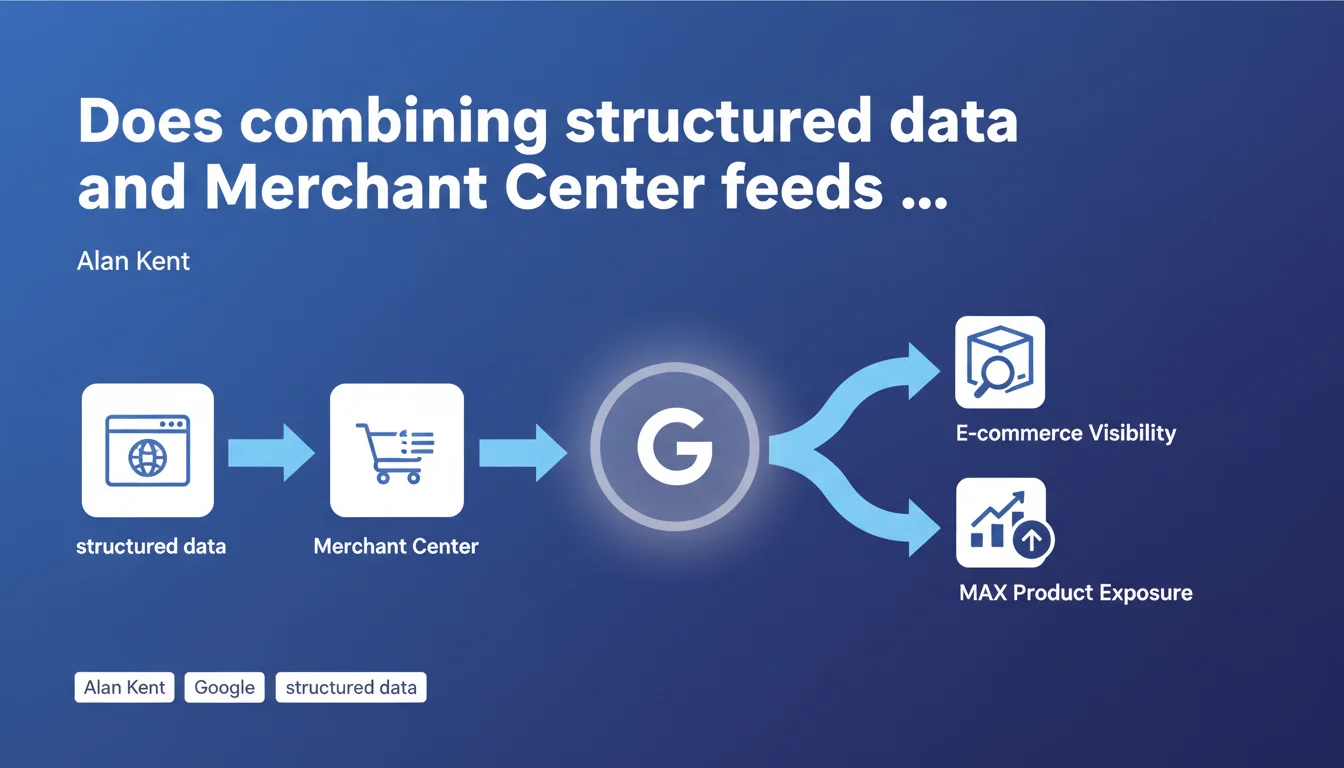
Google confirms that a combined approach — Product structured data on pages AND Google Merchant Center feeds — maximizes product exposure across its results. This official statement validates what many practitioners have already observed: a single channel is no longer enough to dominate competitive e-commerce SERPs.
What you need to understand
Does Google Merchant Center replace Product structured data?
No. The statement from Alan Kent is clear: the two channels are complementary, not interchangeable. Product structured data embedded directly in your product page HTML allows Google to understand and display enriched information in organic results (price, availability, reviews).
The Merchant Center feed, on the other hand, fuels a different ecosystem: Google Shopping, product ads, and specific features like free product listings. The two systems coexist and reinforce each other — they don't cannibalize one another.
Why does Google recommend this dual approach?
Because each channel has its own entry points in the SERPs. Rich snippets generated by structured data appear in standard organic results. The Merchant Center feed, meanwhile, powers the Shopping tab, product carousels, and other visual formats that Google is deploying increasingly aggressively.
By combining both, you multiply your chances of appearing in multiple placements simultaneously for the same query. It's a strategy of maximum SERP coverage.
What are the risks of relying on just one channel?
If you only deploy structured data without a Merchant Center feed, you forfeit all visibility in the Shopping ecosystem — including free placements. Conversely, feeding only Merchant Center without marking up your pages deprives you of organic rich snippets, which often generate better click-through rates than standard results.
In either case, you're leaving market share to competitors who play both angles.
- Product structured data powers enriched organic results (price, reviews, availability).
- Google Merchant Center feeds activate visibility in Shopping, carousels, and free product listings.
- Google explicitly recommends combining both channels to maximize exposure.
- One channel alone = partial coverage of e-commerce SERPs, meaning missed opportunities.
SEO Expert opinion
Is this statement aligned with what we actually see in the field?
Absolutely. Audits I've conducted over several years show that e-commerce sites dominating competitive SERPs consistently use both levers. Pure players who bet solely on Merchant Center saw their organic visibility stagnate, while those who never opened a GMC account miss out on thousands of free clicks in the Shopping tab.
What's interesting is that Google is finally formalizing this dual strategy — when it was already an implicit standard for any serious e-commerce SEO professional. The real question is: why this clarification now? Probably because Google Shopping is evolving toward an increasingly hybrid model, where the line between paid and organic is blurring.
Are there cases where this rule doesn't apply — or applies less?
If you're selling ultra-niche products with marginal search volume, the effort to maintain a Merchant Center feed can exceed the benefit. Same if your catalog changes constantly (ephemeral products, ultra-volatile inventory): Merchant Center demands near real-time synchronization, which can quickly become unmanageable without solid infrastructure.
Another case: certain B2B markets or quote-based products. Google Shopping is historically consumer-oriented — if your prices aren't publicly displayable, the feed loses much of its value. [To verify]: Google mentions a "recommended combined approach," but never quantifies the actual impact. No hard data on visibility or traffic gains. As usual, Google stays vague on concrete metrics.
What nuances should we add to this recommendation?
Be careful not to confuse "recommended" with "mandatory." If your site already generates solid organic traffic with well-configured rich snippets, adding Merchant Center will be an incremental gain — not a game-changer. Conversely, if you're starting from scratch, I always prioritize structured data first, because it has direct immediate SEO impact, while Merchant Center requires a validation and ramp-up phase.
Another point: quality trumps quantity. A poorly structured Merchant Center feed (generic titles, low-quality images, rough categorization) won't help you. Better to have 500 perfectly optimized products than 10,000 hastily assembled listings.
Practical impact and recommendations
What should you do concretely to implement this dual strategy?
First step: audit what you have. Verify that your product pages properly integrate Product structured data (Product schema, not Offer alone). Use Google's Rich Results Test to spot errors or missing properties. Fix alerts before proceeding further.
Next, open a Google Merchant Center account if you haven't already, and configure a product feed. Prefer an automated feed (API, plugin, connector) over a static CSV file — you'll avoid chronic desynchronization. Make sure your feed meets Google's specifications: descriptive titles, high-resolution images, GTIN where applicable.
Finally, establish a continuous synchronization process. Prices, inventory, promotions: everything must be up-to-date everywhere, in real-time or near real-time. A gap between your site and Merchant Center = feed suspension, or even manual penalties.
What mistakes should you absolutely avoid in this setup?
Don't blindly duplicate your SEO titles into the Merchant Center feed. GMC titles should be descriptive and conversion-focused (brand + model + key features), not keyword-stuffed. Google heavily penalizes over-optimized titles in Shopping.
Another common trap: neglecting product categorization. Merchant Center uses its own taxonomy (Google Product Category). If you ignore it or categorize roughly, your products will be under-exposed, or even invisible in certain queries.
Lastly, don't launch a Merchant Center feed without first verifying that your site complies with Google's merchant policies. A single non-compliant product can lock down your entire account.
How do you verify that everything is correctly configured and synchronized?
For structured data: use Google's Rich Results Test. Also check the "Enhancements" reports in Google Search Console — they flag errors detected on your Product tags.
For Merchant Center: consult the "Diagnostics" tab to identify rejected or pending products. Enable email alerts so you're notified immediately of issues (account suspension, non-compliance detected).
Test manually too: search a few strategic product queries on Google, switch to the Shopping tab, and verify that your listings appear. If not, dig into the Merchant Center logs.
- Deploy Product structured data (schema.org) on all product pages
- Set up and configure a Google Merchant Center account with an automated feed
- Ensure real-time synchronization between your website and GMC feed (prices, inventory, promotions)
- Verify strict consistency between structured data and Merchant Center feed
- Use descriptive (non-over-optimized) titles and precise categorization in GMC
- Regularly test with the Rich Results Tool and Google's Shopping tab
- Monitor Merchant Center's "Diagnostics" reports and Search Console's "Enhancements"
❓ Frequently Asked Questions
Les données structurées Product suffisent-elles sans flux Merchant Center ?
Que se passe-t-il si les données diffèrent entre le site et Merchant Center ?
Faut-il utiliser les deux canaux même pour un petit catalogue ?
Google Merchant Center est-il réservé aux annonces payantes Shopping ?
Combien de temps avant de voir les premiers effets de cette double approche ?
🎥 From the same video 14
Other SEO insights extracted from this same Google Search Central video · published on 28/07/2022
🎥 Watch the full video on YouTube →
💬 Comments (0)
Be the first to comment.