
Official statement
Other statements from this video 14 ▾
- □ Does Google really rewrite your title tags however it wants?
- □ Should you really remove prices and stock levels from your title tags?
- □ Is your title tag really showing up the way you think it is in Google's search results?
- □ Why does Google really require 1200 pixels for product images to appear in rich results?
- □ Should you really be using the Max Image Preview tag to control how your images appear in Google?
- □ Are structured data really essential to avoid missing out on rich snippets?
- □ Why does Google really insist on 6 minimum fields in product structured data?
- □ Why aren't your rich snippets showing up even though you have Schema.org markup in place?
- □ Does combining structured data and Merchant Center feeds really unlock maximum e-commerce visibility?
- □ Does Google really calculate price drops independently from what merchants declare?
- □ Why does Google reject price ranges in product structured data?
- □ Do GTIN Identifiers Really Boost Your Product Visibility on Google?
- □ Does Google really exclude 100% online businesses from Business Profile — and why?
- □ Are structured data and Merchant Center really the most profitable SEO strategy in the long run?
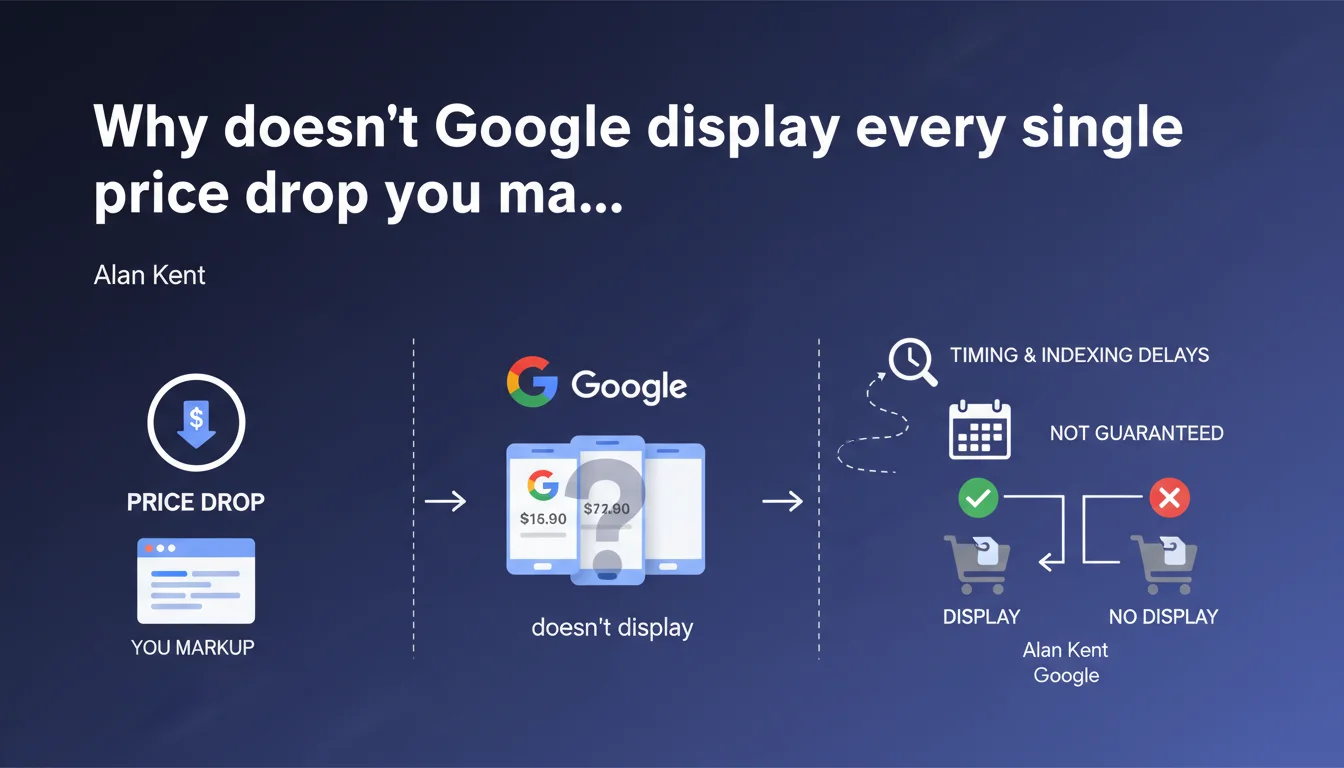
Google does not guarantee the display of all marked-up price drops in search results. The display is random and heavily depends on indexing timing. In other words: correct markup alone isn't enough — Google also needs to crawl at the right moment and decide to show the information.
What you need to understand
What does this lack of guarantee actually mean in practice?
Alan Kent from Google puts it bluntly: even if you perfectly mark up your price drops with Schema.org, nothing guarantees that Google will display this information in the SERPs. The display is random — meaning: discretionary.
The search engine sovereignly decides whether or not it deems it relevant to show a price drop. This depends on undocumented criteria: product relevance, price history, trust granted to the site, query context.
Why is indexing timing such a problem?
A price drop has a limited lifespan. If Google crawls your product page before you've updated the markup, it misses the information. If it crawls after the promotion ends, same result.
The delay between updating your markup and Google picking it up can range from a few hours to several days. For flash sales or Black Friday events, this is a real issue: you risk missing the window of opportunity.
What are the implications for e-commerce businesses?
- Marking up price drops remains essential — it's the price of entry, not a guarantee of results.
- You need to anticipate crawl delays and force reindexing if possible (Search Console, dynamic sitemaps).
- Random display means you can't rely on this enrichment as a stable lever.
- Google likely favors sites with a consistent price history and reliable structured data.
SEO Expert opinion
Is this statement consistent with what we observe in the field?
Yes, and it's actually an understatement. E-commerce businesses that correctly mark up their promotions have long noticed that price drop display is erratic. Sometimes it shows, sometimes it doesn't — for no apparent reason.
Google doesn't say whether the algorithm filters out "non-credible" price drops (like permanent -70% discounts) or if there's a minimum discount threshold. [To verify] on what exact criteria the display decision is made. The lack of clarity is total.
What is Google hiding behind this cautious wording?
Saying the display is "random" is an admission: Google doesn't fully control what it shows, or it prefers to keep the final decision in its hands. Probably both.
Indexing timing is a real problem, but it's also a convenient excuse. Google could easily prioritize crawling product pages during sale periods — it doesn't do this systematically. The implicit message: don't count too heavily on us to boost your flash sales.
What nuances should be added to this statement?
Kent's statement doesn't specify whether certain product types or merchants are favored. We can assume that sites with a good Quality Score (in the broad sense: E-E-A-T, stable price history, low product return rate) are better positioned. But nothing confirmed.
There's also a complete lack of guidance on the retention period of price information in Google's index. If your price drop lasts 48 hours and Google crawls once a week, you're out of luck. No official guidance on this.
Practical impact and recommendations
What should you concretely do to maximize your chances?
First thing: mark up properly. Use Schema.org Offer markup with the price, priceCurrency, and especially priceValidUntil properties. Without this, you have no chance.
Next, force reindexing as soon as you launch a promotion. Submit the URL via Search Console, update your XML sitemap in real-time if possible, and hope Googlebot crawls quickly. On large e-commerce sites, automate this process.
What mistakes should you absolutely avoid?
Don't cheat on prices. Google detects suspicious patterns: products always "on sale", artificially inflated reference prices, fake price drops. If your structured data doesn't match what's actually displayed, you lose all credibility.
Another trap: don't rely on price drop display as your primary traffic lever. It's a plus, not a foundation. If your e-commerce SEO strategy is based on this, you're vulnerable.
How do you verify that everything is in place?
- Test your markup with Google's Rich Results Test — verify there are no errors.
- Monitor your server logs to see how often Googlebot crawls your promotional product pages.
- Compare the frequency of price drop display across different products to identify any patterns (category, price, popularity).
- Regularly request reindexing of key pages via Search Console, especially during sales periods.
- Maintain a clean and consistent price history — Google values transparency.
❓ Frequently Asked Questions
Le balisage Schema.org des baisses de prix est-il obligatoire pour espérer un affichage ?
Peut-on forcer Google à afficher une baisse de prix dans les résultats ?
Combien de temps faut-il à Google pour indexer une nouvelle baisse de prix ?
Les gros sites e-commerce sont-ils avantagés pour l'affichage des baisses de prix ?
Faut-il utiliser priceValidUntil dans le balisage des promos temporaires ?
🎥 From the same video 14
Other SEO insights extracted from this same Google Search Central video · published on 28/07/2022
🎥 Watch the full video on YouTube →
💬 Comments (0)
Be the first to comment.