
Official statement
Other statements from this video 14 ▾
- □ Google réécrit-il vraiment vos balises title à sa guise ?
- □ Faut-il vraiment bannir les prix et stocks des balises title ?
- □ Comment vérifier efficacement l'affichage réel de vos title links dans les SERP Google ?
- □ Pourquoi Google impose-t-il un seuil de 1200 pixels pour les images produits ?
- □ Faut-il vraiment utiliser la balise Max Image Preview pour contrôler l'affichage de vos images dans Google ?
- □ Pourquoi Google insiste-t-il sur 6 champs minimaux dans les données structurées produits ?
- □ Pourquoi vos rich snippets n'apparaissent-ils pas malgré un balisage Schema.org en place ?
- □ Faut-il vraiment combiner données structurées et flux Merchant Center pour le SEO produit ?
- □ Comment Google calcule-t-il réellement les baisses de prix affichées dans les résultats enrichis ?
- □ Pourquoi Google refuse-t-il les fourchettes de prix dans les données structurées produit ?
- □ Pourquoi Google n'affiche-t-il pas toutes les baisses de prix que vous balisez ?
- □ Les GTIN boostent-ils vraiment l'exposition produit sur Google ?
- □ Google Business Profile : pourquoi les entreprises 100% en ligne sont-elles exclues ?
- □ Les données structurées et Merchant Center sont-elles vraiment la stratégie SEO la plus rentable sur le long terme ?
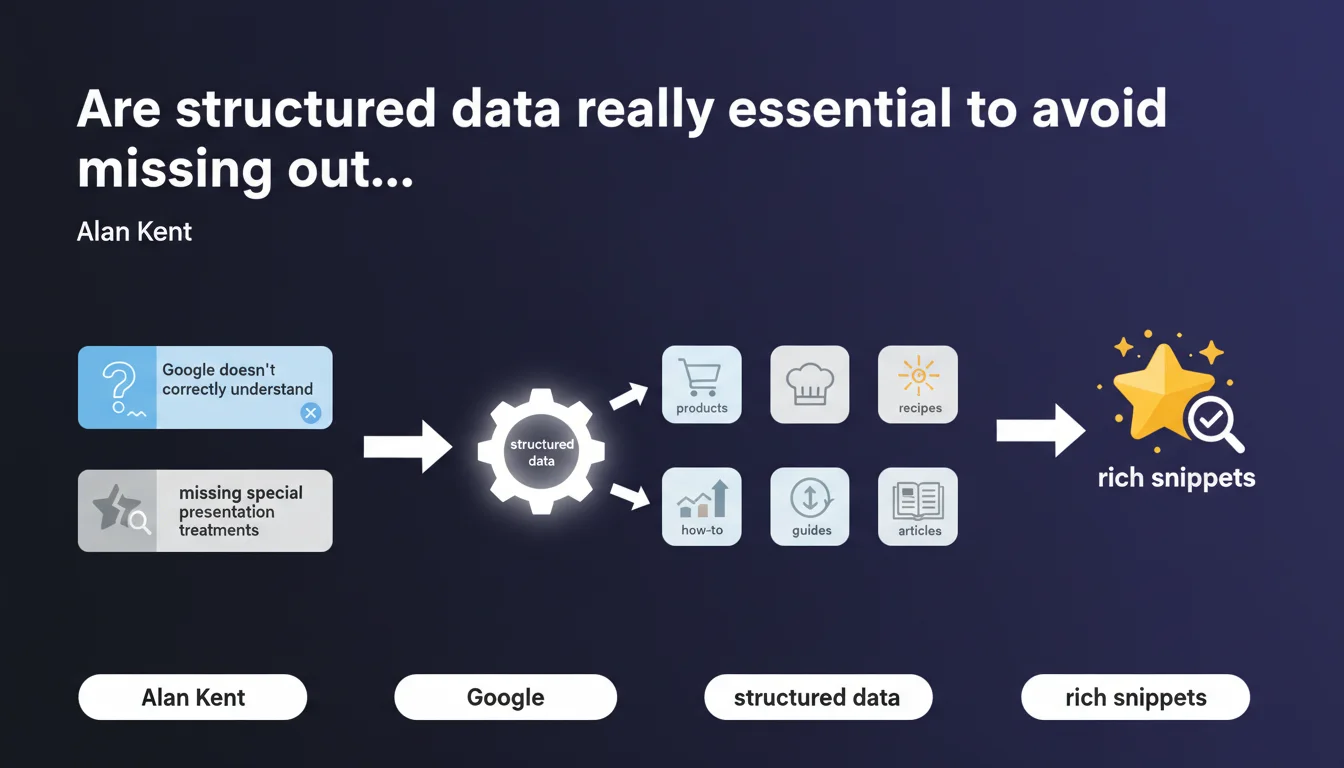
Google confirms that structured data helps identify page intent. Without this markup, certain visual enhancements in SERPs (rich snippets, rich cards) can simply pass you by, even if your content is relevant. Alan Kent specifically points to products, recipes, guides, and articles.
What you need to understand
Why does Google emphasize page intent so much?
Google doesn't just read your text content: it seeks to categorize each page to determine what kind of treatment to apply. A product page doesn't have the same display needs as a blog article or a recipe.
Structured data (Schema.org in JSON-LD, microdata, or RDFa) provides explicit metadata — price, availability, cooking time, author, publication date. It removes ambiguity when HTML alone isn't enough.
Which types of pages are prioritized first?
Alan Kent mentions four categories: products (e-commerce), recipes (cooking), how-to guides (HowTo), and articles (news, blogs). These are obviously not the only ones, but they're where Google offers the most visible visual enhancements.
For an e-commerce site, ignoring Product markup is like voluntarily refusing rating stars, prices displayed directly in results, and availability status. In other words, competitors using it have a display advantage over you.
What actually happens without structured data?
You don't disappear from SERPs — rest assured. But Google may misinterpret your page type, or simply not offer you special presentation treatments (rich snippets, rich cards, carousels). You remain stuck in a standard organic result: blue title, meta description, green URL.
Concretely, that's fewer clicks. When a competitor displays stars and a price next to their title, the user's eye naturally gravitates toward them.
- Structured data guarantees no ranking boost as such — Google has repeated this many times.
- They increase your chances of getting a visual enhancement, which can improve CTR.
- They help the engine better categorize your pages, especially if content is ambiguous or unclear.
- Google remains free to display or not display a rich snippet, even if the markup is present and valid.
SEO Expert opinion
Is this statement consistent with practices observed in the field?
Yes — and it's actually more of a reminder than a revelation. For years, sites implementing Schema.org correctly have seen CTR improvement when rich snippets display. It's not magic, but it's measurable.
The interesting point is that Google acknowledges an inverse problem here: if you don't mark up, you risk missing out on treatments. In other words, the absence of structured data becomes a competitive disadvantage the moment your competitors have it.
What nuances should be noted?
Google does not say that structured data is required to rank. They are not a direct ranking factor. But they condition access to certain visual formats, which themselves influence CTR — and CTR, in turn, can strengthen your position if you're already well-ranked. [To verify]: Google has never published a quantified correlation between CTR and ranking.
Another nuance: not all Schema types are created equal. Google officially supports a restricted list of enhanced types (products, recipes, events, FAQ, HowTo, job postings, etc.). Marking up a page with an exotic Schema.org type won't give you anything visually — even if it remains useful for other search engines or assistants.
In what cases does this rule not apply?
If your site is a personal blog with no commercial ambitions, or if you publish standard editorial content with no technical elements (no recipe, no product, no step-by-step guide), structured data remains optional. Article-type NewsArticle or BlogPosting can help, but visual impact will be minimal.
Similarly, if you operate in an ultra-niche field where nobody marks anything up, the urgency is lower. But the moment a competitor adopts Schema.org, the display gap widens — and catching up takes time.
Practical impact and recommendations
What should you do concretely to implement structured data?
First identify your priority page types: product sheets, blog articles, recipes, events, FAQs. For each, choose the corresponding Schema.org type (Product, Recipe, HowTo, Article, Event, FAQPage…).
Prioritize the JSON-LD format, which Google explicitly recommends. It goes in the <head> tag or just before </body>, and it doesn't touch visible HTML. Cleaner and easier to maintain than microdata nested in content.
Then validate your markup with Google's Rich Results Test and Search Console (Enhancements report). Fix critical errors before rolling out at scale.
What errors must you absolutely avoid?
Never mark up data invisible to users. If you add a price or rating to Schema when they appear nowhere on the visible page, Google considers that manipulation and may deindex your enhancements — or even penalize the site.
Also avoid generic or approximate markup. If you have a product sheet, use Product with all required properties (name, image, offers with price and availability). Incomplete or poorly formed markup will trigger no rich snippet.
- Audit strategic page types (products, articles, guides, recipes, events, FAQs)
- Choose the appropriate Schema.org for each content type
- Implement in JSON-LD in the
<head>or before</body> - Verify all required properties are filled in (see Google Rich Results documentation)
- Validate with Rich Results Test and Search Console (Enhancements report)
- Monitor the appearance (or not) of rich snippets in SERPs after indexing
- Never mark up invisible or false data — risk of manual penalty
❓ Frequently Asked Questions
Les données structurées améliorent-elles directement le classement dans Google ?
Tous les types de Schema.org sont-ils pris en charge par Google ?
Que se passe-t-il si je balise des données invisibles pour l'utilisateur ?
Faut-il utiliser JSON-LD, microdata ou RDFa ?
Comment vérifier que mes données structurées sont bien prises en compte ?
🎥 From the same video 14
Other SEO insights extracted from this same Google Search Central video · published on 28/07/2022
🎥 Watch the full video on YouTube →
💬 Comments (0)
Be the first to comment.