
Official statement
Other statements from this video 9 ▾
- □ Does Google's new Search Status Dashboard really eliminate the need to monitor Twitter for search outages?
- □ Which incidents does Google officially communicate on its status dashboard?
- □ Why doesn't Google inform you about all of its technical incidents?
- □ What are the two hidden channels Google uses to detect search engine incidents?
- □ Should you really sit tight when Google reports an incident on the dashboard?
- □ Does Google really guarantee regular updates on its search incidents?
- □ Why did Google technically separate its Search Status Dashboard from google.com?
- □ Why does Google leave certain search features out of its public incident monitoring?
- □ Should you subscribe to the Search Status Dashboard RSS feed to anticipate Google incidents?
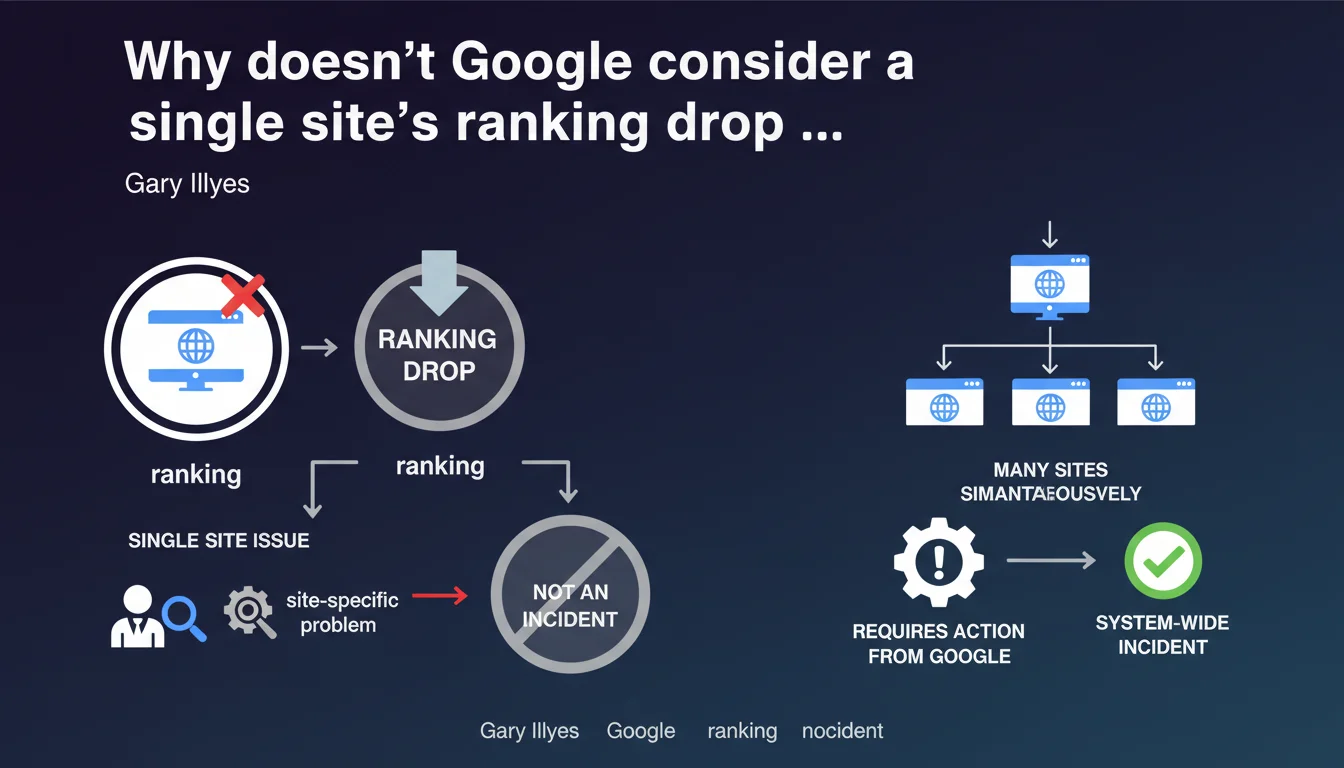
Google clearly distinguishes between global technical incidents (affecting multiple sites simultaneously) and individual ranking problems. If your site loses positions alone, it's an internal issue to investigate — not a Google bug. This clarification absolves Google of responsibility for isolated drops and shifts the burden back to webmasters.
What you need to understand
What is Google's definition of an incident?
An incident refers to a technical malfunction in the search engine that strikes multiple sites at the same time. Typically: a massive indexing bug, a crawl system outage, or a display problem in the SERPs affecting an entire category of results.
Google only intervenes in these cases — because they stem from a problem with their own infrastructure. If you crash alone, in Google's eyes, it's not their problem to fix.
Why doesn't a single site losing its ranking count as an incident?
Because Google's logic is based on the following assumption: if a single site tanks, the cause is specific to that site. A noindex tag added by mistake, a structural change, a targeted algorithmic penalty, a perceived quality drop.
It's a defensive stance — but not illogical. A global incident is detected by its scale. An isolated drop requires an internal diagnosis before pointing fingers at the algorithm.
What are the implications for an SEO practitioner?
Concretely, this means you can no longer hide behind a supposed Google bug whenever a client loses positions. You must prove that other sites are affected simultaneously to qualify the problem as an incident.
Otherwise, the fault is presumed internal — and it's up to you to dig deeper: server logs, recent technical changes, accidental deindexing, lost backlinks, duplicate content, failed migration.
- An incident requires Google to take action on its infrastructure
- An isolated drop is presumed to be a problem specific to the site
- If you want to prove an incident, you must show that multiple unrelated sites are affected
- Google will never validate an incident based on a single case
SEO Expert opinion
Is this distinction really that clear in practice?
In theory, yes. In practice? It's sometimes murkier. We've seen targeted algorithmic penalties strike an entire vertical (example: affiliate sites, health sites) without Google communicating about it immediately.
Technically, it's not an incident since the algorithm is working as intended — but for affected sites, it looks a lot like a sectoral incident. The line between "algorithm evolution" and "bug impacting a segment" is sometimes thin.
Does Google use this definition to get itself off the hook?
Let's be honest: yes, partly. By making this distinction, Google protects itself against complaints from webmasters convinced a bug explains their drop — when they've simply been outpaced by competitors or penalized for good reason.
But this stance has a downside: certain real bugs that only affect a small number of sites can be overlooked because they don't reach the scale threshold needed to qualify as an incident. [To verify]: how many isolated cases are actually unrecognized bugs?
In what cases does this rule not apply?
When you observe a strong correlation between multiple unrelated sites (different industries, different hosting) that drop at exactly the same moment. There, you have grounds to document a potential incident.
Another case: silent indexing bugs. A site wrongly deindexed by a crawl bug can remain invisible if no one reports it. Google will never detect it as an incident if you don't report it with solid evidence.
Practical impact and recommendations
What should you do concretely when facing a ranking drop?
First reflex: check indexation. A site:example.com search in Google, a quick look at Search Console to spot an accidentally added noindex tag, a misconfigured robots.txt, a canonical pointing to the wrong URL.
Next, compare with your direct competitors. If they dropped too, at the same time, on the same queries: you might have found an incident. Otherwise, it's a problem specific to you.
How do you verify if it's an incident or an internal problem?
Use position tracking tools on a sample of unrelated competitors. If everyone drops on a given query, it's probably an incident or an algorithm change. If you're alone, it's you.
Check SEO forums, Twitter, professional groups. Incidents are quickly spotted: multiple people report the same issue simultaneously. Others' silence is a clue: the problem is yours.
What mistakes should you absolutely avoid?
Not documenting your technical changes. A migration, a CMS change, a redesign — everything should be tracked. Without it, you can't correlate a drop to a specific action.
Never assume "Google bugged out" without evidence. This stance discredits you — and worse, it makes you waste precious time while the real problem goes unsolved.
- Check site indexation (site:, Search Console, noindex tags, robots.txt)
- Compare competitor positions on the same queries at the same time
- Analyze server logs to detect a drop in Googlebot activity
- Consult SEO communities to identify a potential global incident
- Document all recent technical changes (migration, redesign, redirects)
- Only qualify a problem as an incident if multiple unrelated sites are affected
❓ Frequently Asked Questions
Comment savoir si ma chute de classement est liée à un incident Google ?
Google communique-t-il systématiquement sur les incidents de classement ?
Puis-je signaler un incident si mon site seul est affecté ?
Quels outils utiliser pour détecter un incident global ?
Que faire si Google nie l'incident mais que plusieurs sites sont affectés ?
🎥 From the same video 9
Other SEO insights extracted from this same Google Search Central video · published on 14/12/2022
🎥 Watch the full video on YouTube →
💬 Comments (0)
Be the first to comment.