
Official statement
Other statements from this video 26 ▾
- □ Does the location of your server really influence local SEO?
- □ Can a 503 error during migration really harm your SEO?
- □ How do web fonts disrupt SEO with Cumulative Layout Shift?
- □ Why does Google filter adult content sites even with exact match queries?
- □ What should you do when facing persistent 503 errors in SEO?
- □ Is resubmitting your XML sitemap really a waste of time?
- □ Should You Use the Disavow Tool for Mass Copied Sites?
- □ Why doesn’t Google take action against copycat websites?
- □ Should submitting a DMCA complaint really be free for SEOs?
- □ Should you manually review automatic translations for SEO?
- □ How does a translation button affect SEO?
- □ How can hreflang solve international content issues in SEO?
- □ How can you optimize hreflang without a guarantee of total success?
- □ Is it necessary to translate every page of a website to rank well?
- □ How Do Keyword Variations with or Without Spaces Impact SEO?
- □ How does Google automatically simplify certain URLs?
- □ How does Google approach adult sites based on search intent?
- □ Why Don't Sponsored Links Boost Your SEO?
- □ Are unlinked brand mentions an overlooked SEO opportunity?
- □ How does Google really handle client-side rendering?
- □ Is it a bad idea to invest solely in SSR just for Google?
- □ Why doesn't Google index all your pages?
- □ Why is the Structured Data Testing Tool essential for Google indexing?
- □ Is it true that JavaScript pagination can affect your SEO crawl?
- □ Why is rendered DOM essential for Google indexing?
- □ Why should SEO improvement be multifactorial?
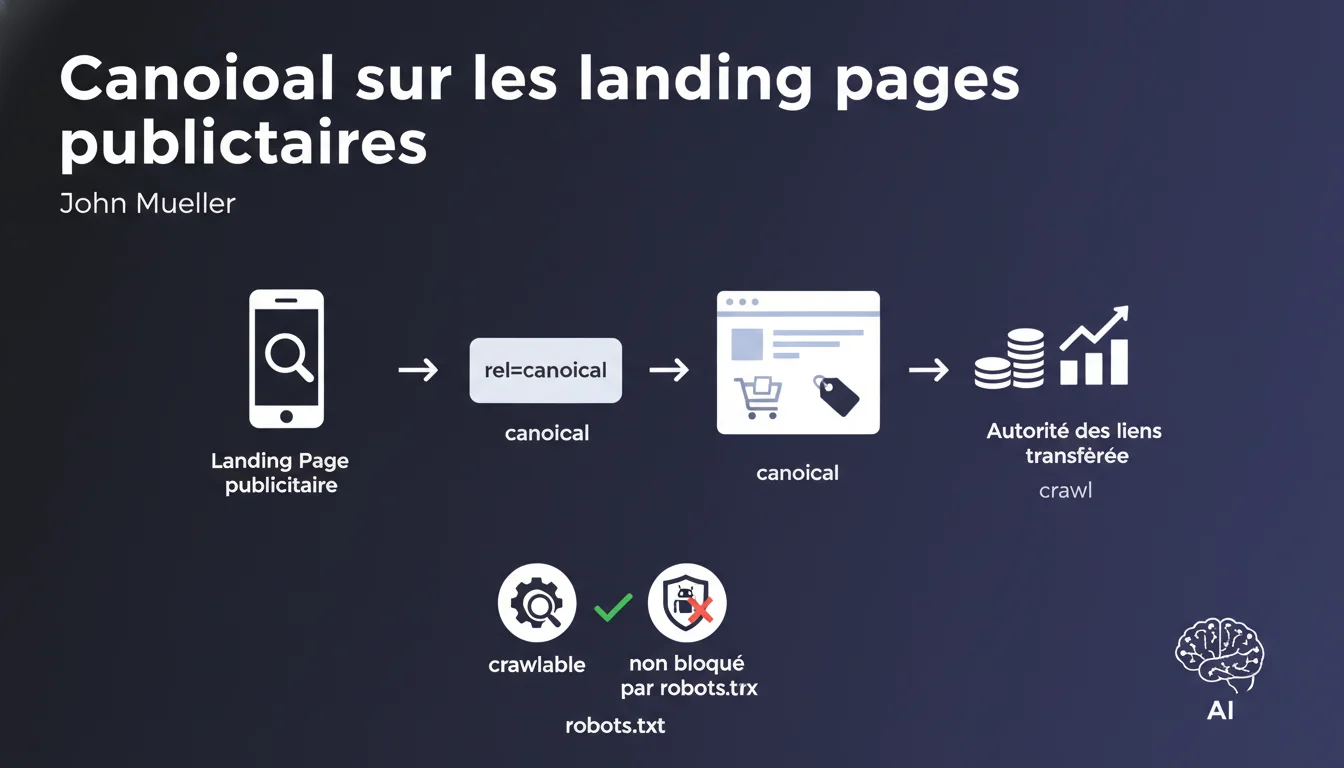
Google explicitly allows the use of the canonical tag on advertising landing pages to point to main product pages. This practice helps consolidate the authority of backlinks gained through paid campaigns towards canonical URLs, provided that these pages remain crawlable and accessible to bots.
What you need to understand
Why does Google endorse this canonicalization approach? \n\n
Mueller's statement acknowledges a ground reality: advertising landing pages often generate external backlinks (social shares, mentions, natural links) that dilute authority if these pages remain isolated. By canonizing towards the main product page, you concentrate SEO juice on the strategic URL.\n\n
This official position clarifies a gray area. Many advertisers hesitated to canonicalize out of fear of being penalized for "duplication" between commercial pages and SEO pages. Google confirms that this concern is unfounded.\n\n
What is the essential condition for it to work? \n\n
The pages must be crawlable. If your landing page is blocked in robots.txt or is protected by a noindex, the canonical tag will never be read. Google cannot transfer authority from a page it does not see.\n\n
In practice, this means making these pages accessible to bots while removing them from indexing via the canonical — and not via a harsh exclusion directive.\n\n
How does this change the architecture of e-commerce sites? \n\n
This validation paves the way for a dual URL strategy: hyper-optimized landing pages for conversion (CRO-focused, with persuasive blocks, aggressive CTAs) that remain crawlable but canonize towards traditional product pages better positioned for organic SEO.\n\n
- \n
- Backlinks gained through paid campaigns feed the authority of SEO pages\n
- Landing pages can be tested and modified without impacting organic search rankings\n
- Consolidating authority avoids fragmentation of internal PageRank\n
- Google explicitly treats these pages as legitimate variants, not as penalizing duplicate content\n
SEO Expert opinion
Is this statement consistent with ground observations? \n\n
Yes, but with an important nuance. On paper, the canonical tag does transfer authority — this is regularly observed in audits. However, the timing of consolidation varies greatly depending on crawl frequency and the perceived "freshness" of the canonical page.\n\n
On sites with low crawl budgets, it can sometimes take several weeks for Google to effectively consolidate signals. In the meantime, the landing page can remain indexed and generate transient cannibalization. [To be verified]: no official data specifies the average consideration timeframe.\n\n The first trap: canonizing a landing page that converts 3x better than the traditional product page. If this LP generates residual organic traffic (long-tail, branded searches), you are directing these visitors to a less performing conversion page. The canonical is technical, not commercial — it does not know your ROAS.\n\n The second pitfall: signal conflicts. If your landing page includes a hreflang different from the canonical page, or if it is linked in the XML sitemap while the canonical points elsewhere, Google may ignore the directive. To be honest, signal consistency remains the decisive factor — and Mueller doesn't mention it.\n\n If your landing pages are too different from the product page (distinct geographic targeting, different language, exclusive promotional offer), canonizing creates a semantic inconsistency. Google may then ignore the directive and index both pages separately.\n\n Another marginal case: seasonal campaigns. An LP for Black Friday canonizing to a generic product sheet poses a problem if the LP contains strong temporal signals. The bot may consider that the pages are not sufficiently "equivalent" to accept consolidation.What potential risks should be anticipated? \n\n
In which cases does this approach not apply? \n\n
Practical impact and recommendations
What practical steps should be taken for effective canonicalization? \n\n
First step: audit your current advertising landing pages. Identify those that receive external backlinks (check in Search Console or your backlink tool). These are the priority candidates for canonicalization.\n\n
Next, ensure that these pages are crawlable: no noindex, no robots.txt blocking, no intermediary redirection. Add the tag Finally, monitor the consolidation of signals in Search Console. If the LP remains indexed after several weeks, check the consistency of hreflang, internal links, and HTML structure between the two pages.\n\n Do not canonicalize to a page that redirects 301 elsewhere. Google can follow the chain, but it is a contradictory signal that weakens the directive. The target page of the canonical must be stable and accessible in 200.\n\n Avoid also massively canonicalizing all your LPs to a single product page if they target different intents. An LP for "men's running shoes" and an LP for "women's trail shoes" should not point to the same canonical, even if the products are similar.\n\n<link rel="canonical" href="https:\/\/yoursite.com\/main-product-page" \/> in the <head>.\n\nWhat mistakes should be absolutely avoided? \n\n
\n
<head>\n
❓ Frequently Asked Questions
La canonical transfère-t-elle l'autorité des backlinks acquis via les campagnes publicitaires ?
Peut-on bloquer une landing page dans le robots.txt tout en utilisant une canonical ?
Faut-il retirer les landing pages canonisées du sitemap XML ?
Combien de temps faut-il pour que Google consolide l'autorité vers la page canonique ?
Peut-on canoniser une landing page vers une page produit dans une langue différente ?
🎥 From the same video 26
Other SEO insights extracted from this same Google Search Central video · published on 18/12/2021
🎥 Watch the full video on YouTube →
💬 Comments (0)
Be the first to comment.