
Official statement
Other statements from this video 26 ▾
- □ Can a 503 error during migration really harm your SEO?
- □ Should you use canonical tags on advertising landing pages to point to main product pages?
- □ How do web fonts disrupt SEO with Cumulative Layout Shift?
- □ Why does Google filter adult content sites even with exact match queries?
- □ What should you do when facing persistent 503 errors in SEO?
- □ Is resubmitting your XML sitemap really a waste of time?
- □ Should You Use the Disavow Tool for Mass Copied Sites?
- □ Why doesn’t Google take action against copycat websites?
- □ Should submitting a DMCA complaint really be free for SEOs?
- □ Should you manually review automatic translations for SEO?
- □ How does a translation button affect SEO?
- □ How can hreflang solve international content issues in SEO?
- □ How can you optimize hreflang without a guarantee of total success?
- □ Is it necessary to translate every page of a website to rank well?
- □ How Do Keyword Variations with or Without Spaces Impact SEO?
- □ How does Google automatically simplify certain URLs?
- □ How does Google approach adult sites based on search intent?
- □ Why Don't Sponsored Links Boost Your SEO?
- □ Are unlinked brand mentions an overlooked SEO opportunity?
- □ How does Google really handle client-side rendering?
- □ Is it a bad idea to invest solely in SSR just for Google?
- □ Why doesn't Google index all your pages?
- □ Why is the Structured Data Testing Tool essential for Google indexing?
- □ Is it true that JavaScript pagination can affect your SEO crawl?
- □ Why is rendered DOM essential for Google indexing?
- □ Why should SEO improvement be multifactorial?
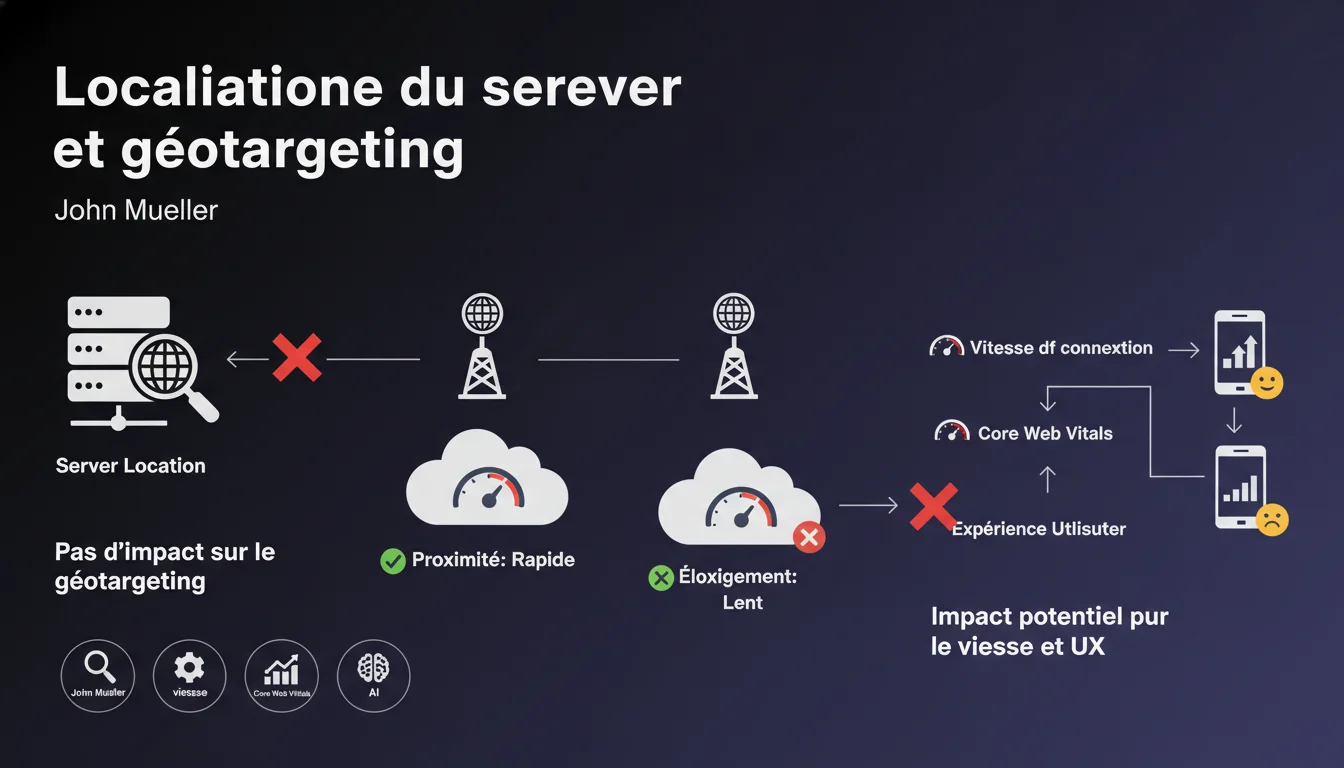
The geographical location of your server does not matter for geotargeting. Google ignores this criterion in its ranking algorithm. The only risk is high latency which can degrade Core Web Vitals if the server is too far from your target users.
What you need to understand
Why does this confusion between server location and geotargeting persist?
For years, the SEO industry has perpetuated the myth that hosting a site on a server physically close to its geographical target would improve its local SEO. The idea seemed logical: a French site hosted in France would rank better in France.
Mueller cuts to the chase: Google does not consider server location as a geotargeting signal. Your server can be in Tokyo or Stockholm; it will not influence your ability to rank in Paris or Marseille.
What are the real geotargeting signals for Google?
Google relies on much more reliable indicators than the IP address of the data center. The ccTLD (.fr, .uk, .de) remains the strongest signal. Next, the Search Console settings allow you to target a specific country for gTLDs (.com, .org).
Local structured data, the physical address mentioned on the site, local backlinks, and content in the local language complement this picture. The server location is never part of the equation.
Where does the question of server location come into play?
Mueller clarifies a crucial point: if your server is geographically far from your users, network latency increases. This latency directly affects the initial loading time, potentially impacting your Core Web Vitals.
However, CWV is a confirmed ranking factor. Through this indirect channel — and only through this channel — server location can impact your SEO. But it is a matter of technical performance, not of geotargeting.
- Server location is not a geotargeting criterion
- True signals: ccTLD, Search Console settings, structured data, local backlinks
- Possible impact via latency and Core Web Vitals
- User performance issue, not an algorithmic geographic signal
SEO Expert opinion
Does this statement align with field observations?
Let’s be honest: this position from Mueller confirms what tests have shown for years. Websites hosted across the Atlantic rank perfectly in Europe, and vice versa. The myth of local servers persists mainly among hosting providers who use it as a selling point.
However, the nuance regarding CWV deserves attention. We regularly observe international sites with poorly distributed servers geographically that show degraded TTFB for certain areas. And a high TTFB negatively impacts LCP, one of the three Core Web Vitals metrics.
What situations still require consideration of location?
If you are targeting multiple distant geographic markets with significant traffic volumes, the question arises differently. A site with 40% European traffic and 60% Asian traffic benefits from using a CDN or a multi-region infrastructure.
Second case: sites with non-cacheable dynamic content. If every request queries your database located 10,000 km away, you’ll accumulate latency. A cloud hosting with geographic replication becomes relevant — but it’s CWV optimization, not geotargeting.
[To be verified] The statement remains vague on the thresholds for problematic latency. From how many milliseconds does the impact become measurable on ranking? Google does not provide precise figures.
Does the commercial argument of server proximity still hold?
Some hosting providers continue to sell the French location of the data center as an SEO advantage. This is factually incorrect for geotargeting. However, it can marginally affect speed for an exclusively French audience — provided you do not use a CDN that would render that point moot.
The real question becomes: what is the opportunity cost? Paying more for local hosting versus investing in a high-performance CDN or optimizing the code. Budget allocation should follow actual impact, not outdated beliefs.
Practical impact and recommendations
What should you check on your current infrastructure?
First reflex: test your Core Web Vitals from different geographical areas. PageSpeed Insights provides an overall picture, but tools like WebPageTest allow you to select the test location. Compare the TTFB between a nearby server and a distant one from your hosting.
If you find significant discrepancies (> 200-300 ms) and these areas represent a large share of your audience, that’s where infrastructure decisions come into play. Otherwise, you’re optimizing a non-issue.
How can you fix a geographical latency issue?
The standard solution: implement a CDN with geographical distribution. Cloudflare, Fastly, AWS CloudFront distribute your content across global points of presence. The visitor queries the nearest server — the location of your origin server becomes secondary.
For sites with a lot of dynamic content, consider an architecture with smart caching at the edge. Cloudflare Workers or AWS Lambda@Edge allow you to execute code close to the user, not just serve static cache.
Tight budget? Start by optimizing things that cost nothing: GZIP/Brotli compression, minification, lazy loading, database query optimization. The impact on TTFB will often be more pronounced than changing data centers.
What mistakes should you avoid in your geotargeting strategy?
Classic mistake: migrating to a local host thinking it will boost SEO without measuring before/after on CWV. You’re spending budget for an unverified benefit. Measure first, optimize later.
Second trap: neglecting real geotargeting signals while focusing on hosting. A site in .com without Search Console targeting, without proper hreflang, without a local address mentioned — the server location will never compensate for these shortcomings.
- Test Core Web Vitals from the geographical areas of your target audience
- Identify TTFB discrepancies greater than 200-300 ms
- Check geotargeting settings in Search Console for gTLDs
- Implement a CDN if latency is problematic and audience is international
- Prioritize performance optimizations with high ROI (compression, minification, database optimization)
- Never migrate hosts for SEO reasons without a before/after benchmark
- Document the real geotargeting signals: ccTLD, hreflang, local structured data
Server location only plays a role through its potential impact on Core Web Vitals. Focus your efforts on real geotargeting signals and overall performance rather than the geography of your data center.
These optimizations touch on advanced technical aspects — CDN infrastructure, edge computing configuration, fine analysis of performance metrics. If you lack internal resources to audit and implement these projects, working with a technical SEO agency allows you to prioritize high-impact actions and avoid costly mistakes on your tech stack.
❓ Frequently Asked Questions
Dois-je héberger mon site en France pour mieux ranker en France ?
Un serveur éloigné peut-il quand même impacter mon référencement ?
Un CDN suffit-il à compenser un serveur loin de mon audience ?
Comment vérifier si la localisation de mon serveur pose problème ?
Quels sont les vrais signaux de géotargeting pour Google ?
🎥 From the same video 26
Other SEO insights extracted from this same Google Search Central video · published on 18/12/2021
🎥 Watch the full video on YouTube →
💬 Comments (0)
Be the first to comment.