
Official statement
Other statements from this video 7 ▾
- □ Is Looker Studio really the best way to track your SEO performance?
- □ Are you structuring your SEO data visualizations correctly to actually maximize your analytics insights?
- □ Why does Google recommend analyzing Search Console data in 7-day increments?
- □ Why does Google recommend simplified visualizations for SEO monitoring?
- □ How can you unlock the full potential of data blending to supercharge your Search Console analysis?
- □ How can you analyze Search Console performance for Discover and Google News separately?
- □ Why are regular expressions the game-changer for analyzing your Search Console data in Looker Studio?
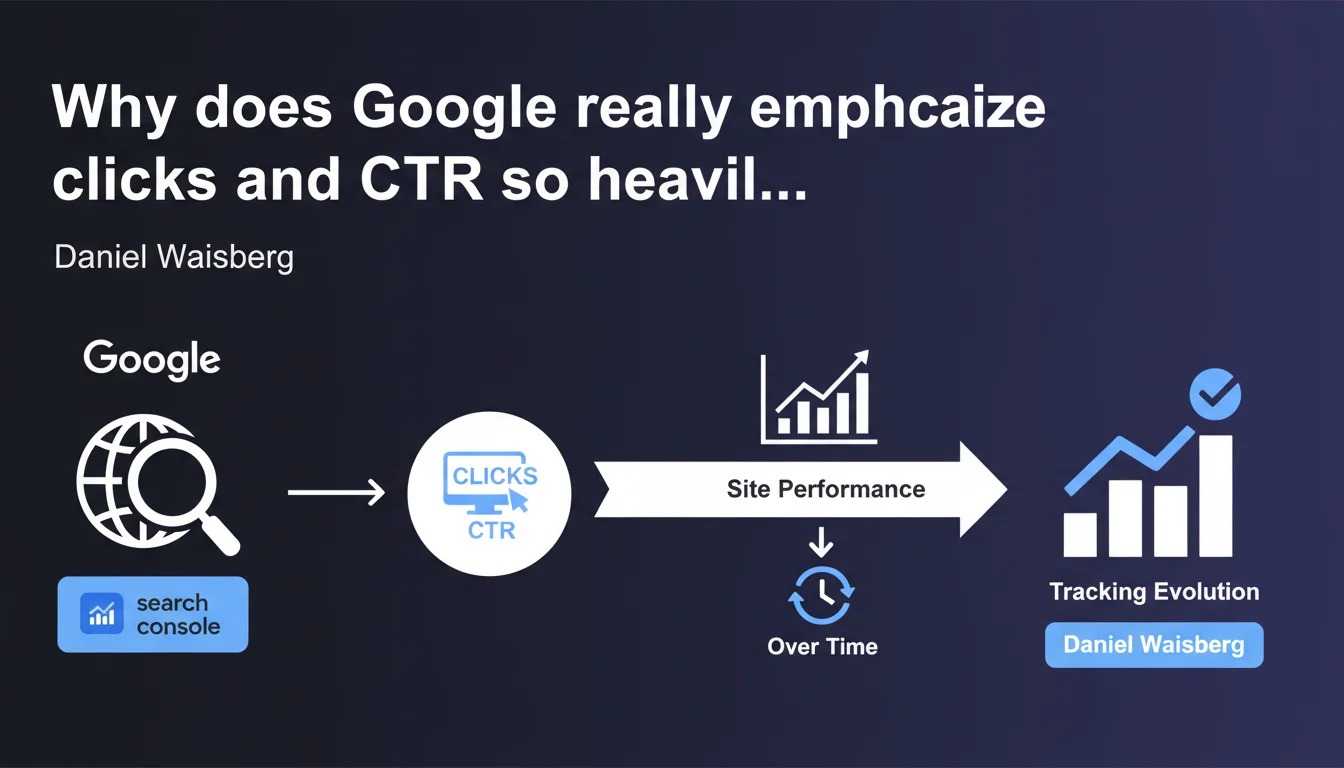
Google officially designates clicks and CTR as the two primary metrics to track in Search Console. These indicators directly reflect a site's ability to capture attention in the SERPs and transform visibility into real traffic — a signal that the algorithm increasingly values.
What you need to understand
What does this statement reveal about Google's priorities?
By emphasizing clicks and CTR, Google signals that simply appearing on the first page is no longer enough. The algorithm observes whether the results it proposes actually generate engagement. A site displaying 100,000 impressions but only 50 clicks sends a weak signal — it's visible, certainly, but not attractive.
This position fits within a logic where user experience in the SERPs becomes a relevance criterion. Google wants to reward pages that answer the search intent right from the snippet. CTR thus becomes a proxy for perceived quality even before the click happens.
Why these metrics rather than impressions or average position?
Impressions measure raw visibility, but they say nothing about actual performance. A result displayed in position 8 with a 5% CTR can outperform a result in position 3 with a 1% CTR. Google therefore prioritizes converting visibility into traffic.
Average position, on the other hand, remains a useful but misleading indicator. It masks variations by query type, device, and personalization. CTR, by contrast, directly translates the comparative attractiveness of the snippet against competitors in the same SERP.
What is the relationship between CTR and algorithmic ranking?
Google has always been ambiguous about CTR's role as a direct ranking factor. What is certain: a high CTR maintains or improves visibility, while a structurally low CTR can lead to gradual degradation. [To verify] whether this effect is purely mechanical or if there's explicit algorithmic feedback.
- Clicks and CTR are the two KPIs officially recommended by Google for monitoring Search performance
- These metrics translate the attractiveness of the snippet in results and the ability to convert visibility into traffic
- Google values results that generate real engagement, not just passive visibility
- CTR likely acts as an indirect quality signal before the click, influencing ranking stability
SEO Expert opinion
Is this statement consistent with practices observed in the field?
Yes — and it's actually a rare point of convergence between official discourse and empirical observations. A/B tests on title tags and meta descriptions consistently show that a 2-3 point improvement in CTR translates into increased organic traffic, even without ranking gains. Mechanically, more clicks = more traffic. But not just that.
We also observe that pages with a structurally higher CTR than the average for their position tend to progress in the SERPs over 3 to 6-month periods. Correlation, causation? Google will never say clearly. What is certain: CTR is not a declared direct ranking factor, but it influences the ecosystem of signals Google uses to assess relevance.
What nuances should be applied to this recommendation?
First, CTR varies enormously by position. A 3% CTR in position 5 is excellent; in position 1, it's catastrophic. Comparing CTRs without controlling for average position is a common analytical error. Google Search Console allows you to cross-reference this data, but you must segment by position range and query type.
Second, certain industries have structurally low CTRs (informational queries with featured snippets, rich results that absorb clicks, SERPs saturated with ads). Benchmarking your CTR against a universal standard makes no sense — you need to compare against the industry average and SERP type.
In what cases does this rule not apply?
Strong brand sites with massive direct traffic may display lower organic CTRs without impacting visibility — Google knows the audience arrives through other channels. Similarly, pages with high topical authority (definitions, reference resources) maintain their position even with modest CTR, because their informational value is recognized.
Finally, in verticals where Google prioritizes its own widgets (calculators, weather, sports results), organic CTR structurally collapses. Optimizing the snippet in these cases amounts to polishing a cannonball — better to diversify entry points or rework content strategy.
Practical impact and recommendations
What specifically should you do to improve clicks and CTR?
First step: audit pages with a CTR below the average for their position. Search Console lets you filter by query and position — identify top 3 pages with CTR under 20%, and positions 4-10 pages with CTR under 5%. These are your quick wins.
Next, test title and meta description variations. The title should include the primary keyword at the beginning, but also a differentiation element (number, year, clear benefit). Meta description isn't a ranking factor, but it directly influences CTR — it should include a call-to-action or value promise.
Third lever: structured data. Rich snippets (reviews, FAQ, howto, breadcrumbs) increase the display surface area in SERPs and associated CTR. A result with 5 stars captures 30% more clicks than a standard result at the same position.
What errors should you avoid in CTR optimization?
Classic mistake: changing the title of a well-ranked page without testing. A poorly reformulated title can cause ranking drops if Google deems it less relevant for the target query. Ideally, test on low-traffic pages first, or use split-testing tools if your volume allows.
Another trap: confusing CTR with conversion rate. High CTR with zero conversion rate signals a mismatch between snippet promise and actual content. Google detects these signals through pogo-sticking (rapid return to SERPs) — and it can eventually hurt rankings.
How do you effectively monitor these metrics over time?
Set up a Search Console dashboard with custom segments: CTR by device, by page category, by position range. Automate alerts if CTR drops more than 15% in a week — this can signal a SERP change (new competitor, stolen featured snippet, etc.).
Cross-reference this data with Google Analytics to verify that CTR increases translate into real engagement (pages/session, duration, conversions). An inflated CTR without business impact is a false KPI.
- Audit pages with CTR below average for their position in Search Console
- Test title and meta description variations oriented toward benefit and differentiation
- Implement structured data (reviews, FAQ, breadcrumbs) to enrich snippets
- Segment tracking by device, page category, and position range
- Cross-reference CTR with post-click behavior (bounce rate, time spent, conversions)
- Automate alerts on sharp CTR drops to detect SERP changes
❓ Frequently Asked Questions
Le CTR est-il un facteur de classement direct selon Google ?
Quel est un bon CTR selon la position dans les résultats ?
Comment améliorer le CTR sans risquer de perdre des positions ?
Les données structurées augmentent-elles réellement le CTR ?
Faut-il optimiser le CTR même si le taux de conversion est faible ?
🎥 From the same video 7
Other SEO insights extracted from this same Google Search Central video · published on 15/03/2023
🎥 Watch the full video on YouTube →
💬 Comments (0)
Be the first to comment.