
Official statement
Other statements from this video 7 ▾
- □ Faut-il vraiment utiliser Looker Studio pour monitorer ses performances SEO ?
- □ Comment structurer vos visualisations de données SEO pour exploiter vraiment vos analytics ?
- □ Pourquoi Google recommande-t-il d'analyser la Search Console par tranches de 7 jours ?
- □ Pourquoi Google recommande-t-il des visualisations simplifiées pour le monitoring SEO ?
- □ Comment exploiter pleinement le data blending pour enrichir vos analyses Search Console ?
- □ Pourquoi les expressions régulières sont-elles indispensables pour analyser vos données Search Console dans Looker Studio ?
- □ Pourquoi Google insiste-t-il autant sur les clics et le CTR dans Search Console ?
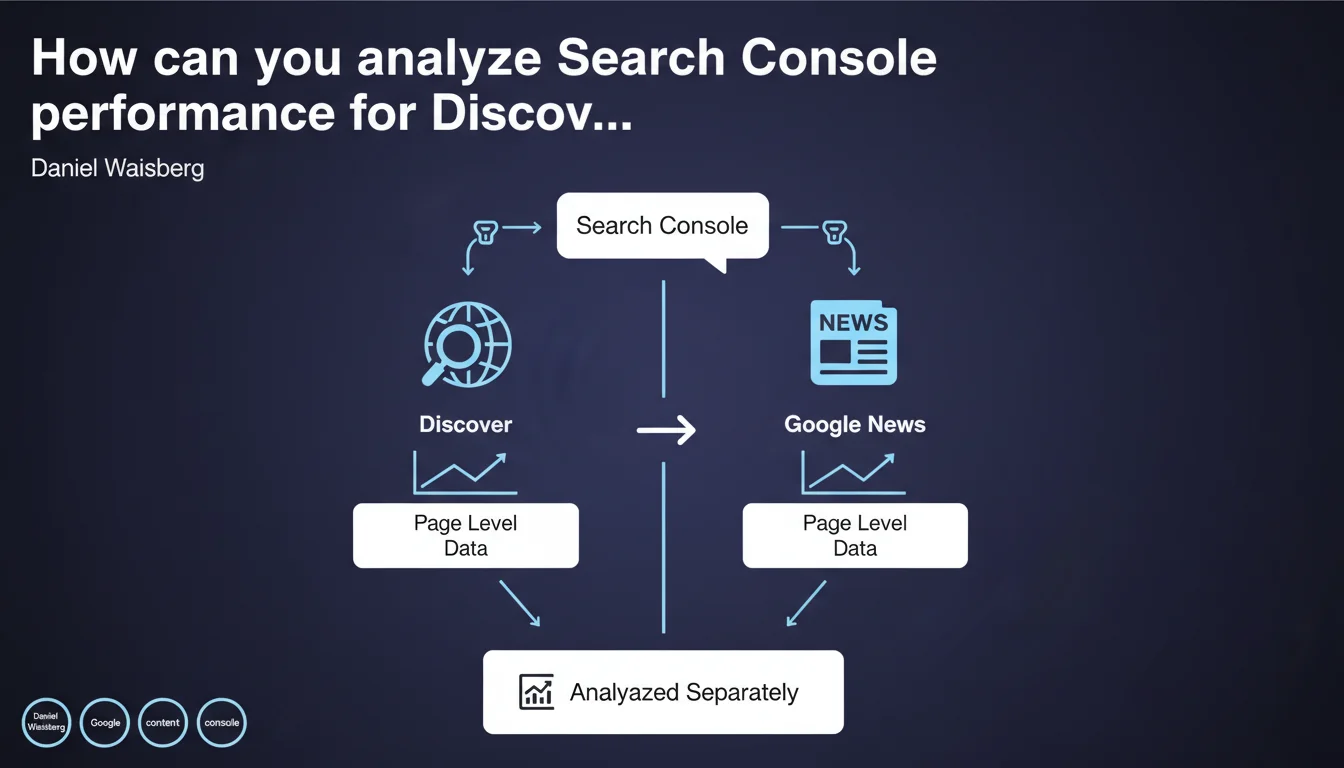
Google Search Console now allows you to filter data by content type — standard Web, Discover, and Google News. Each traffic source can be analyzed independently at the page level, making it easier to identify performance levers specific to each channel.
What you need to understand
Why is Google offering this filtering by content type?
Aggregated data in Search Console mixes three traffic sources with very different logic: standard search, Google Discover (personalized mobile feed) and Google News (news). An article can perform well in Discover without ever appearing in classic SERPs, or vice versa.
Analyzing these flows separately becomes essential to identify what actually works. An 8% click-through rate may seem excellent — until you discover it comes only from Discover, while organic positions stagnate on page 3.
What metrics can you isolate with this filtering?
Filtering applies to performance data at the page level: impressions, clicks, CTR, average position (for standard search only). Each content type reveals its own relevant KPIs.
Concretely, you can now answer questions like: which URLs generate the most impressions in Discover? What content works in Google News but not in organic search? And that's where it becomes actionable.
Does this feature change the structure of available data?
No, it doesn't create new metrics. It simply offers an additional level of granularity on already collected data. Previously, you either had to export and segment manually, or settle for aggregated views that were barely usable.
The interface becomes more aligned with traffic reality: three channels, three editorial strategies, three separate dashboards if needed.
- Filtering available for Web search, Discover and Google News
- Analysis at the level of individual pages for each source
- Allows you to identify top-performing content by channel
- Facilitates detection of specific opportunities for each flow
- No new metrics — just finer segmentation
SEO Expert opinion
Does this feature address a real field need?
Absolutely. News and editorial content sites have been juggling CSV exports for years to understand where their traffic really comes from. The same article can blow up in Discover for 48 hours then disappear, without being able to isolate this performance in the interface.
The problem is that this segmentation should have existed since Discover's launch in 2018. Better late than never — but we're looking at a catch-up feature, not an innovation.
What limitations should you anticipate with this filtering?
First limitation: Discover doesn't return average position, since the very concept of ranking doesn't exist in a personalized feed. Impressions and clicks are there, but it's impossible to measure a "progression" like in classic SEO. [To be verified]: we don't yet know if Google exposes metrics specific to Discover like "freshness" or "user relevance".
Second limitation: data remains sampled beyond a certain volume. If you generate 500K Discover impressions per day, the interface will only give you a partial view — and there's no guarantee that sampling is consistent across the three content types.
Does this announcement hide an underlying algorithm change?
Nothing in the statement suggests any modification to selection criteria for Discover or Google News. This is a purely interface evolution, not an algorithmic overhaul.
That said, the timing is intriguing. Google is pushing harder and harder on Discover (especially mobile), and offering dedicated measurement tools may indicate a desire to professionalize this channel — in other words, to encourage publishers to optimize specifically for this flow. Be wary: if Discover becomes a strategic lever, Google will have every incentive to monetize privileged access through advertising.
Practical impact and recommendations
How to use this filtering to optimize your editorial strategy?
Start by segmenting your high-performing content according to its distribution channel. Identify articles that blow up in Discover but stagnate in classic search: they likely reveal good emotional/visual appeal but lack traditional SEO optimization (keywords, heading structure, internal linking).
Conversely, content well-positioned in SERPs but absent from Discover may be missing striking visuals or a "fresh news" angle valued by the personalization algorithm. Adjust editorial strategy accordingly.
Which indicators should you prioritize for each channel?
For standard search: average position and CTR remain reference KPIs. For Discover: click-through rate and impression volume — position doesn't exist, only exposure matters. For Google News: speed of impression growth after publication (the algorithm favors freshness).
Compare conversion rates or engagement by channel. If Discover generates lots of clicks but few secondary page views, content hooks but doesn't retain — an editorial quality or navigation structure problem.
What should you do concretely right now?
- Enable filtering by content type in Search Console and create custom views for each channel
- Export data from the last 90 days and identify the top 20 pages by source
- Analyze common patterns: which topics, formats, visuals work in Discover vs classic search?
- Set up a weekly dashboard segmented by content type to detect rapid variations
- Test specific optimizations: high-quality images for Discover, FAQ structure for featured snippets in classic search
- Cross-reference this data with Analytics to evaluate traffic quality by channel (time spent, bounce rate, conversions)
❓ Frequently Asked Questions
Le filtrage par type de contenu est-il disponible pour tous les sites dans Search Console ?
Peut-on exporter les données filtrées par type de contenu ?
Pourquoi certaines pages apparaissent-elles dans Discover mais pas en recherche classique ?
Les données Discover sont-elles temps réel ou avec délai ?
Faut-il optimiser différemment pour Discover et la recherche classique ?
🎥 From the same video 7
Other SEO insights extracted from this same Google Search Central video · published on 15/03/2023
🎥 Watch the full video on YouTube →
💬 Comments (0)
Be the first to comment.