
Official statement
Other statements from this video 14 ▾
- □ Does Google really ignore links coming from penalized sites?
- □ Should you really abandon directories and social bookmarking for your SEO strategy once and for all?
- □ Does Google really ignore spam links automatically without any action needed?
- □ Should you really use Google's link disavow tool, or is it just wasting your time?
- □ Does your choice of CMS and programming language really impact your SEO?
- □ Do keywords in URLs really matter for SEO rankings?
- □ Does image URL depth really prevent Googlebot from crawling your images?
- □ Are your Search Console metrics really showing what's actually happening to your site in Google search results?
- □ Should you abandon dynamic rendering for SEO?
- □ Do you really need to optimize image file names for SEO?
- □ Does Google really render EVERY successfully crawled page with JavaScript?
- □ Does invalid schema markup really hurt your search rankings?
- □ Should you really worry about the difference between 301 and 302 redirects anymore?
- □ Does extended boilerplate content really hurt your SEO rankings?
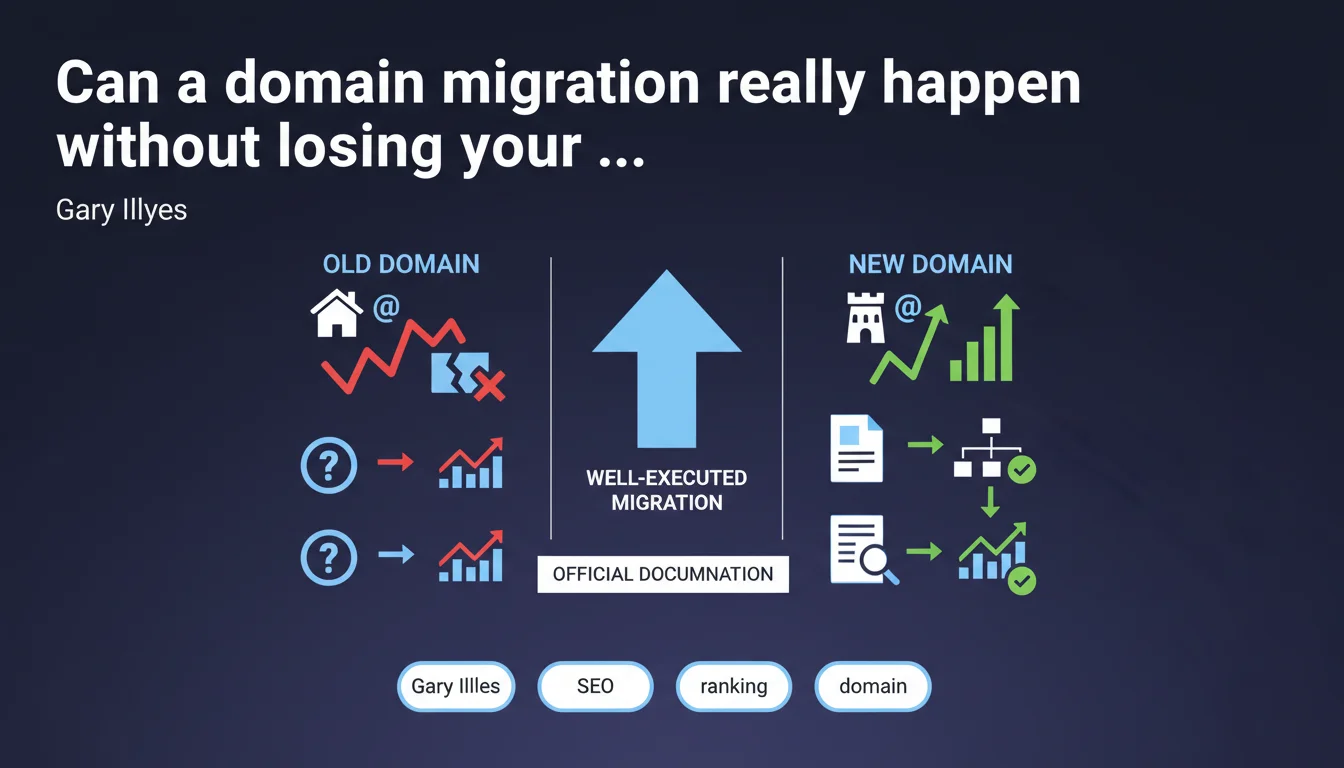
Google affirms that a well-executed domain change causes no lasting loss of traffic or rankings. The condition: strictly follow official documentation. Gary Illyes emphasizes that a clean technical migration guarantees SEO continuity.
What you need to understand
What exactly does Google say about the impact of a domain change?
Gary Illyes, Search Analyst at Google, states that a website move including a domain change should not result in any lasting traffic loss if the operation is executed properly. The emphasis is on the word "lasting" — Google implicitly acknowledges that temporary fluctuations may occur, but promises a return to normal.
This statement rests on a strict prerequisite: following Google's official documentation from Google Search Central. No improvisation, no shortcuts. The method is formalized, documented, and Google believes it works if applied correctly.
Why is this statement important for an SEO practitioner?
Because it demystifies one of SEO's most persistent myths: the idea that a domain change equals digital suicide. Many professionals dread this operation, fearing an irreversible drop in rankings. Google affirms the opposite here — with one major caveat: you must execute it properly.
This is a direct accountability of practitioners. If it fails, it's because you didn't follow the guidelines. Google absolves itself of responsibility by pointing to its documentation. The underlying message? "We've given you the keys, figure it out."
What is the real scope of this guarantee?
Google speaks of lasting loss, not immediate loss. In other words, temporary fluctuations — a few days, even weeks — do not contradict this statement. The ambiguity persists about the acceptable duration of this transition.
Moreover, the statement doesn't clarify what "well-executed" means. What are the objective criteria? How long does it take for Google to recognize the migration as successful? These gray areas leave considerable room for interpretation.
- A clean domain change causes no permanent SEO loss according to Google
- The sine qua non condition: follow official documentation to the letter
- Google implicitly admits temporary fluctuations, without defining their duration
- The term "well-executed" remains vague and subjective — no precise indicators provided
- This statement holds the practitioner accountable: if it fails, it's your fault
SEO Expert opinion
Does this statement reflect real-world observations?
Yes and no. Successful domain migrations do exist — sites that switch domains without significant long-term damage. But calling this "no lasting loss" is marketing optimism. In practice, even the best-orchestrated migrations experience traffic fluctuations of 10 to 30% for several weeks, sometimes months.
Google mentions nowhere the recovery duration. Does a site that loses 40% of its traffic for two months before returning to normal suffer a "lasting" loss? Technically no according to Google, but commercially yes for the company involved. This ambiguity is problematic.
What are the limitations of this official statement?
First limitation: Google assumes that all signals transfer perfectly. 301 redirects, link juice, history — everything must switch flawlessly. Yet, certain signals remain opaque. For example, TrustRank or other reputation metrics are never explicitly guaranteed as transferable.
Second limitation: official documentation doesn't cover all edge cases. What happens with a reactivated expired domain? With an old domain having a spam history? With complex subdomains or partial migrations? [To verify] because Google remains evasive on these scenarios.
Should you take this statement literally?
No. It reflects an idealized vision of the process. Google describes what should happen in the best case, not what systematically happens. Practitioners must build in a safety margin: anticipate temporary traffic loss, expect a recovery delay, monitor actively.
Let's be honest: if Google were as confident as that, it would provide clear success metrics. Yet, no objective definition of a "well-executed" migration is given. No SLA, no guaranteed timeline. This is a statement of principle, not a contractual commitment.
Practical impact and recommendations
What concretely must you do to avoid traffic loss during a domain migration?
Critical first step: map all URLs from the old to the new domain. Each page must have its individual 301 redirect — no mass redirects to the homepage. Use a spreadsheet to cross-reference old and new domains, then test each redirect before launch day.
Next, declare the address change in Google Search Console. This is an explicit signal you give to Google to accelerate recognition of the new domain. Without this declaration, the engine will take longer to understand the migration.
Update your strategic backlinks by contacting major referring sites. Even with 301s, directly transmitting the new URL limits SEO juice dilution. Prioritize backlinks with the highest Domain Authority.
What mistakes must you absolutely avoid during a domain migration?
Never let the old domain expire too quickly. Keep 301 redirects active for at least 12 months — ideally 24 months if budget permits. Google needs time to consolidate the authority transfer.
Avoid changing domain and URL structure simultaneously. If you modify your architecture too, you multiply error risks. Do one thing at a time: first the domain, then the architecture if necessary.
Don't neglect redirects for ancillary resources: images, PDFs, CSS/JS files referenced from other sites. These elements contribute to crawl budget and user experience. A single 404 on an image can degrade quality perception.
How do you verify the migration went smoothly?
- Confirm that 100% of old URLs return a 301 code — no 404s, no temporary 302s
- Check in Google Search Console that the number of indexed URLs on the new domain progresses regularly
- Monitor Core Web Vitals on the new domain to detect any technical performance regression
- Analyze server logs to confirm Googlebot actively crawls the new URLs
- Compare organic traffic week by week for at least 3 months post-migration
- Manually test main strategic pages to confirm they display correctly and retain their meta tags
A domain migration without SEO loss is possible, but it requires meticulous preparation and flawless execution. Every detail matters: individual redirects, Search Console declaration, prolonged maintenance of the old domain, rigorous monitoring of indicators. Google provides the framework, but implementation rests entirely on your technical expertise.
Given the complexity of these operations and their associated financial risks, many sites prefer to entrust this critical step to an SEO agency specialized in migrations. Professional guidance secures each phase of the process, anticipates technical pitfalls and guarantees rigorous post-migration monitoring — which can make all the difference between a smooth transition and a commercial disaster.
❓ Frequently Asked Questions
Combien de temps faut-il pour qu'un changement de domaine soit complètement stabilisé selon Google ?
Dois-je rediriger toutes mes URLs une par une ou puis-je faire des redirections globales ?
Que se passe-t-il avec les backlinks pointant vers l'ancien domaine après la migration ?
Est-ce qu'un changement de domaine réinitialise l'historique et l'autorité SEO du site ?
Puis-je faire une migration de domaine en même temps qu'une refonte complète du site ?
🎥 From the same video 14
Other SEO insights extracted from this same Google Search Central video · published on 04/05/2023
🎥 Watch the full video on YouTube →
💬 Comments (0)
Be the first to comment.