
Official statement
Other statements from this video 14 ▾
- □ Does Google really ignore links coming from penalized sites?
- □ Should you really abandon directories and social bookmarking for your SEO strategy once and for all?
- □ Does Google really ignore spam links automatically without any action needed?
- □ Does your choice of CMS and programming language really impact your SEO?
- □ Do keywords in URLs really matter for SEO rankings?
- □ Does image URL depth really prevent Googlebot from crawling your images?
- □ Are your Search Console metrics really showing what's actually happening to your site in Google search results?
- □ Should you abandon dynamic rendering for SEO?
- □ Do you really need to optimize image file names for SEO?
- □ Does Google really render EVERY successfully crawled page with JavaScript?
- □ Does invalid schema markup really hurt your search rankings?
- □ Should you really worry about the difference between 301 and 302 redirects anymore?
- □ Does extended boilerplate content really hurt your SEO rankings?
- □ Can a domain migration really happen without losing your SEO rankings?
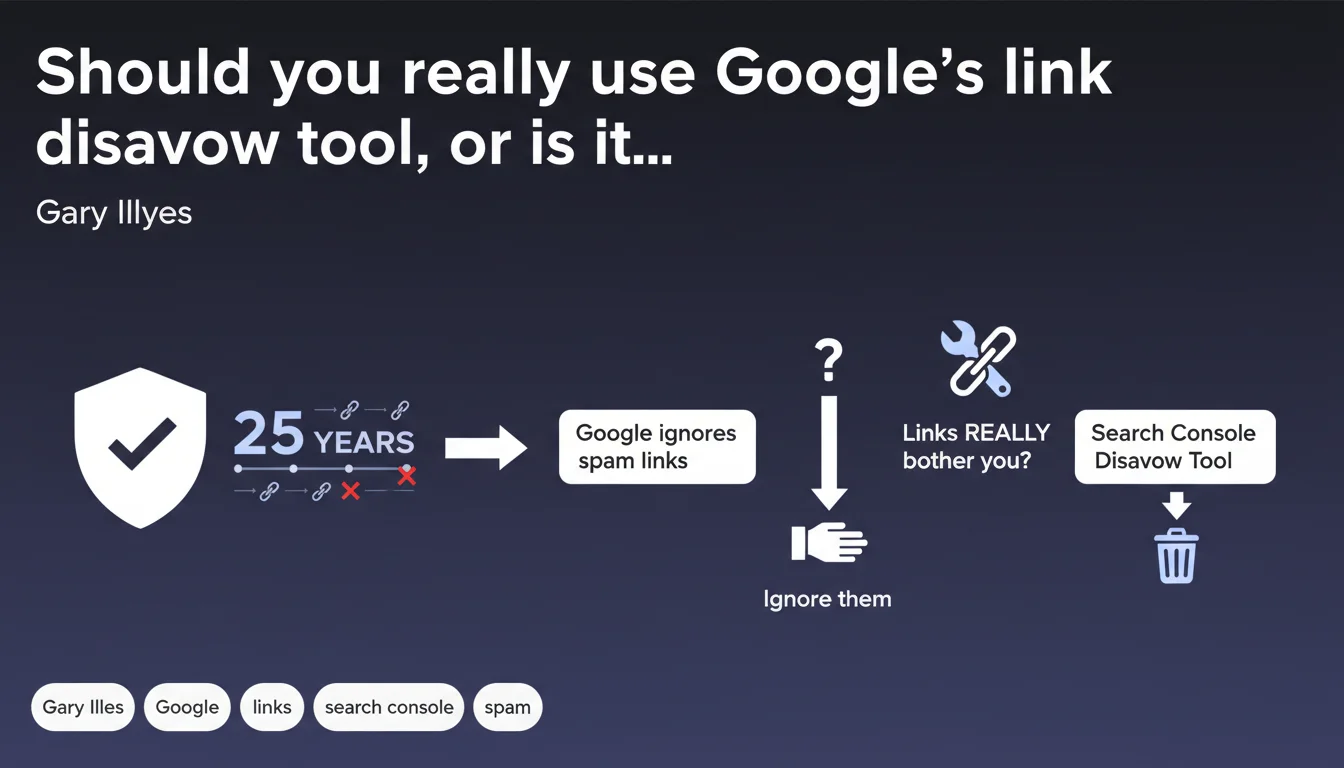
Google has been managing spam links for 25 years and knows how to ignore them automatically. The Disavow Links tool in Search Console should only be used if spam links personally bother you — otherwise, let Google do its job. Clear message: stop obsessing over systematic disavowal.
What you need to understand
Why does Google keep insisting that disavowal is pointless?
Gary Illyes reminds us that Google has been managing spam links for a quarter century. The search engine has learned to identify and neutralize toxic backlinks without human intervention. The algorithm integrates anti-spam filters that automatically devalue manipulative links, link farms, worthless directories, and other black hat practices.
This statement reflects a desire to relieve support team workload — and incidentally, to limit collective hysteria around link profile cleanup. Google has been repeating this message for several years, but fear of penalties still pushes too many SEOs to frantically disavow.
What does "if links really bother you" actually mean in practice?
The wording is deliberately vague. Google doesn't say "if links harm your rankings," but "if links bother you" — in other words, if you have a psychological problem with their presence. Important nuance.
This suggests that in 99% of cases, these links have no measurable negative impact. You could have 10,000 terrible backlinks from Russian or Chinese sites — as long as your clean link strategy is solid, Google will simply ignore them.
Is the Disavow tool still relevant in specific situations?
Yes, but only for very specific situations. If you inherit a site with heavy black hat history (massive automated link campaigns, documented negative SEO attacks, recurring manual actions), disavowal can serve as a good faith signal to Google.
But even then, Google has never confirmed that the Disavow file accelerates manual penalty removal. It's more of a psychological crutch for SEOs than a technical necessity.
- Google automatically filters the vast majority of spam links without you lifting a finger
- The Disavow tool is a historical relic from the Penguin era — it remains available but is no longer central to Google's anti-spam strategy
- The phrasing "if it bothers you" shows that Google treats disavowal as an optional cosmetic feature, not an operational necessity
- Real Disavow use cases: documented negative SEO attacks, heavy black hat inheritance, or desire to clean up before requesting reconsideration
- In all other cases: ignore the junk links and focus on acquiring quality backlinks
SEO Expert opinion
Is this position consistent with real-world observations?
Yes and no. In most situations, we actually observe that sites with mediocre link profiles suffer no visible penalty — as long as they also have clean and relevant backlinks. Google does seem to ignore the background noise.
But — and this is where it gets tricky — we still see cases where massive cleanup via Disavow coincides with ranking improvements. Correlation isn't causation, of course. Maybe Google simply recalculated the profile during a crawl, or a core update reshuffled the deck. [Needs verification] on large samples.
Why does Google maintain the tool if it's useless?
Good question. Several hypotheses: first, removing it would be interpreted as an admission that Google doesn't control everything — which would give ammunition to black hats. Second, there are probably still edge cases where the algorithm struggles to isolate certain spam patterns, and Disavow serves as a backup option.
Finally, and let's be honest, Google loves maintaining a certain strategic ambiguity. By keeping the tool available without ever explicitly saying "never use this," they shift responsibility to the webmaster. If your site tanks after poorly calibrated disavowal, that's your fault — not the algorithm's.
In what situations does this rule not apply?
Two scenarios where disavowal remains relevant, even necessary. First case: you've received a manual action for artificial links. Then Google explicitly asks you to clean up — and if you can't remove the links at the source, Disavow becomes mandatory for your reconsideration request.
Second case: massive and recent negative SEO attack. If you see 50,000 terrible backlinks appear in 48 hours from spam networks, better to prevent than cure. But be careful — these attacks are rarer than people think. Most of the time, they're just crawlers discovering links that have existed for months.
Practical impact and recommendations
What should you concretely do with your existing Disavow files?
If you already have an active Disavow file in Search Console, don't abruptly delete it. First analyze its content with a tool like Ahrefs, Majestic, or SEMrush. Verify that you haven't accidentally disavowed domains sending traffic or positive signals.
Then ask yourself: are these links truly toxic or just mediocre? A mediocre link (low-grade directory, footer spam) will be ignored by Google. A toxic link (detected PBN network, link farm) might deserve disavowal — but again, Google usually handles this itself.
What mistakes must you absolutely avoid?
First mistake: panic-disavowing in bulk after traffic drops. The cause is rarely a sudden influx of spam links — it's usually a core update, technical issues, or loss of quality backlinks. Disavow never fixes underlying problems.
Second mistake: confusing "low-quality link" with "toxic link." An amateur blog linking to you without much authority isn't toxic — it's just neutral. Only disavow what truly causes problems: proven spam, black hat networks, mass-purchased links you no longer control.
How do you intelligently audit your link profile without blind disavowal?
Focus on acquiring quality backlinks rather than obsessive cleanup. A good signal-to-noise ratio is sufficient — you can have 20% junk links if 80% are solid. Google weights links, it doesn't calculate simple averages.
If you identify truly problematic links (black hat campaign you're a victim of, documented attack), first try to contact webmasters for removal. Disavow should be a last resort, not a default reflex.
- Audit your link profile every 6 months with a reliable tool (Ahrefs, Majestic, SEMrush)
- Only disavow domains that are clearly spammy or from documented black hat campaigns
- Prioritize creating quality backlinks — it's more effective than obsessive cleanup
- If you have a manual action, document your removal attempts before disavowing
- Never use Disavow in panic mode after ranking drops — analyze root causes first
- Verify that you haven't accidentally disavowed quality referring domains
- Keep a history of your Disavow files — Google only preserves the latest version
❓ Frequently Asked Questions
Dois-je supprimer mon fichier Disavow si je l'ai déjà soumis ?
Comment savoir si un lien est vraiment toxique ou juste de mauvaise qualité ?
Le désaveu accélère-t-il la levée d'une pénalité manuelle ?
Les attaques SEO négatives existent-elles vraiment ?
Combien de temps faut-il pour que Google prenne en compte un fichier Disavow ?
🎥 From the same video 14
Other SEO insights extracted from this same Google Search Central video · published on 04/05/2023
🎥 Watch the full video on YouTube →
💬 Comments (0)
Be the first to comment.