
Official statement
What you need to understand
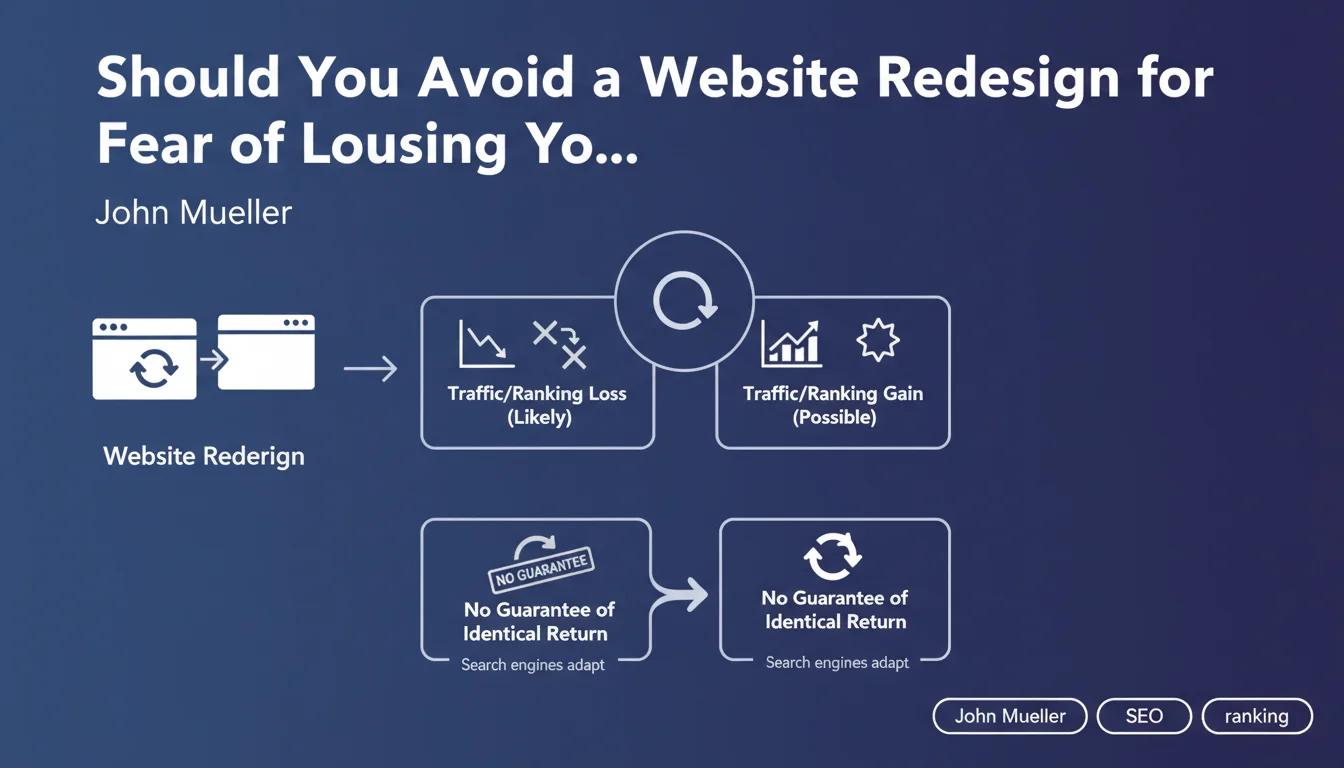
John Mueller confirmed a reality that is often ignored: any website redesign inevitably leads to a period of adjustment for search engines. There is no guarantee of recovering exactly the same level of traffic and rankings as before the redesign.
This statement emphasizes that technical, structural or content changes are never neutral in Google's eyes. The search engine must reassess the entire site according to its new configuration, which can take time and produce unpredictable results.
The most important aspect of this communication is the absence of a "return to identical". Google considers each version of a site as a distinct entity to be evaluated on its own merits, not according to its past performance.
- No redesign is without risk for organic search
- Search engines must completely relearn and reevaluate the site
- The result can be positive, negative or stable depending on the quality of the changes
- There is no guaranteed timeframe for recovering your original visibility
- Performance history does not protect against a temporary or permanent decline
SEO Expert opinion
This position from Mueller is perfectly consistent with field observations over the years. Website redesigns indeed represent one of the most critical moments in the life of a web project, with SEO consequences often underestimated by decision-makers.
However, it's important to nuance: a well-prepared and methodically executed redesign significantly reduces risks. Cases of massive traffic losses generally concern projects where SEO best practices were neglected (poorly managed redirects, destroyed internal linking, content deleted without analysis, unplanned URL changes).
Experience shows that sites that rigorously document their redesign, test in pre-production and deploy progressively experience much more limited fluctuations. The adaptation period always exists, but it is generally short (2-6 weeks) and losses are minimal if the new site genuinely improves user experience and technical quality.
Practical impact and recommendations
Strategic recommendation: Don't give up on necessary redesigns, but approach them as full-fledged SEO projects requiring preparation, rigorous execution and post-launch monitoring.
- Exhaustively audit your current site: map all performing URLs, analyze internal linking, identify traffic and conversion-generating pages
- Create a complete 301 redirect plan before going live, mapping each old URL to its most relevant new destination
- Preserve or improve fundamental SEO elements: URL structure, title and meta tags, structured data, internal linking, crawl depth
- Test the new version in pre-production with tools like Screaming Frog, Google Search Console (URL inspection) and PageSpeed Insights
- Deploy progressively if possible: start with less critical sections to validate your approach before complete migration
- Monitor daily after going live: organic traffic, rankings, crawl errors, loading times, Core Web Vitals
- Prepare a rollback plan and keep the old version accessible for at least 2-3 weeks in case of major issues
- Document every structural change to facilitate diagnosis in case of unexpected traffic drop
- Don't change everything simultaneously: avoid modifying URL, content, design and technical infrastructure at the same time
- Communicate with Google via Search Console: submit the new sitemap, use the change of address tool if applicable
These optimizations require sharp technical expertise and experience with complex migrations. Coordination between technical, editorial and SEO teams is delicate, and mistakes can cost months of traffic.
For large-scale projects or sites with high commercial stakes, support from an SEO agency specialized in redesigns helps secure the process through proven methodologies, professional tools and an external perspective capable of anticipating pitfalls. An investment in personalized support quickly pays for itself compared to the financial risks of a failed migration.
💬 Comments (0)
Be the first to comment.