
Official statement
Other statements from this video 11 ▾
- □ How can you leverage massive Search Console data exports to BigQuery to transform your SEO strategy?
- □ Does Google really reward content quality regardless of how it's produced?
- □ Is automation really considered spam by Google when it's used to boost rankings?
- □ Is using AI to generate SEO content spam or a legitimate opportunity?
- □ Does Google really treat AI-generated content the same as human-written content in rankings?
- □ Is Google's Status Dashboard Really a Game-Changer for SEO Professionals?
- □ Why is Google making Experience a core ranking factor alongside Expertise, Authority, and Trustworthiness?
- □ Does Google's Updated rel=canonical Documentation Change How You Should Handle Duplicate Content?
- □ Why did Google just release an official gallery of search visual elements?
- □ Why is Google publishing a specific guide on links for web designers?
- □ Is Google's product review system expanding globally? Here's what's changing for your website and why it matters
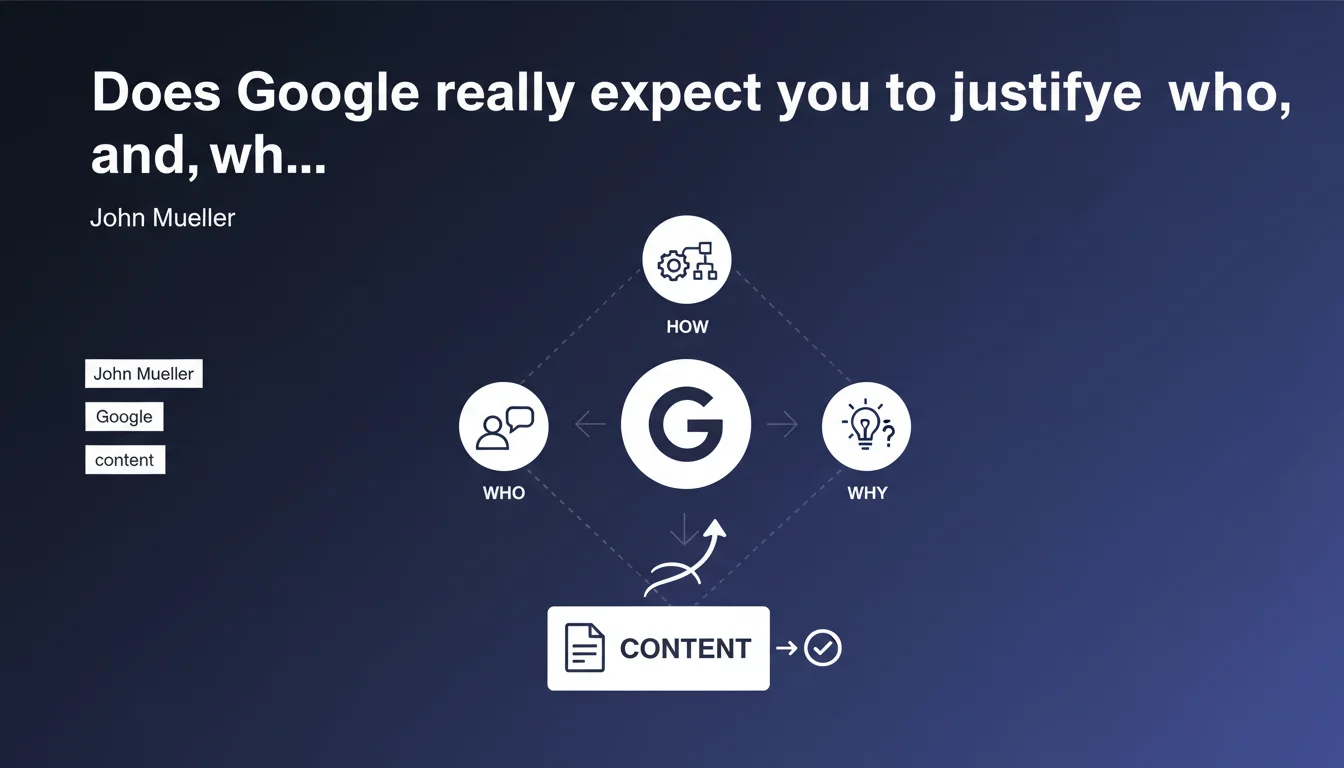
Google recommends integrating three dimensions into every piece of content: who writes it (expertise/authority), how it is created (method/process), and why it exists (intention/added value). This approach aims to differentiate quality content from algorithmic filler, but remains intentionally vague about concrete evaluation criteria.
What you need to understand
Why does Google insist on these three dimensions?
The recommendation is consistent with the E-E-A-T framework (Experience, Expertise, Authoritativeness, Trustworthiness). Google is trying to guide creators toward a more holistic approach to content.
The "who" refers to the author's identity and their legitimacy to treat the subject. The "how" concerns the creation process — methodology, sources, verifications. The "why" questions the reason for the content's existence: does it answer a real need or does it just exist to rank?
How do these criteria translate into the algorithm?
Let's be honest: Google provides no indication of the actual weight of these signals. We know Quality Raters use these dimensions in their evaluations, but the connection to ranking remains indirect.
Probable signals include: presence of a detailed author bio, mentions of primary sources, thematic consistency of the site, signals of freshness and updates, user engagement metrics.
Does this approach apply to all types of content?
No. The intensity of these criteria varies depending on the YMYL level (Your Money Your Life) of the content. An article on personal finance will be scrutinized differently than a DIY tutorial.
Google also evaluates overall consistency: an e-commerce site does not need to justify the "who" in the same way as a medical blog. Context matters as much as the criteria themselves.
- The "who" strengthens the perceived authority of the author and the site
- The "how" signals a rigorous method rather than rushed content
- The "why" differentiates useful content from content generated for engines
- Application varies depending on industry and YMYL level
- These dimensions complement E-E-A-T without replacing it
SEO Expert opinion
Does this recommendation really bring anything new?
Not really. The "who, how, why" reformulates principles already present in the Search Quality Rater Guidelines for years. It's just a more accessible way to present E-E-A-T.
What's changing is Google's insistence on communicating publicly about these criteria — likely in response to the explosion of AI-generated content. The timing is not coincidental.
Can you really measure the impact of these criteria?
[To be verified] — Google provides no concrete metrics to assess whether your "who, how, why" is sufficient. Quality Raters note these aspects, but we don't know how these notes influence the algorithm.
In practice, we observe correlations: sites with detailed author signatures and transparent editorial processes tend to perform better in YMYL. But correlation is not causation — these sites often have other advantages (backlinks, age, editorial budget).
When is this approach counterproductive?
Adding "who, how, why" artificially can dilute the content and slow access to information. If your author bio spans three paragraphs on a light listicle page, you're creating unnecessary friction.
The problem with Google's vague recommendations: they push some to over-optimize. I've seen sites add redundant "Our Methodology" sections to every article, just to check the box. That's noise.
Practical impact and recommendations
What should you concretely do to integrate these dimensions?
Start by auditing your strategic pages: YMYL, key commercial pages, content pillars. For each one, ask yourself: who is legitimate to write about this? How did we create this information? Why does this content exist?
For the "who": add rich author bios with real expertise, not just "SEO Writer since 2015". Mention certifications, publications, concrete projects. Use schema.org/Person markup and link authors to verified social profiles.
For the "how": when relevant, document your process. A product comparison? Specify how many you tested, over what period, with which criteria. A technical guide? Cite your primary sources, show screenshots, test results.
What mistakes should you absolutely avoid?
Don't generalize these requirements to your entire site. An e-commerce category page doesn't need a "Our Product Selection Methodology" section if it just lists inventory. Keep proportionality in mind.
Avoid anonymous "who" on YMYL content. "By the MyBrand Team" is no longer sufficient in finance, health, law. Google wants identifiable individuals with traceable expertise.
Don't confuse "why" with SEO intent. "This article exists to rank for 'best CRM 2024'" is not a valid why. The why should be user-centered: what problem are you solving that others aren't?
How can you verify that your content meets these criteria?
Use an outside perspective: have someone outside SEO read your content. Can they identify who wrote it, how the information was obtained, why it exists? If not, these dimensions are invisible.
Compare with your top 3 competitors on your strategic queries. Analyze their approach to "who, how, why". Often, you'll see patterns: rich author pages, methodology sections, evidence of real-world use.
- Identify YMYL and strategic pages requiring overhaul
- Create or enrich author pages with verifiable expertise
- Add schema.org/Person markup with sameAs links to social profiles
- Document creation processes when relevant (tests, research, sources)
- Cite primary sources and verifiable data
- Clarify the unique "why" of each pillar content
- Audit top 3 competitors on these dimensions
- Avoid filler: each addition should add value
❓ Frequently Asked Questions
Le "qui, comment, pourquoi" remplace-t-il E-E-A-T ?
Faut-il ajouter une bio auteur sur chaque page ?
Comment Google évalue-t-il le "comment" sans voir mon processus de création ?
Le contenu généré par IA peut-il respecter ces critères ?
Ces critères ont-ils un impact direct sur le ranking ?
🎥 From the same video 11
Other SEO insights extracted from this same Google Search Central video · published on 18/04/2023
🎥 Watch the full video on YouTube →
💬 Comments (0)
Be the first to comment.