
Official statement
Other statements from this video 11 ▾
- □ Comment exploiter l'export massif de données Search Console vers BigQuery pour optimiser votre stratégie SEO ?
- □ Google récompense-t-il vraiment la qualité du contenu indépendamment de sa méthode de production ?
- □ L'automatisation du contenu est-elle vraiment considérée comme du spam par Google ?
- □ L'IA pour générer du contenu SEO : spam ou opportunité légitime ?
- □ Faut-il vraiment se soucier du qui, comment et pourquoi dans la création de contenu ?
- □ Le tableau de bord de statut de Google change-t-il vraiment la donne pour les professionnels SEO ?
- □ Pourquoi Google ajoute-t-il l'Expérience aux critères EAT pour évaluer la qualité des contenus ?
- □ Rel=canonical : pourquoi Google a-t-il mis à jour sa documentation officielle ?
- □ Pourquoi Google publie-t-il une galerie officielle des éléments visuels de la recherche ?
- □ Pourquoi Google publie-t-il un guide spécifique sur les liens destiné aux designers web ?
- □ Le système d'avis produits de Google s'étend : quelles langues sont concernées et qu'est-ce que ça change pour vous ?
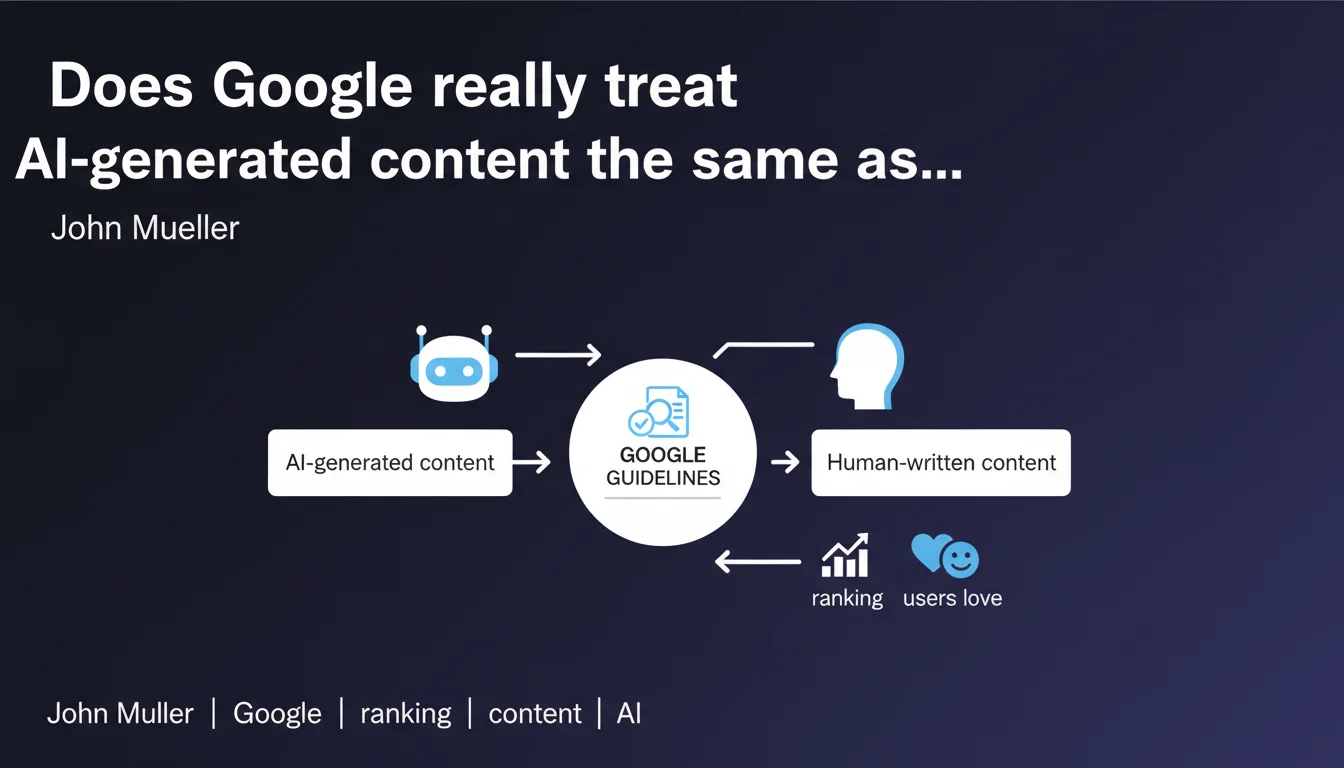
Google states that its content evaluation criteria remain identical, whether the content is generated by AI or written manually. The production method has no importance: only compliance with quality guidelines matters. The message is clear — focus on what users are searching for, not on the tool used.
What you need to understand
This statement comes in the context of the massive democratization of AI content generation tools, which has disrupted editorial practices for many websites. Faced with legitimate questions about the acceptability of this content, Google clarifies its position.
The search engine makes no technical distinction between text written by a human and text generated by machine — as long as the final result meets the expected quality standards. This displayed neutrality aims to avoid a witch hunt based solely on content origin.
What are the quality guidelines that Google is referring to?
Google primarily speaks about its E-E-A-T framework (Experience, Expertise, Authoritativeness, Trustworthiness) and the criteria defined in the Quality Rater Guidelines. These documents detail what constitutes useful, reliable, and relevant content for the user.
The emphasis is on the content's ability to precisely answer the search intent, provide verifiable information, and demonstrate real expertise on the subject matter. Regardless of how you produced this content — what matters is that it serves the end user.
Does this position mark a shift in doctrine?
Not really. Google has always displayed neutrality regarding production methods, focusing on the result. The novelty lies in the explicit clarification that this rule also applies to AI-generated content.
The search engine seeks to avoid two pitfalls: penalizing quality content simply because it uses AI, and allowing massive spam to pass under the guise of technological sophistication. The line remains drawn by the value delivered to the user.
- The production tool is not a ranking factor — neither bonus nor penalty for AI
- The Quality Rater Guidelines remain the absolute reference for evaluating quality
- The focus shifts from "how" to "what" — result before process
- The ability to demonstrate real expertise and experience becomes differentiating
- Google expects human supervision on all published content, regardless of its origin
SEO Expert opinion
Is this statement consistent with practices observed in the field?
Partially. On paper, the position is clear and defensible. But observations show that many sites that massively published generic AI-generated content saw their traffic collapse during Helpful Content updates. The problem? These contents looked too much like filler without real added value.
The real question isn't therefore "Does Google detect AI?" but rather "Does this content bring something that a user can't already find elsewhere?". And that's where most AI content fails — it rewords existing material without enriching it. [To verify]: Google claims not to penalize AI as such, but the patterns of mass-generated content without supervision closely resemble those hit by quality filters.
Can you really trust this displayed neutrality?
Let's be honest — Google has every incentive to maintain this diplomatic position. The search engine develops its own AI tools (Gemini, SGE) and cannot afford to demonize a technology it commercializes. The displayed neutrality is also a strategic protection.
That said, the core remains true: if your AI content demonstrates real expertise, cites verifiable sources, brings an original angle, and precisely answers an intent — there's no objective reason it should be penalized. The trap is that 90% of current AI content doesn't check any of these boxes.
What are the practical limitations of this approach?
The main issue is that the quality signals Google searches for (real experience, verifiable expertise, originality) are precisely those that AI models struggle to generate authentically. An LLM can mimic an expert's style, but cannot share lived experience it never had.
Result: even if Google doesn't technically "detect" AI, generic content produced en masse naturally fails relevance and usefulness tests. It's an indirect filter but terrifyingly effective. Sites that succeed are those that use AI as an assistant, not as an autonomous writer.
Practical impact and recommendations
How to adapt your content production process?
If you use AI to generate content, qualified human supervision is not optional. Every text must be reviewed, enriched, and validated by someone who truly masters the subject. AI can accelerate the draft phase, but should never be the final point.
Concentrate your efforts on what truly differentiates: field expertise, proprietary data, concrete experience feedback, numbered case studies. These are elements that AI cannot invent and that Google increasingly values.
What fatal mistakes must you absolutely avoid?
Publishing masses of unsupervised, unenriched AI-generated content is the fastest way to trigger a quality filter. Google spots patterns — sudden volume, structural similarity, absence of primary sources, repetitive formatting.
Another trap: believing that rewording existing content with AI is enough to create value. If your article brings no new information, no original angle, no verifiable expertise — it will be considered redundant noise, regardless of who or what wrote it.
- Audit your existing content with E-E-A-T criteria in mind
- Identify pages where real expertise is absent or insufficiently demonstrated
- Systematically enrich all AI content with proprietary elements (data, client cases, field feedback)
- Cite verifiable and primary sources, not just summaries
- Train your writers on Quality Rater Guidelines — it's the absolute reference
- Implement an editorial validation process before publication
- Track real engagement metrics (time on page, bounce rate, scroll depth) — they reveal whether your content truly serves
The production method matters little — only the final result matters. Google evaluates your content on its ability to precisely answer user needs, demonstrate real expertise, and deliver reliable information. AI can be a powerful tool, but it doesn't replace qualified human supervision or editorial added value.
These strategic adjustments often require a thorough overhaul of editorial processes and pointed SEO expertise to identify priority levers. If alignment with Google's guidelines seems complex to orchestrate internally, support from a specialized SEO agency may prove decisive in structuring a coherent approach and measuring the real impact of your optimizations.
❓ Frequently Asked Questions
Google pénalise-t-il les sites qui utilisent du contenu généré par IA ?
Comment Google détermine-t-il si un contenu respecte ses directives qualité ?
Peut-on publier du contenu 100% généré par IA sans intervention humaine ?
Les Quality Rater Guidelines sont-elles obligatoires à suivre ?
Quelle différence entre contenu utile et contenu optimisé SEO ?
🎥 From the same video 11
Other SEO insights extracted from this same Google Search Central video · published on 18/04/2023
🎥 Watch the full video on YouTube →
💬 Comments (0)
Be the first to comment.