
Official statement
Google is rolling out the Search Generative Experience (SGE), a feature that integrates generative AI directly into search results to provide enriched and contextualized answers. This evolution is disrupting traditional organic visibility: content now appears within AI-generated responses, not just as classic blue links. SEOs must rethink their strategy to remain visible in this hybrid environment.
What you need to understand
What exactly is the Search Generative Experience?
SGE transforms the SERP into a conversational assistant. Instead of simply displaying 10 blue links, Google generates a synthetic answer at the top of the page, compiling information from multiple sources. The user gets a contextual summary before even clicking on a result.
This generated response occupies massive visual space — often equivalent to several mobile screens. Traditional organic links end up pushed down the page, which directly impacts the click-through rate of positions 1 to 3.
Why is Google betting on generative AI right now?
The answer comes down to two words: competition and retention. ChatGPT and other AI tools have proven that users prefer direct answers rather than browsing multiple pages. Google wants to keep its users on its platform by offering a comparable experience.
But there's a paradox: generative AI reduces the need to click through to third-party sites, which threatens the very ecosystem that feeds Google — web content. SGE attempts to reconcile these two imperatives by citing its sources, but the balance remains fragile.
Which search queries are affected by SGE?
Initially, SGE targets complex informational queries: how-to guides, comparisons, technical explanations. Simple transactional queries and navigational queries remain less impacted for now.
Google is gradually expanding the scope, but certain sensitive categories — health, finance, breaking news — are subject to restrictions. Generative AI is not deployed uniformly across sectors.
- Generated synthetic answers: AI compiles and reformulates information from multiple sources into a single answer visible at the top of the SERP
- Source citations: Content used is generally cited with clickable links, but visibility remains contingent on perceived quality by the AI
- Impact on organic traffic: Expected reduction in CTR for traditional organic positions, especially on mobile
- Evolving scope: Progressive deployment depending on query types and verticals
- User experience priority: Google prioritizes answer speed and relevance over source diversity displayed
SEO Expert opinion
Does this statement mask negative impacts for publishers?
Let's be honest: Google presents SGE as an enhancement to user experience, but says nothing about traffic cannibalization for source sites. Early field reports show significant CTR drops — sometimes 20 to 40% — on queries where SGE appears.
The problem is that Google benefits twice: it keeps the user on its platform and continues monetizing through ads around the AI answer. Publishers, meanwhile, lose visits without compensation. [To be verified]: Google has published no official data on the average CTR impact of SGE.
Can Google's AI really replace expert content?
No — and that's where the opportunity lies. SGE excels at synthesizing consensual factual information, but struggles with original analysis, proprietary case studies, exclusive data. Generic content becomes invisible; differentiated content remains indispensable.
Sites that invest in recognized expertise, field-tested proof, and unique angles have better odds of being cited as sources. But be careful: being cited doesn't guarantee a click. Users may be satisfied with the summary without visiting your site.
Should you optimize differently for SGE than for traditional SEO?
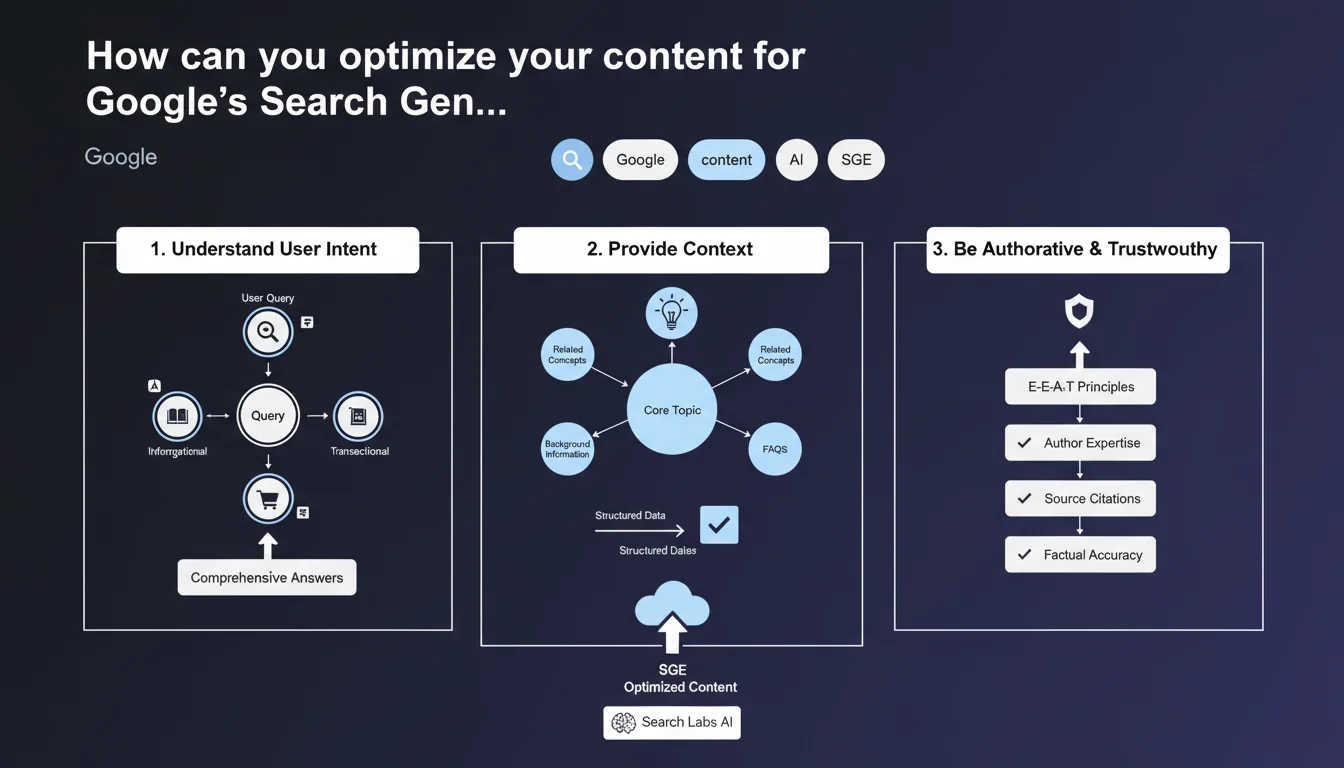
Yes and no. The fundamentals remain valid: clear architecture, structured content, rich semantic data. But you need to add another layer: optimization to be understandable and citable by AI.
Concretely? Direct answers to questions, structured formats (lists, tables, definitions), citations of reliable sources, natural language without unnecessary jargon. Generative AI favors content it can easily parse and reformulate without ambiguity.
Practical impact and recommendations
What specifically needs to change in your content strategy?
The priority: produce content that AI will want to cite. This means abandoning generic recompiled content and betting on originality. Case studies, proprietary data, exclusive methodologies, field experience — everything an AI cannot invent.
Next, you need to structure this content so it's easily extractable. Use semantic tags (schema.org), explicit titles, direct answers at the start of sections. AI doesn't dig deep — it pulls what is immediately intelligible.
What content formats should you prioritize facing SGE?
Formats that provide added value impossible to summarize in three lines: technical videos, interactive tools, calculators, simulators, personalized comparators. Everything requiring user interaction remains beyond generative AI's reach.
Paradoxically, ultra-short and ultra-targeted content also works well: precise answers to specific questions. AI cites them easily, and if your answer is intriguing enough, users click for more.
How do you measure SGE's impact on your organic traffic?
Start by segmenting your queries based on their SGE exposure. Identify keywords where you observe abnormal CTR drops despite stable positions. Compare mobile vs desktop traffic — SGE impacts mobile more.
Also monitor engagement metrics: if your bounce rate spikes on certain pages, it might be because AI has already answered the question and visitors find nothing new from you. Adjust your content accordingly.
- Audit your existing content to identify those with high non-synthesizable added value
- Restructure key pages with direct answers at the top of page and unique deepening afterward
- Implement schema.org (FAQPage, HowTo, Article) on all informational content
- Create exclusive content assets: proprietary data, case studies, original methodologies
- Track CTR by query in Search Console and detect drops correlated with SGE appearance
- Test interactive or rich formats (videos, tools) to generate engagement outside AI
- Analyze sources cited by SGE on your target queries to understand selection criteria
❓ Frequently Asked Questions
La SGE va-t-elle remplacer les résultats organiques classiques ?
Mon site peut-il être pénalisé si l'IA ne le cite jamais ?
Faut-il créer du contenu spécifiquement pour nourrir l'IA de Google ?
La SGE est-elle déployée partout dans le monde ?
Les annonces Google Ads sont-elles impactées par la SGE ?
🎥 From the same video 2
Other SEO insights extracted from this same Google Search Central video · published on 13/07/2023
🎥 Watch the full video on YouTube →
💬 Comments (0)
Be the first to comment.