
Official statement
Other statements from this video 11 ▾
- □ Comment exploiter l'export massif de données Search Console vers BigQuery pour optimiser votre stratégie SEO ?
- □ L'automatisation du contenu est-elle vraiment considérée comme du spam par Google ?
- □ L'IA pour générer du contenu SEO : spam ou opportunité légitime ?
- □ L'IA générative impose-t-elle de nouvelles règles d'évaluation du contenu selon Google ?
- □ Faut-il vraiment se soucier du qui, comment et pourquoi dans la création de contenu ?
- □ Le tableau de bord de statut de Google change-t-il vraiment la donne pour les professionnels SEO ?
- □ Pourquoi Google ajoute-t-il l'Expérience aux critères EAT pour évaluer la qualité des contenus ?
- □ Rel=canonical : pourquoi Google a-t-il mis à jour sa documentation officielle ?
- □ Pourquoi Google publie-t-il une galerie officielle des éléments visuels de la recherche ?
- □ Pourquoi Google publie-t-il un guide spécifique sur les liens destiné aux designers web ?
- □ Le système d'avis produits de Google s'étend : quelles langues sont concernées et qu'est-ce que ça change pour vous ?
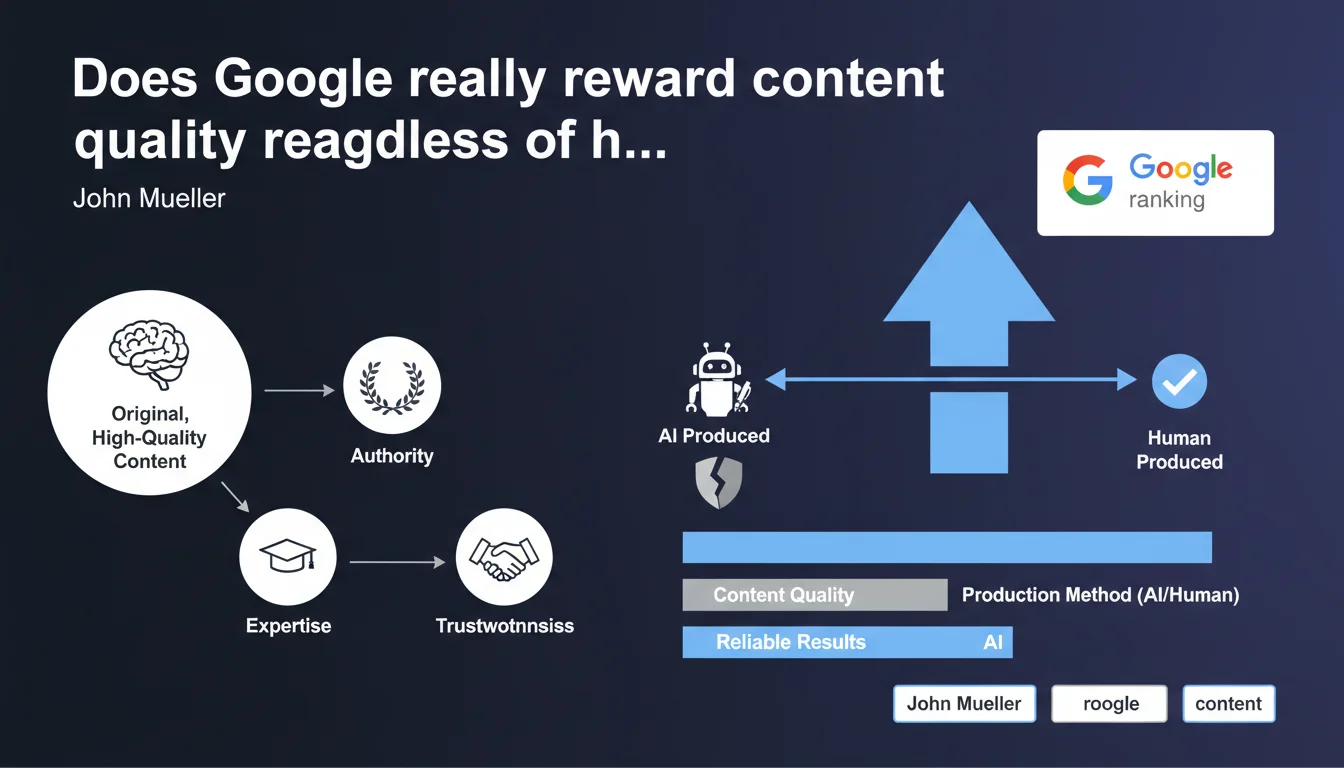
Google claims to focus on content quality rather than how it's produced. Whether your content is AI-generated, outsourced, or written in-house — only expertise, authority, and trustworthiness matter according to this statement. The real question is whether this theoretical position matches what we actually observe in the field.
What you need to understand
What does this neutrality statement on production methods really mean?
Google is taking a clear position: the method of content creation is not in itself a ranking factor. Whether you use generative AI, outsource writing to freelancers, or produce everything in-house, the algorithm theoretically makes no distinction.
This approach is based on evaluating measurable criteria like expertise, authority, and trustworthiness (E-E-A-T). The system seeks to identify quality signals in the final result, not in the production process.
Why is Google adopting this position now?
The explosion of generative AI tools made this clarification necessary. Google is protecting itself against accusations of systematically penalizing AI-assisted content — something that would be technically difficult to detect reliably.
But let's be honest: this statement is also a defensive maneuver. By claiming that only the result matters, Google avoids taking a stand on complex ethical or technical questions it can't necessarily solve algorithmically.
What are the concrete criteria behind this "quality"?
Google mentions three pillars: originality, authority, and expertise. Originality assumes content that brings unique value, not just a restatement of existing sources. Authority refers to reputation signals (quality backlinks, mentions, industry recognition).
Expertise is measured through depth of treatment, factual accuracy, and ideally clear identification of authors with their qualifications. But the difficulty is that these criteria remain intentionally vague in Google's official communications.
- Production method: officially non-discriminatory (AI, manual writing, mix of both)
- E-E-A-T: expertise, experience, authority and trustworthiness as primary evaluation criteria
- Originality: content providing a unique perspective or new information
- Quality signals: depth of treatment, factual accuracy, identification of qualified authors
- Defensive position: Google avoids committing to technical detection of AI content
SEO Expert opinion
Does this statement really match what we observe in practice?
Officially, Google doesn't discriminate based on production method. In practice? [To be verified] because many sites that published large volumes of low-value AI content suffered penalties during Helpful Content updates.
The problem may not be the tool, but the result: generic AI-generated content often presents the same flaws (predictable structure, lack of depth, absence of unique perspective). If Google penalizes low-quality content, it de facto penalizes much AI-generated content — without specifically targeting the method.
What nuances should be added to this official position?
Pattern detection remains possible even without explicitly identifying AI. Algorithms can detect repetitive structures, generic vocabulary, absence of verifiable factual data, or concrete examples. All characteristics frequently found in unsupervised generated content.
The other nuance is the question of volume and velocity. A site suddenly publishing 500 articles in a month — regardless of method — sends suspicious signals. Google may not judge the method, but it certainly evaluates abnormal behavior.
In what cases doesn't this rule protect your site?
If your AI content merely rephrases information available everywhere else, you're vulnerable — regardless of what Google claims about ignoring production methods. Originality isn't optional, it's a prerequisite.
Similarly, the absence of expertise signals (identifiable authors, qualifications, demonstrated experience) weakens your positioning. An anonymous article generated in 30 seconds by ChatGPT on a complex medical topic? Good luck convincing the algorithm you're demonstrating "authority and expertise".
Practical impact and recommendations
What should you do concretely to align your content with these criteria?
First priority: clearly identify your authors and highlight their qualifications. Detailed author pages, credible bios, and mentions of industry expertise strengthen E-E-A-T signals.
Next, ensure that each piece of content brings unique and verifiable value. Exclusive data, real case studies, perspectives from field experts — everything that differentiates your content from a simple compilation of existing sources.
What mistakes to avoid if you use AI in your production?
Never publish AI content without thorough editorial review. The risk isn't tool detection, but the mediocrity of the final result. Generic phrasings, predictable structures, and absence of concrete examples betray content without added value.
Also avoid massive simultaneous publication. A consistent and natural editorial pace inspires more trust than a sudden explosion of 200 articles in 48 hours. Abnormal velocity remains an alarm signal regardless of the method used.
How can you verify that your content meets Google's quality standards?
Ask yourself these questions for each publication: would an industry expert immediately recognize generic content? Does your article provide information you can't find elsewhere? Are claims sourced and verifiable?
Also analyze your actual engagement metrics: time on page, bounce rate, organic shares. Quality content naturally generates interaction — if your metrics stay low despite traffic, your content probably lacks substance.
- Create detailed author pages with documented sector qualifications and expertise
- Systematically integrate original data, case studies, or unique perspectives
- Manually review all AI-assisted content before publication
- Maintain a natural and consistent publication pace (no sudden volume spikes)
- Source all factual claims with verifiable references
- Monitor engagement metrics (time on page, bounce, shares) as indicators of perceived quality
- Eliminate generic phrasings and overly predictable structures
- Prioritize depth of treatment on targeted topics over multiplication of superficial content
❓ Frequently Asked Questions
Google pénalise-t-il spécifiquement le contenu généré par IA ?
Puis-je utiliser ChatGPT ou d'autres outils IA pour rédiger mes articles sans risque ?
Quels sont les signaux concrets que Google utilise pour évaluer l'expertise et l'autorité ?
Comment prouver l'originalité de mon contenu face à Google ?
La publication massive de contenu reste-t-elle une stratégie viable selon cette déclaration ?
🎥 From the same video 11
Other SEO insights extracted from this same Google Search Central video · published on 18/04/2023
🎥 Watch the full video on YouTube →
💬 Comments (0)
Be the first to comment.