
Official statement
Other statements from this video 11 ▾
- □ Comment exploiter l'export massif de données Search Console vers BigQuery pour optimiser votre stratégie SEO ?
- □ Google récompense-t-il vraiment la qualité du contenu indépendamment de sa méthode de production ?
- □ L'automatisation du contenu est-elle vraiment considérée comme du spam par Google ?
- □ L'IA pour générer du contenu SEO : spam ou opportunité légitime ?
- □ L'IA générative impose-t-elle de nouvelles règles d'évaluation du contenu selon Google ?
- □ Faut-il vraiment se soucier du qui, comment et pourquoi dans la création de contenu ?
- □ Le tableau de bord de statut de Google change-t-il vraiment la donne pour les professionnels SEO ?
- □ Rel=canonical : pourquoi Google a-t-il mis à jour sa documentation officielle ?
- □ Pourquoi Google publie-t-il une galerie officielle des éléments visuels de la recherche ?
- □ Pourquoi Google publie-t-il un guide spécifique sur les liens destiné aux designers web ?
- □ Le système d'avis produits de Google s'étend : quelles langues sont concernées et qu'est-ce que ça change pour vous ?
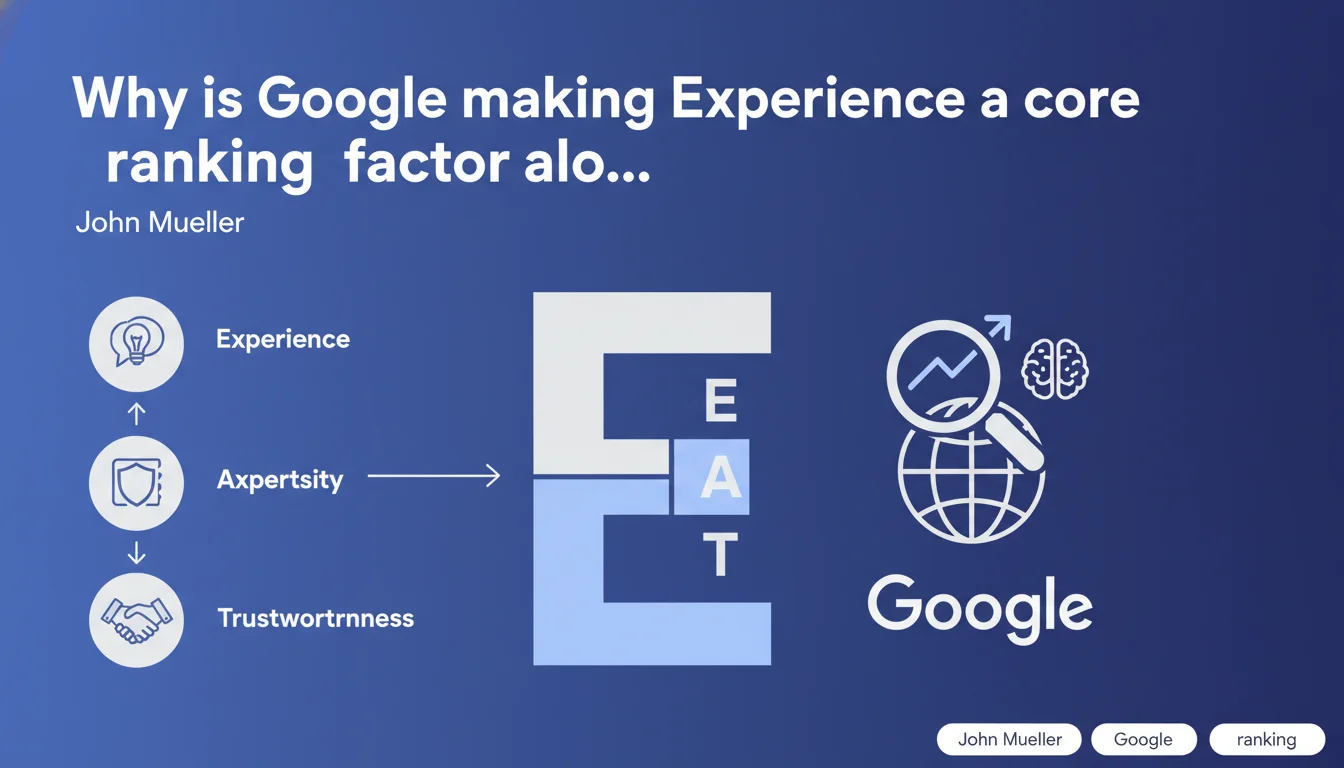
Google officially integrates Experience as the fourth pillar of content quality criteria, transforming EAT into EEAT. This update to quality rater guidelines signals that demonstrating hands-on, concrete, and direct experience now carries the same weight as theoretical expertise, perceived authority, or trustworthiness. A clear message for content creators: prove you've tested, handled, and lived what you're writing about.
What you need to understand
What exactly changes with this addition of Experience to the EAT criteria?
The acronym shifts from EAT to EEAT in the Quality Rater Guidelines, the reference document for human raters who audit search results. Experience joins Expertise, Authority, and Trustworthiness as an explicit quality criterion.
Let's be honest: Google was already valuing experience implicitly before this formalization. But now the signal becomes public, documented, and acknowledged. Raters receive clear instructions to identify whether the author has direct, lived, tangible experience with the topic being discussed.
How does Google distinguish between Experience and Expertise?
Expertise refers to theoretical, academic, or technical mastery of a domain. A licensed doctor undoubtedly possesses medical expertise. Experience, on the other hand, reflects personal lived experience and real-world practice of the subject matter.
Concrete example: an article on "how to choose a stroller" will carry more weight if it comes from a parent who has actually tested multiple models in the field than from a writer who compiles product datasheets. One has the experience, the other may have writing expertise — but Google now prioritizes the former.
Does this change apply to all types of content?
No. The weight of Experience varies depending on the nature of the query and YMYL context (Your Money Your Life). For a recipe, the testimonial of a home cook who shares their failed and successful attempts can easily suffice. For medical advice, the expertise of a healthcare professional takes priority.
Google doesn't rank the four criteria uniformly. Depending on the topic, Experience may become the central criterion — or remain secondary to Expertise. That's the full subtlety of this framework.
- Experience becomes an official and distinct criterion in the Quality Rater Guidelines
- It values direct and concrete lived experience from the author on the discussed topic
- It complements Expertise without replacing it — both can coexist or conflict depending on context
- Its weight varies significantly depending on the type of query and YMYL level of the content
- Google allows raters to judge the balance between the four EEAT criteria for each page
SEO Expert opinion
Does this announcement really change the game for content sites?
Yes and no. In practice, sites that were already performing well were often those that demonstrated lived experience, even before this formalization. Product comparison articles with original photos, real tests, and concrete usage feedback have always ranked better than aggregators of copy-pasted product specs.
What changes: Google states this publicly and codifies it in its guidelines. Raters receive explicit instructions to rate Experience. As a result, algorithms will likely refine their detection of these signals — even though Google remains vague about the exact mechanisms.
What concrete signals can convey Experience in Google's eyes?
Original unstocked photos, personal screenshots, test videos, first-person narratives with specific details impossible to fabricate — anything proving real contact with the subject matter. Generic, impersonal content compiled from other sources will suffer.
[To verify] Google doesn't detail how its algorithms automatically detect Experience at scale. We can assume that NLP identifies linguistic markers (I, we, my opinion after testing…), that images are analyzed for originality, that citation and reference patterns play a role. But nothing officially confirmed.
And that's where it gets tricky: between what Quality Raters manually score and what the algorithm detects automatically, there's often a gap. Guidelines evolve, algorithms follow with delay — or never fully catch up.
Are niche sites run by enthusiasts favored over mainstream media outlets?
In theory, yes. A blog run by a marathon runner sharing their actual training should outrank a lifestyle site compiling training plans found elsewhere. In practice, Authority and Trustworthiness (backlinks, domain reputation) sometimes compensate for lack of Experience.
Large editorial sites with strong domain authority can still rank with impersonal content — but their margin for error shrinks. Google is clearly pushing toward content personalization and authenticity. Sites that don't pivot risk losing ground to niche creators with lived experience.
Practical impact and recommendations
How can you concretely demonstrate Experience in your content?
Prioritize first-person narratives with specific details. Instead of "this product performs well," write "after three months of daily use, I noticed that…". Integrate personal photos, screenshots, original videos that prove your hands-on manipulation of the subject.
Document the process. Show your attempts, failures, adjustments. A tutorial that exposes mistakes before the final result will be perceived as more authentic than a perfect, polished guide. Google values transparency of lived experience, not editorial perfection.
Do you need to revise all your existing content to add Experience?
Not necessarily all of it, but identify strategic pages where Experience can make a difference. Prioritize YMYL content, product comparisons, how-to guides, tutorials — all topics where lived testimony adds real value.
If you lack direct experience on a topic, you have two options: either delegate writing to someone who has it, or clearly document your sources and position yourself as a reliable aggregator rather than a lived expert. The worst strategy would be to fabricate fictional experience — contradictory signals will eventually penalize you.
What risks do you run by ignoring the Experience criterion?
Your generic, compiled, impersonal content risks gradually losing ground to niche creators with lived experience. Algorithm updates (notably the Helpful Content Update) already target this type of mass-produced content with no real added value.
Editorial sites that don't pivot toward more authenticity and personalization will see their traffic erode in favor of specialized blogs, YouTube creators, Reddit communities — all spaces where Experience expresses itself naturally.
- Add first-person narratives with specific, verifiable details
- Integrate original photos, videos, screenshots as tangible proof
- Document processes, failures, adjustments to showcase authentic lived experience
- Identify strategic content where Experience delivers genuine added value
- If you lack direct experience, delegate to contributors who have it or clearly reposition as an aggregator
- Highlight authors with detailed bios, social profile links, proof of lived credibility
- Absolutely avoid simulating fictional experience — contradictory signals will penalize you
❓ Frequently Asked Questions
L'Expérience remplace-t-elle l'Expertise dans les critères de Google ?
Comment Google détecte-t-il automatiquement l'Expérience d'un contenu ?
Un site éditorial généraliste peut-il encore ranker sans Expérience vécue ?
Faut-il obligatoirement écrire à la première personne pour démontrer l'Expérience ?
Cette mise à jour impacte-t-elle tous les secteurs de la même manière ?
🎥 From the same video 11
Other SEO insights extracted from this same Google Search Central video · published on 18/04/2023
🎥 Watch the full video on YouTube →
💬 Comments (0)
Be the first to comment.