
Official statement
Other statements from this video 11 ▾
- □ Comment exploiter l'export massif de données Search Console vers BigQuery pour optimiser votre stratégie SEO ?
- □ Google récompense-t-il vraiment la qualité du contenu indépendamment de sa méthode de production ?
- □ L'automatisation du contenu est-elle vraiment considérée comme du spam par Google ?
- □ L'IA pour générer du contenu SEO : spam ou opportunité légitime ?
- □ L'IA générative impose-t-elle de nouvelles règles d'évaluation du contenu selon Google ?
- □ Faut-il vraiment se soucier du qui, comment et pourquoi dans la création de contenu ?
- □ Le tableau de bord de statut de Google change-t-il vraiment la donne pour les professionnels SEO ?
- □ Pourquoi Google ajoute-t-il l'Expérience aux critères EAT pour évaluer la qualité des contenus ?
- □ Rel=canonical : pourquoi Google a-t-il mis à jour sa documentation officielle ?
- □ Pourquoi Google publie-t-il une galerie officielle des éléments visuels de la recherche ?
- □ Pourquoi Google publie-t-il un guide spécifique sur les liens destiné aux designers web ?
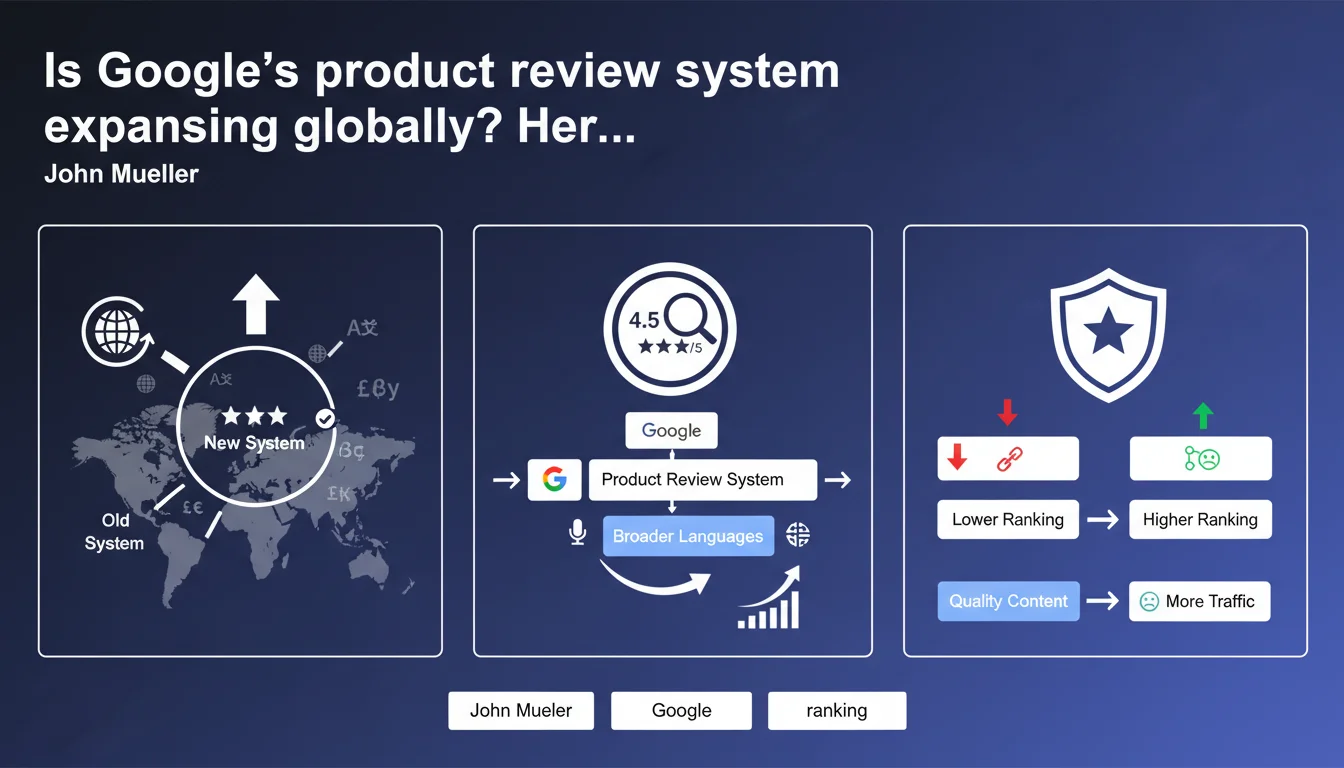
Google is rolling out its product review ranking system to new languages. In practical terms, websites publishing product reviews in these languages will now face the same quality standards as English-language content. If your reviews don't meet Google's depth and authenticity criteria, prepare for significant traffic loss.
What you need to understand
Which languages are actually affected by this update?
Google is deliberately staying vague about the complete list. The announcement mentions "a set of new languages" without specifying which ones exactly. Classic Google communication: they tell you something's changing, then leave you to figure out the details.
On-the-ground observations suggest that major European languages — French, German, Spanish, Italian — are included in the rollout. Some have also reported fluctuations in Portuguese and Dutch. But nothing officially confirmed.
What exactly does this product review ranking system do?
This system prioritizes in-depth product reviews written by experts who have actually tested the product firsthand. It penalizes shallow, mass-produced content that merely rehashes manufacturer specifications.
Google looks for concrete usage demonstrations, substantiated comparisons, original photography, objective measurements. The algorithm detects — with varying degrees of accuracy — content that delivers genuine added value versus content that simply recycles existing information.
Why is this international expansion happening now?
The system was initially tested in English, then refined over several months. Google gradually rolls out to other markets once it believes its detection capabilities are reliable enough to minimize false positives.
It's also a response to regulatory pressure from European authorities regarding content quality and consumer protection. By standardizing requirements across languages, Google aligns its editorial policy globally.
- The system now analyzes product review depth across several European languages
- Shallow affiliate sites are the first casualties of this rollout
- Google deliberately withholds the complete list of affected languages
- Quality standards are identical to those applied to English-language markets for several months
- Impact can be severe for sites that haven't anticipated this change
SEO Expert opinion
Does this announcement align with observed real-world fluctuations?
Yes and no. Significant shifts have definitely been observed on French and German-language product review sites in recent weeks. However, it's nearly impossible to clearly isolate what stems from this specific system versus other concurrent algorithmic updates.
What's certain: several Amazon affiliate sites have lost 30 to 60% of their organic traffic on transactional queries. Sites with in-depth, authentic content have generally maintained — or even improved — their rankings. [Needs verification]: Is this solely attributable to the Product Reviews System or a combination of multiple ranking systems?
Are Google's criteria truly applicable to all review types?
Let's be honest: no. Google's guidelines favor an editorial model that works for high-ticket products (electronics, appliances, sports equipment) but becomes absurd for $15 items.
Producing a 2,000-word comparative test with original photography for a budget electric toothbrush is economically unsustainable for 99% of publishers. Google knows this, but maintains identical requirements anyway. The result? Traffic concentration among a handful of well-funded players.
Should we expect additional language rollouts?
Very likely. Google typically tests in English, refines across major European languages, then progressively expands to Asia and Latin America. Japanese, Korean, and Brazilian Portuguese are obvious candidates for upcoming waves.
The real question: how quickly? Google moves deliberately to avoid linguistic interpretation errors that could harm legitimate sites. But once launched, rollout can accelerate rapidly.
Practical impact and recommendations
What immediate actions should you take on your existing content?
First step: audit your product review pages that drive traffic. Identify those that merely rehash manufacturer technical sheets. These are your vulnerability points.
Next, prioritize efforts on content generating the most revenue or targeting strategic keywords. You can't overhaul everything at once — focus on the 20% delivering 80% of ROI.
- Add original photography showing the product in real-world usage scenarios
- Include objective measurements: weight, dimensions, power consumption that you've personally tested
- Compare with 2-3 competing products, explaining concrete differences
- Document your testing conditions: duration of use, context, user profile
- Mention the product's weaknesses, not just strengths
- Sign your reviews with a real name and credible expert biography
How do you avoid common mistakes when revamping your reviews?
Classic error: artificially inflating content with padding to hit an arbitrary word count. Google detects filler — 800 dense words beat 2,000 diluted words every time.
Another trap: using generic photography everyone else uses (manufacturer images or stock photos). If Google finds your visuals on 50 other sites, that damages credibility. And that's where it gets tough — producing original visuals is expensive.
Don't fall into the fake detailed review trap either. Writing 3,000 words about a product you've never touched by compiling forum posts and other sites' content won't work anymore. Google has refined its detection signals, including coherence analysis across your different content pieces.
Should you abandon low-margin products and focus on premium items?
That's the uncomfortable question. Financially, it's increasingly hard to justify in-depth reviews for low-margin products. Many publishers are making this strategic choice: move upmarket and drop the bottom of the catalog.
Alternative: develop a hybrid model with comparative buying guides for smaller items (less resource-intensive) and deep solo reviews for high-ticket products. But this requires rethinking your entire content architecture.
❓ Frequently Asked Questions
Comment savoir si ma langue est concernée par cette mise à jour ?
Les avis clients générés par les utilisateurs sont-ils aussi affectés ?
Combien de temps faut-il pour récupérer après une pénalisation liée à ce système ?
Peut-on contourner ce système avec du contenu IA bien prompté ?
Les sites d'affiliation Amazon sont-ils voués à disparaître ?
🎥 From the same video 11
Other SEO insights extracted from this same Google Search Central video · published on 18/04/2023
🎥 Watch the full video on YouTube →
💬 Comments (0)
Be the first to comment.