
Official statement
What you need to understand
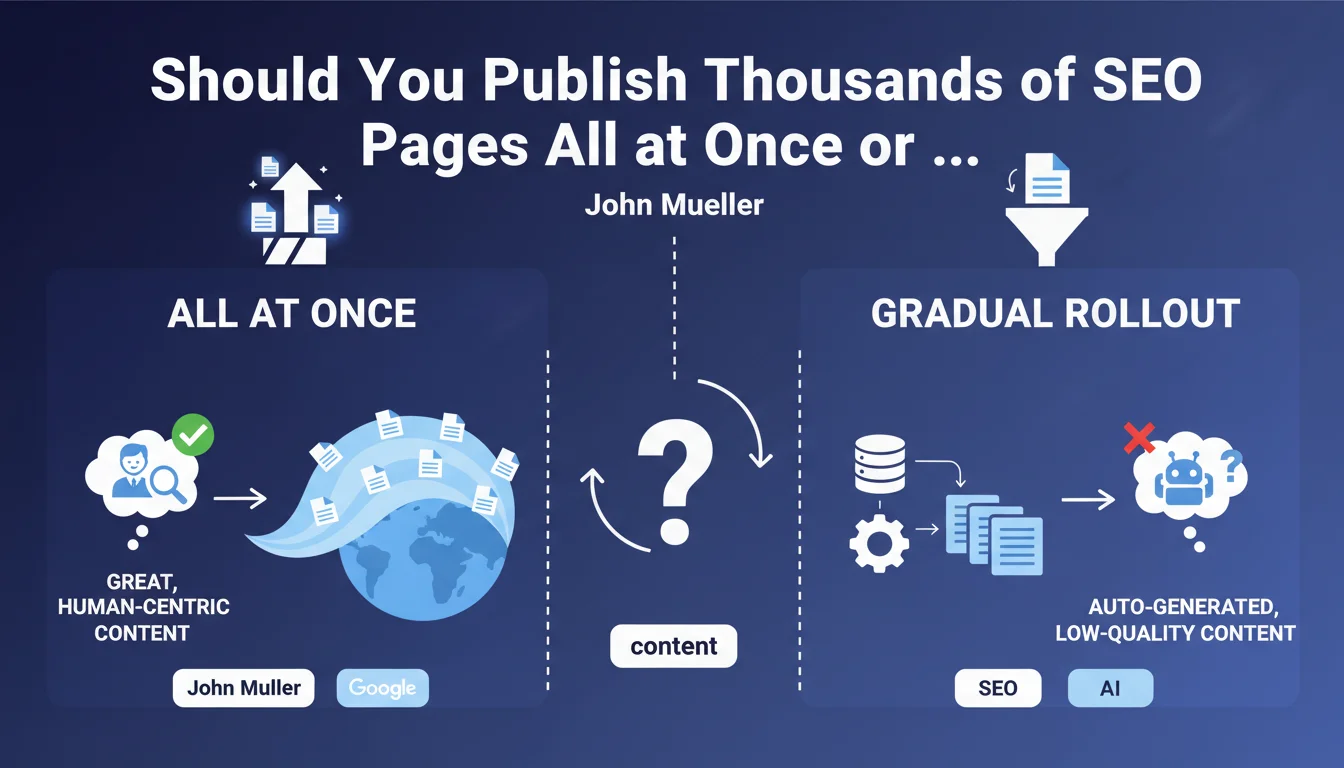
This statement from John Mueller addresses a crucial question for large-scale sites: the strategy of massive content publication. Historically, SEO professionals feared that a sudden launch of thousands of pages would trigger algorithmic penalties.
Google's current position seems more nuanced: quality trumps quantity. If the content meets a real user need and provides value, the volume of publication is not a problem in itself.
However, Mueller introduces an important nuance regarding automatically generated pages from a database. This remark signals that Google remains vigilant about mass-created content without real added value.
- Massive publication is no longer systematically penalized if the content is quality
- Auto-generated content remains under scrutiny by Google's algorithms
- The question to ask: does this content address a real user need?
- The intention behind page creation matters as much as the volume
SEO Expert opinion
This Google position indeed reflects the evolution of algorithms observed in recent years. E-commerce sites, marketplaces, and aggregators regularly publish thousands of pages without issues, as long as quality is present.
However, significant nuance is needed depending on the type of content generated. Product pages with unique descriptions, detailed specifications, and customer reviews perform well. Conversely, templated pages with little textual variation and low added value risk being considered thin content.
The real question is therefore not "how many" but "why." If you're generating 8,000 pages solely to target long-tail keywords without real differentiating content, Google will detect it. The Helpful Content algorithm is particularly effective at identifying this type of strategy.
Practical impact and recommendations
- Audit quality: before any massive publication, verify that each page template provides unique and substantial value
- Test progressively: even if Google allows it, start by publishing a sample (500-1,000 pages) to observe algorithmic reactions
- Avoid templated content: if your pages only vary by a few keywords, reconsider your strategy
- Prioritize high-potential pages: publish first the content responding to the most searched queries
- Monitor metrics: crawl budget, indexation rate, average positions after massive publication
- Ensure technical infrastructure: verify that your server supports the intensive crawling that will follow publication
- Create differentiating content: enrich your auto-generated pages with unique elements (guides, comparisons, FAQs)
- Don't rely solely on volume: 100 excellent pages are worth more than 10,000 mediocre pages
Massive page publication is no longer an SEO taboo, but it requires a rigorous strategy and impeccable quality. The balance between volume and added value remains delicate.
These large-scale deployment strategies require sharp technical expertise and a fine understanding of Google quality signals. For ambitious projects involving thousands of pages, guidance from a specialized SEO agency can prove valuable to avoid pitfalls and optimize your content's indexation.
💬 Comments (0)
Be the first to comment.